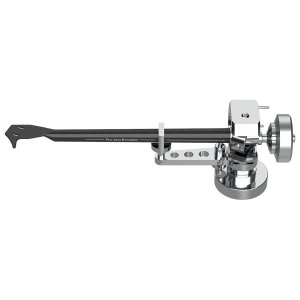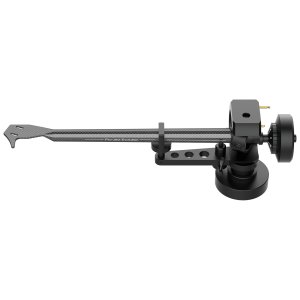

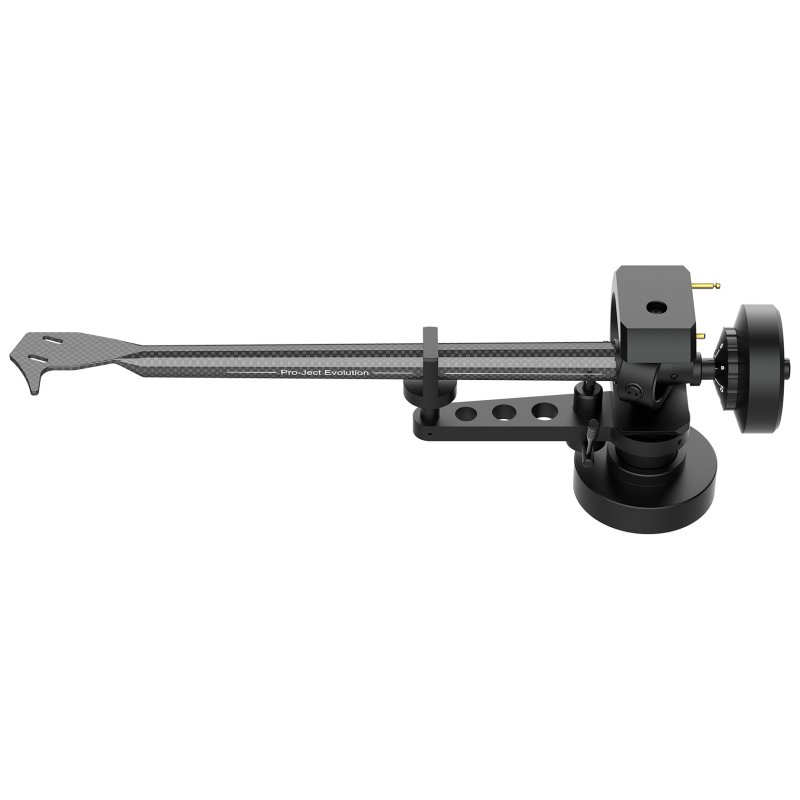

The EVO CC sits at the top of Pro-Ject Audio Systems’ Evolution tonearm range, available in 9-inch, 10-inch, and 12-inch versions with two finish options: CC Black and CC High-Gloss. As a standalone upgrade tonearm, it is designed for use with compatible Pro-Ject turntables or any third-party deck with the appropriate mounting geometry, and is eligible for Pro-Ject’s EVO tonearm upgrade scheme.
Carbon Fibre Arm Tube
The arm tube is machined from a single piece of carbon fibre in a conical profile, tapering from headshell to bearing block. The conical geometry serves a specific acoustic purpose: it prevents standing wave reflections from forming along the tube, which would otherwise colour the signal. The one-piece construction also eliminates mechanical joints between tube and headshell, minimising resonance paths. Carbon fibre is chosen for its high stiffness-to-mass ratio, keeping effective tonearm mass to 8.5 g in the 10-inch version while maintaining the rigidity required for accurate groove tracking.
Bearing Assembly
The EVO CC uses an inverted cardanic bearing with four ABEC 7-specification stainless steel tip points. This configuration is chosen for its low friction and mechanical stability: the tips bear load at four points, resisting chatter and flex in both the horizontal and vertical planes independently. The bearing housing is machined from solid aluminium for rigidity. The result is a smooth, resistance-free pivot that allows the cartridge to trace groove modulations without mechanical interference from the pivot itself.
Counterweight and Damping
Behind the bearing block, the counterweight rod is positioned below the pivot centreline. This lowered position reduces the dynamic force applied to the cartridge stylus when the arm traverses a warped record, limiting the unwanted wow effect that vertical disc movement can introduce. The counterweight itself is fitted with a Thermo-Plastic Elastomer (TPE) liner, chosen for its resonance-absorbing properties. TPE coupling at the counterweight prevents resonances at the rear of the arm from propagating forward towards the cartridge.
Adjustment and Connectivity
Vertical tracking angle (VTA) is adjusted by loosening two grub screws on the bearing collar, allowing the arm height to be set continuously to suit the cartridge and record thickness. Azimuth is adjusted by rotating the arm tube within its single-screw fixing at the headshell end. The arm lift is silicone-damped and adjustable for height. Internal wiring uses flexible high-purity copper, terminating in a gold-plated five-pin DIN output socket. The outer ring of the headshell is open to prevent bell-mode resonances in the headshell body.