


- "This dinky portable DAC is worth every penny" — What Hi-Fi? ★★★★★
- What Hi-Fi? Awards 2018 winner
AudioQuest DragonFly Red USB DAC & Headphone Amplifier
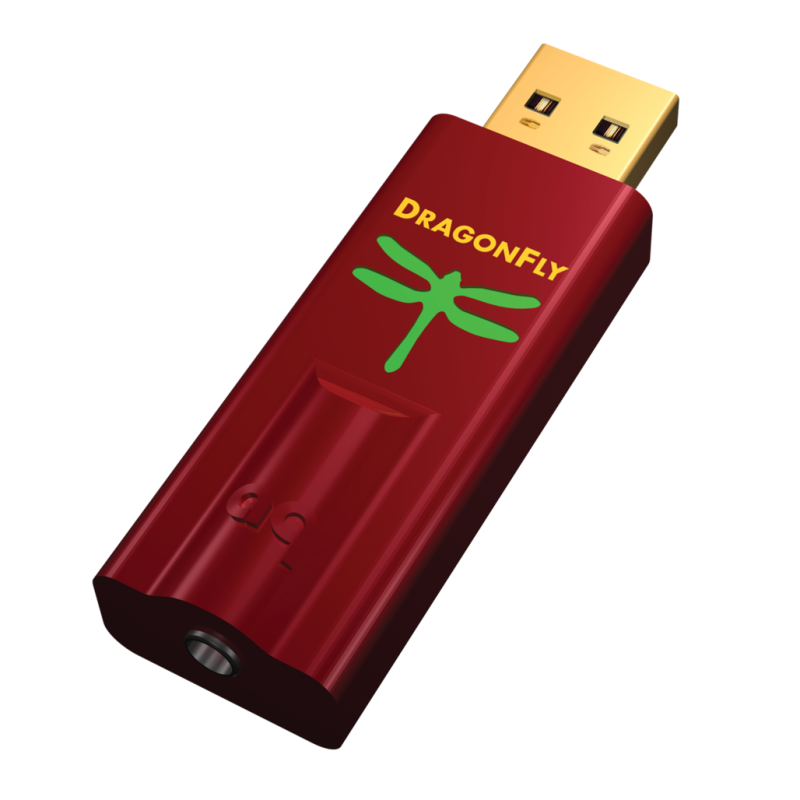

- USB DAC, preamplifier and headphone amplifier
- 32-bit ESS Sabre 9016 with bit-perfect digital volume control
- 2.1V output for driving demanding headphones
Discontinued
This product has been discontinued and is no longer available to purchase.
Looking for something similar? Browse our full range from AudioQuest, or contact us for a recommendation.
Awards & Reviews
Description
The DragonFly Red sits in the middle of AudioQuest's three-model DragonFly family, above the entry-level DragonFly Black and below the flagship DragonFly Cobalt. It shares the same thumb-drive form factor and plug-and-play simplicity as both, but makes two upgrades over the Black that fundamentally change what headphones it can drive and how it handles volume: a higher-performance ESS DAC chip with an integrated ESS headphone amplifier and bit-perfect digital volume control, and a 2.1V maximum output that nearly doubles the Black's 1.2V. For listeners who have outgrown built-in audio and need the authority to drive demanding headphones — or who simply want the best possible dynamic range at any volume — the Red is the point in the DragonFly range where headphone amplification becomes a serious strength rather than a practical concession.
ESS Sabre 9016: The Step Up from Black
The DragonFly Black uses the ESS 9010; the Red steps up to the ESS 9016. Both are 32-bit Sabre converters, and both use minimum-phase digital reconstruction filters that concentrate time-domain ringing after the impulse rather than splitting it before and after — avoiding the perceptually unnatural pre-echo that linear-phase designs introduce. The 9016 is the higher-performance chip in this pairing, offering improved overall resolution and dynamic range. AudioQuest describes it as the kind of converter typically found in dedicated CD and Blu-ray players costing considerably more than the DragonFly Red itself.
The difference between the 9010 and 9016 is not simply one of specification on paper. The 9016 was selected because its performance characteristics allow the Red to extract more musical texture and low-level detail from the same digital source material — the kind of difference that becomes apparent with longer listening sessions or higher-quality headphones, where the subtlety of a recording has more opportunity to reveal itself. As with all DragonFly models, the analogue circuits are direct-coupled from the DAC chip's output, with no coupling capacitors or extraneous components in the signal path.
ESS Headphone Amplifier and Bit-Perfect Volume Control
The most significant architectural difference between the Red and the Black is the headphone amplifier and volume control implementation. The DragonFly Black uses a standalone headphone amplifier with a 64-step analogue volume control — the host device sends a command, and an analogue attenuator adjusts the output level. It works well, but the signal passes through the attenuator circuit regardless of the volume setting, and at lower listening levels the analogue approach inevitably sacrifices some dynamic range.
The Red replaces this with the ESS headphone amplifier paired with a 64-bit bit-perfect digital volume control that resides on the 9016 DAC chip itself. Volume adjustment happens in the digital domain at 64-bit precision before the signal is converted to analogue, meaning the full dynamic range and signal-to-noise ratio of the DAC are preserved at every volume setting. The ESS headphone amplifier is a unity-gain device: it receives the volume-adjusted signal from the DAC at precisely the right level and amplifies it without adding its own gain stage or volume circuitry. The result is a cleaner, more direct signal path with lower noise, and no loss of detail or dynamic contrast when listening at moderate or low volumes.
The practical consequence is most apparent with high-quality headphones. At quiet listening levels, the Red maintains the full texture and micro-dynamic nuance of the recording where the Black's analogue volume control would begin to compress and soften the sound. This matters for late-night listening, for use in quiet environments where you do not need high volume but still want full musical engagement, and for any recording where the quietest passages carry important musical information.
2.1V Output: Driving Difficult Headphones
The Red's maximum output of 2.1V RMS is nearly 75% higher than the Black's 1.2V. This is not merely a louder signal — it represents a fundamentally greater ability to control the headphone driver, particularly at dynamic peaks where the amplifier must deliver instantaneous current to maintain transient speed, bass grip, and the sense of effortless headroom that separates adequate from engaging headphone listening.
The DragonFly Black is well suited to efficient headphones — in-ears, most on-ears, and many over-ears with sensitivities above approximately 95dB/mW. Below that threshold, the Black begins to run out of voltage swing at dynamic peaks, and the leading edges of transients can soften. The Red's 2.1V output extends compatibility to a much wider range of headphones, including power-hungry, low-efficiency over-ear models — planar-magnetic designs and high-impedance dynamic drivers that demand more from the amplifier. AudioQuest specifies a minimum headphone impedance of 12 ohms for the Red.
Streamlength Asynchronous USB and monoClock
The Red shares the same USB platform as the Black: a Microchip PIC32MX270 microcontroller running Gordon Rankin's Streamlength asynchronous USB code. In asynchronous mode, the DragonFly commands the timing of data transfer rather than accepting whatever the host device sends — a critical distinction that keeps the DAC's own high-precision clock in control of conversion timing, eliminating the jitter that degrades sound quality when the host's USB bus clock is allowed to govern the process.
The clocking system uses monoClock — a single ultra-low-jitter clock generated from the ESS DAC chip that runs the headphone amplifier and all microcontroller functions. By deriving everything from one master clock, the DragonFly eliminates the inter-clock interference and timing uncertainty that arise when multiple clocks service different subsystems. The Red shares this architecture with both the Black and Cobalt; the Cobalt upgrades to the faster PIC32MX274 microcontroller with 33% faster processing and lower current draw.
Output Modes and System Integration
Like all DragonFly models, the Red operates in two modes. Connected directly to headphones or powered speakers, it functions in variable-output mode — the host device's volume slider controls the listening level via the internal bit-perfect digital volume control, preserving full resolution at every setting. Connected to a preamplifier, integrated amplifier, or AV receiver input via a 3.5mm-to-RCA cable, you set the host volume to maximum for a fixed 2.1V line-level output and control volume from the amplifier. The Red's 2.1V fixed output comfortably exceeds the standard 2V line-level reference, ensuring it will drive any domestic amplifier input to full output.
MQA Rendering
The Red is an MQA Renderer, completing the final unfolding stage of MQA decoding when a Core signal is provided by a compatible application such as Tidal, Audirvana, or Roon. The LED glows purple during MQA playback. MQA rendering is built into the firmware and costs nothing additional.
Compatibility and LED Indicator
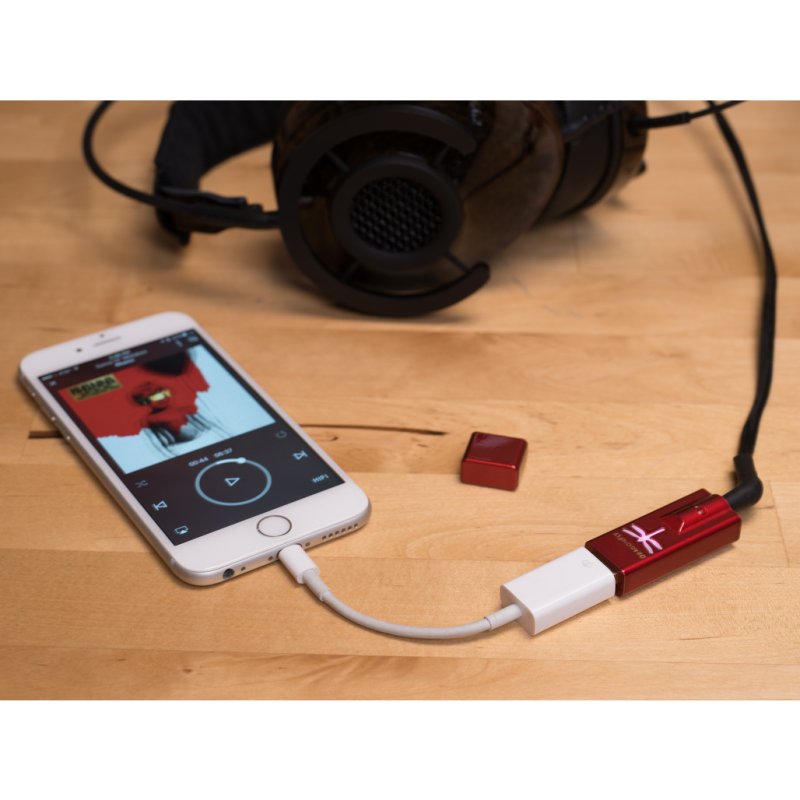
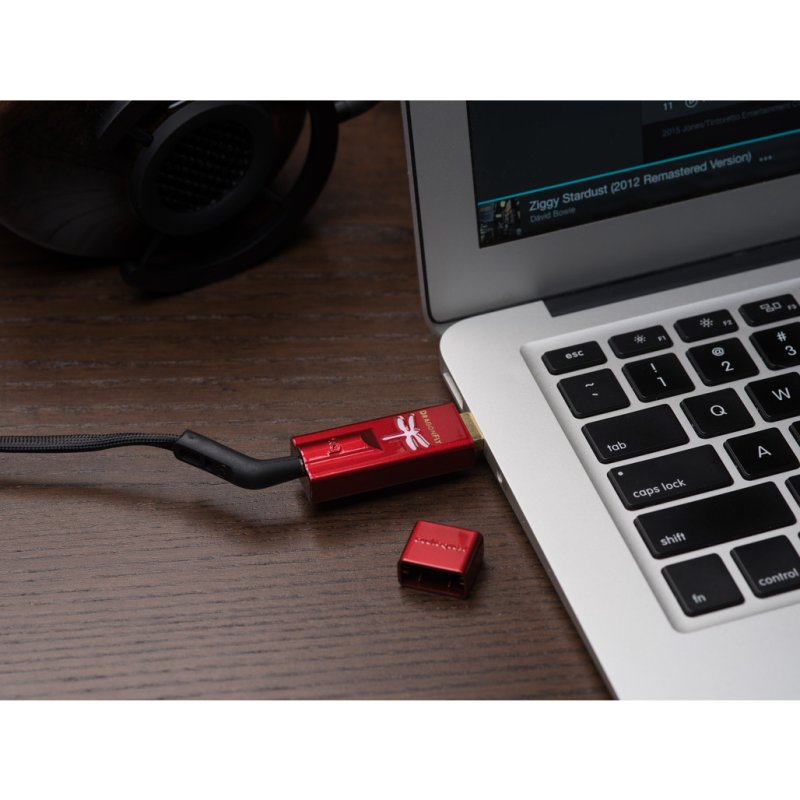
The DragonFly Red is compatible with macOS (10.6.8 and later), Windows (7 and later), and Linux computers, as well as iOS devices (using Apple's Lightning-to-USB 3 Camera Adapter or a USB-C adapter for newer devices) and Android devices running Lollipop 5.0 or later (using AudioQuest's DragonTail or any compatible OTG cable). No drivers are required on any platform. The firmware is upgradeable via AudioQuest's free Desktop Device Manager.
The LED colour scheme indicates the incoming sample rate: red for standby, green for 44.1kHz, blue for 48kHz, amber for 88.2kHz, magenta for 96kHz, and purple for MQA rendering.
Build and Design
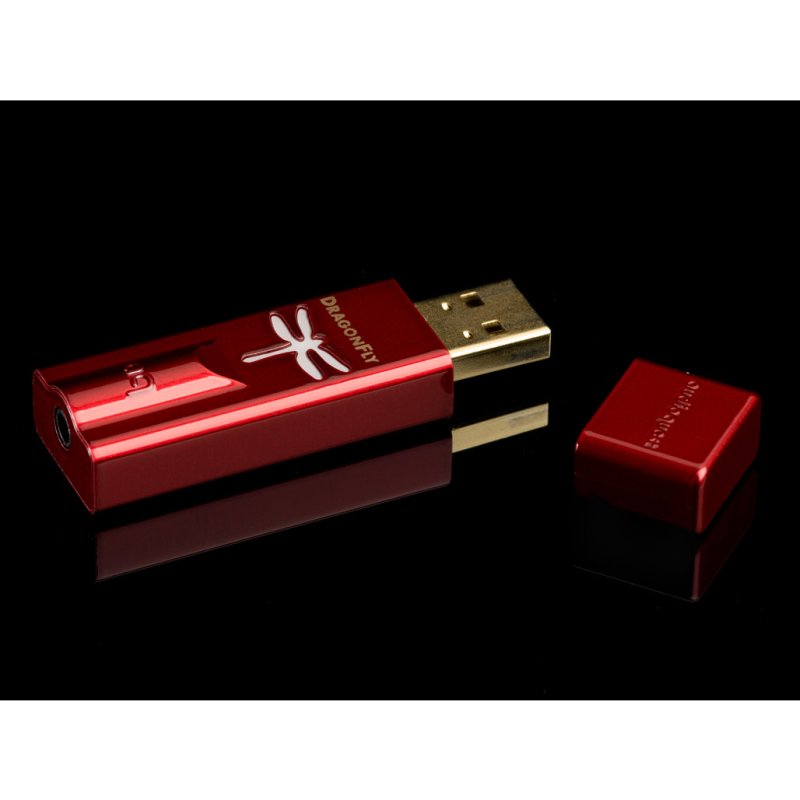
The Red is housed in a zinc alloy case with a soft-touch matte-red finish and gold lettering, measuring 62mm × 19mm × 12mm. The USB Type-A connector is gold-plated, and a protective plastic cap covers the USB end during transport. A leatherette travel pouch is included.
Red in Context: Between Black and Cobalt
The DragonFly Red occupies a clear and specific position in the range. It shares the same Streamlength asynchronous USB platform, monoClock single-clock architecture, direct-coupled analogue output, and MQA rendering capability as the Black and Cobalt. What it adds over the Black is the higher-performance ESS 9016 DAC chip, the ESS headphone amplifier with bit-perfect digital volume control, and the 2.1V output — the three changes that together make it a substantially more capable headphone amplifier with superior resolution at all volume levels. What the Cobalt adds over the Red is the ESS 9038Q2M with its slow roll-off filter for improved transient naturalness, the faster PIC32MX274 microcontroller, and dedicated power-supply noise filtering.
For listeners whose priority is headphone-driving authority — the ability to pair the DragonFly with a wide range of headphones and hear full dynamic range at any volume — the Red delivers the essential upgrades over the Black at a price that remains a fraction of traditional separates.
Specification
| DAC Chip | 32-bit ESS Sabre 9016 |
|---|---|
| Digital Filter | Minimum-Phase |
| USB Microcontroller | Microchip PIC32MX270 (32-bit, USB 2.0) |
| USB Transfer Mode | Isochronous Asynchronous (Streamlength) |
| Clock System | monoClock |
| Headphone Amplifier | ESS Sabre — 64-bit Bit-Perfect Digital Volume Control |
| Maximum Output Voltage | 2.1V RMS |
| Minimum Headphone Impedance | 12 Ohms |
| Bit Depth | Up to 24-bit |
| Supported Sample Rates | 44.1kHz, 48kHz, 88.2kHz, 96kHz |
| MQA | Yes — MQA Renderer |
| Digital Input | USB Type-A (Male, Gold-Plated) |
| Analogue Output | 3.5mm Stereo Jack |
| Output Modes | Variable (Headphones / Powered Speakers) or Fixed (Preamp / Amplifier Input) |
| LED Sample-Rate Indicator | Red (Standby), Green (44.1kHz), Blue (48kHz), Amber (88.2kHz), Magenta (96kHz), Purple (MQA) |
| Desktop Compatibility | macOS 10.6.8+, Windows 7+, Linux |
| Mobile Compatibility | iOS (Requires Apple Camera Adapter), Android 5.0+ (Requires DragonTail or OTG Adapter) |
| Drivers Required | No (Plug-and-Play) |
| Power Supply | USB Bus-Powered |
| Firmware Updates | Yes — Via AudioQuest Desktop Device Manager |
| Enclosure | Zinc Alloy, Soft-Touch Matte Red Finish |
| Dimensions (L × W × D) | 62mm × 19mm × 12mm |
| Weight | 22g |
| Included Accessories | Protective USB Cap, Leatherette Travel Pouch |