


- “USB DACs don’t get better than this” — What Hi-Fi? ★★★★★ (October 2022)
- What Hi-Fi? Awards 2024 winner
AudioQuest DragonFly Cobalt USB DAC and Headphone Amplifier

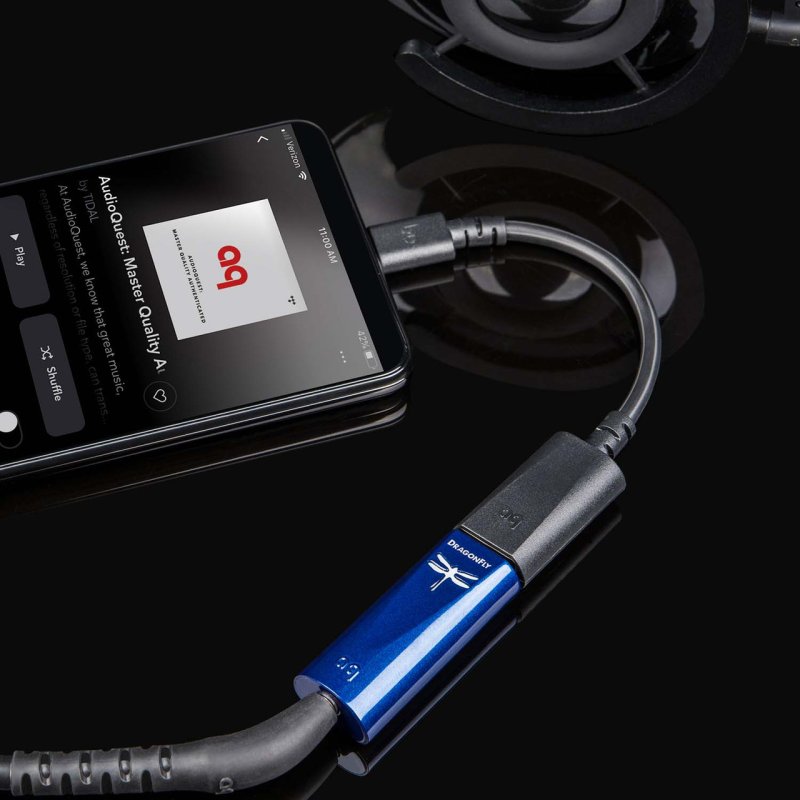
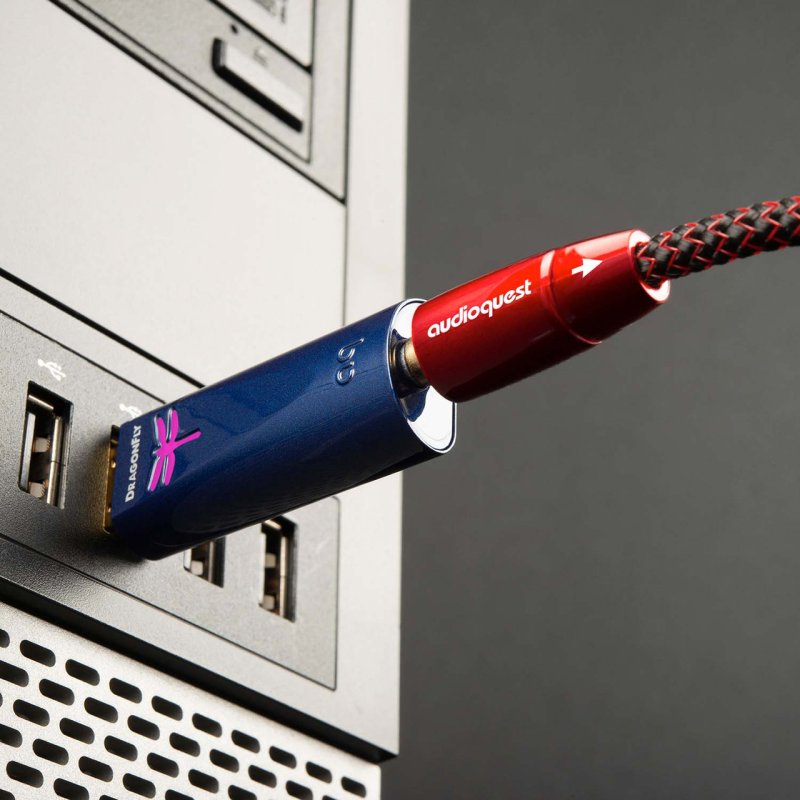

- 32-bit ESS ES9038Q2M DAC with slow roll-off filter
- Dedicated power-supply noise filtering for WiFi and Bluetooth
- 2.1V output with bit-perfect digital volume control
Discontinued
This product has been discontinued and is no longer available to purchase.
Looking for something similar? Browse our full range from AudioQuest, or contact us for a recommendation.
Awards & Reviews
Videos
Description
The DragonFly Cobalt is the flagship of AudioQuest's DragonFly family — the most refined expression of a product category that AudioQuest essentially created in 2012. It sits above the DragonFly Black (ESS 9010, analogue volume control, 1.2V output) and DragonFly Red (ESS 9016, ESS 9601 headphone amplifier, 2.1V output), sharing the same thumb-drive form factor and plug-and-play simplicity but upgrading every critical element of the design: a more advanced DAC chip with a different reconstruction filter, a faster microcontroller with lower current draw, and dedicated power-supply noise filtering that neither the Black nor the Red offers.
ESS ES9038Q2M and Minimum-Phase Slow Roll-Off Filtering
The DragonFly Black uses the ESS 9010, the Red uses the ESS 9016, and the Cobalt steps up to the ESS ES9038Q2M — ESS’s flagship mobile DAC chip at the time of its introduction. All three are 32-bit Sabre converters, and all three use minimum-phase digital reconstruction filters, which concentrate time-domain ringing after the impulse rather than splitting it before and after, avoiding the perceptually unnatural pre-echo of linear-phase designs.
The key difference is that the ES9038Q2M in the Cobalt uses a minimum-phase slow roll-off filter, while the chips in the Black and Red use standard minimum-phase filters. A standard filter achieves steep attenuation above the Nyquist frequency, suppressing ultrasonic aliasing images by 100dB or more, but the steepness produces extended time-domain ringing that can smear transient detail. A slow roll-off filter relaxes the cutoff slope: ultrasonic aliasing suppression is reduced (Stereophile’s measurements show approximately 34dB suppression in the Cobalt versus over 110dB in the Red), but time-domain ringing is dramatically shorter — almost impulse-like — resulting in more natural transient response. The ultrasonic products that are less attenuated sit well above the audible range; the improvement in transient clarity is within it.
Power-Supply Noise Filtering
The Cobalt’s most significant engineering advancement over the Red is dedicated power-supply filtering — a technology informed by AudioQuest’s research into noise-dissipation for their cable products. Every device the DragonFly plugs into generates high-frequency electrical noise: WiFi radios, Bluetooth transmitters, cellular modems, and switching power supplies all produce interference that travels along the USB power line into the DAC, contaminating the analogue audio signal at the point of conversion.
The Black and Red have no dedicated filtering for this noise — they rely on the inherent power-supply rejection of their DAC chips. The Cobalt adds purpose-built filtering circuitry between the USB power input and the audio circuitry, designed to attenuate the frequencies at which WiFi (2.4GHz and 5GHz), Bluetooth (2.4GHz), and cellular signals (700MHz–2.6GHz) operate. The result is a lower noise floor, preserving the quietest musical details — note decay, breath, ambient space — that would otherwise be masked by the electrical environment of the host device.
Upgraded Microcontroller
The Cobalt uses Microchip’s PIC32MX274, replacing the PIC32MX found in the Black and Red. Processing speed increases by 33% while current draw decreases — benefiting both audio performance (reduced timing uncertainty) and battery life on mobile devices. The microcontroller runs Gordon Rankin’s Streamlength asynchronous USB code, which commands the timing of data transfer from the host rather than accepting whatever the computer or phone sends. Asynchronous mode ensures the DAC’s own high-precision clock governs conversion timing, not the host device’s USB bus clock.
The Cobalt retains the monoClock architecture shared across the DragonFly range: a single ultra-low-jitter clock generated from the ESS DAC chip runs all functions — DAC conversion, headphone amplifier, and microcontroller. Where many portable DACs use separate clocks for different subsystems, introducing inter-clock interference and timing uncertainty, the single-clock approach eliminates this noise source entirely.
ESS 9601 Headphone Amplifier and Bit-Perfect Volume Control
The Cobalt shares its headphone amplifier with the DragonFly Red: the ESS Sabre 9601, which includes a bit-perfect digital volume control integrated into the DAC chip. Volume adjustment happens in the digital domain at 64-bit precision before conversion, preserving the full dynamic range and signal-to-noise ratio at every volume setting. This differs from the DragonFly Black’s analogue volume control, where the signal passes through a 64-step analogue attenuator. The practical benefit is most apparent at lower listening levels, where the bit-perfect approach maintains detail and dynamic contrast that an analogue attenuator would compress.
Maximum output is 2.1V RMS — identical to the Red and a significant step up from the Black’s 1.2V. This higher voltage drives a wider range of headphones, including power-hungry, low-efficiency over-ear models that the Black would struggle to control at dynamic peaks. The minimum recommended headphone impedance is 16 ohms.
Two Output Modes
Connected directly to headphones or powered speakers, the Cobalt operates in variable-output mode with the host device’s volume slider controlling listening level via the internal bit-perfect volume control. Connected to a preamplifier, integrated amplifier, or AV receiver via a 3.5mm-to-RCA cable, you set the host volume to maximum for a fixed 2.1V line-level output and control volume from the amplifier. In this second configuration, the Cobalt serves as a high-quality external DAC at a fraction of the cost of a traditional separates-format converter.
MQA Rendering
The Cobalt is an MQA Renderer, completing the final unfolding stage of MQA decoding when a Core signal is provided by a compatible application such as Tidal, Audirvana, or Roon. The LED glows purple during MQA playback. MQA rendering is built into the firmware at no additional cost.
Compatibility and LED Indicator
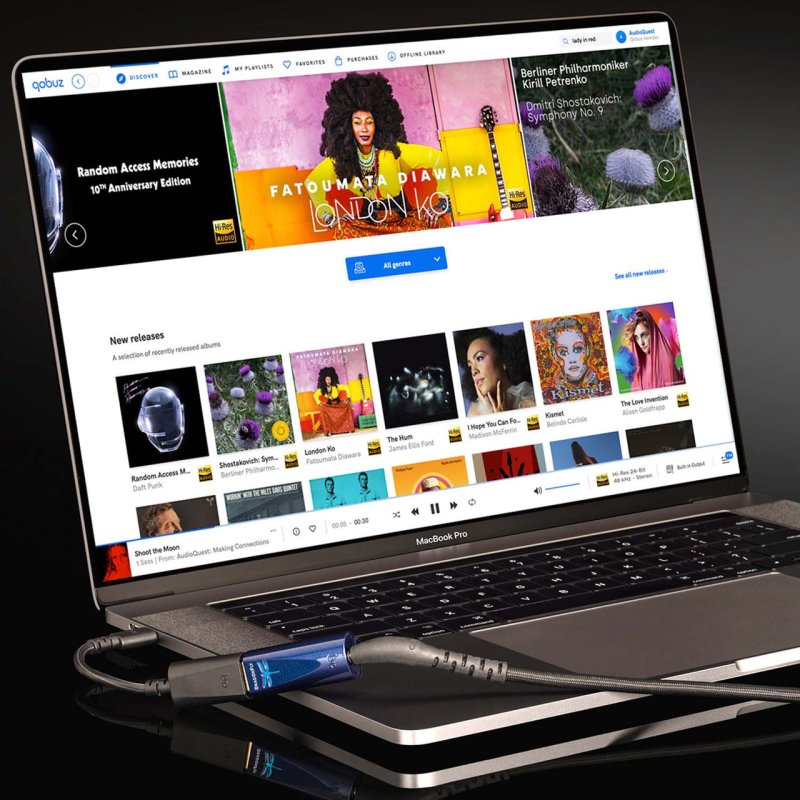
The DragonFly Cobalt is compatible with macOS (10.6.8 and later), Windows (7 and later), and Linux, as well as iOS devices (using Apple’s Lightning-to-USB 3 Camera Adapter, or a USB-C adapter for newer devices) and Android devices running Lollipop 5.0 or later. No drivers are required on any platform. A DragonTail USB-A to USB-C adapter (built to AudioQuest’s Carbon-level USB cable specification) is included, accommodating devices that have moved to USB-C.
The LED colour scheme indicates sample rate: red for standby, green for 44.1kHz, blue for 48kHz, yellow for 88.2kHz, light blue for 96kHz, and purple for MQA rendering. Files above 96kHz will play — the host device’s software downsamples them before sending to the DragonFly.
Build and Accessories
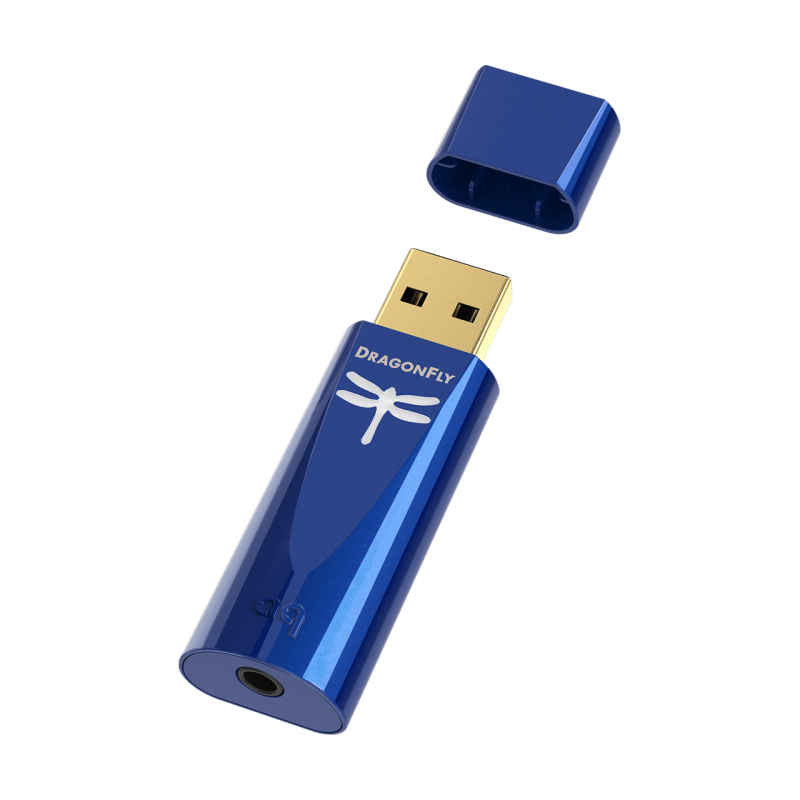
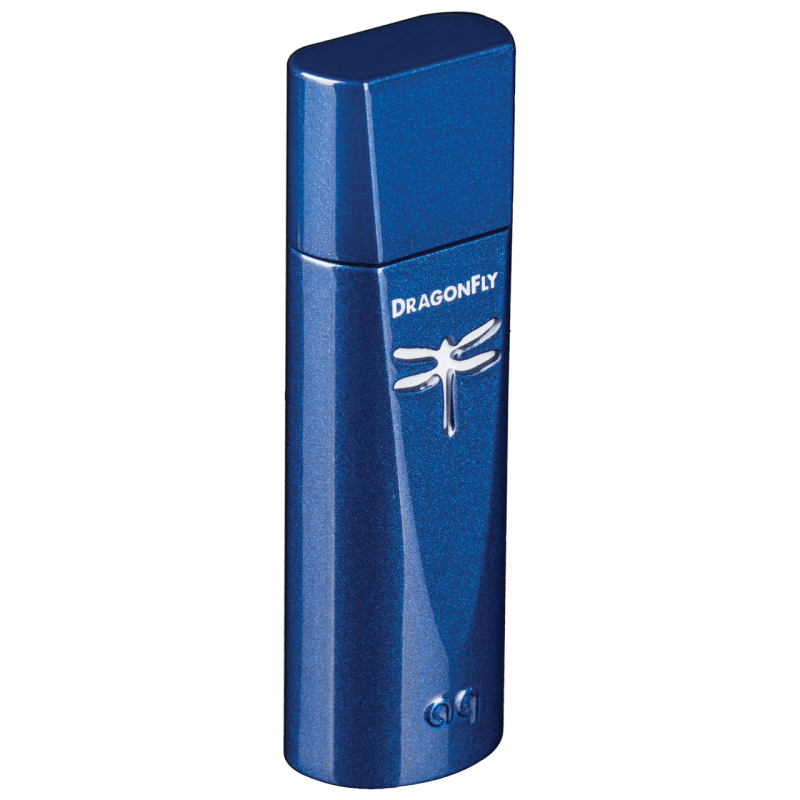
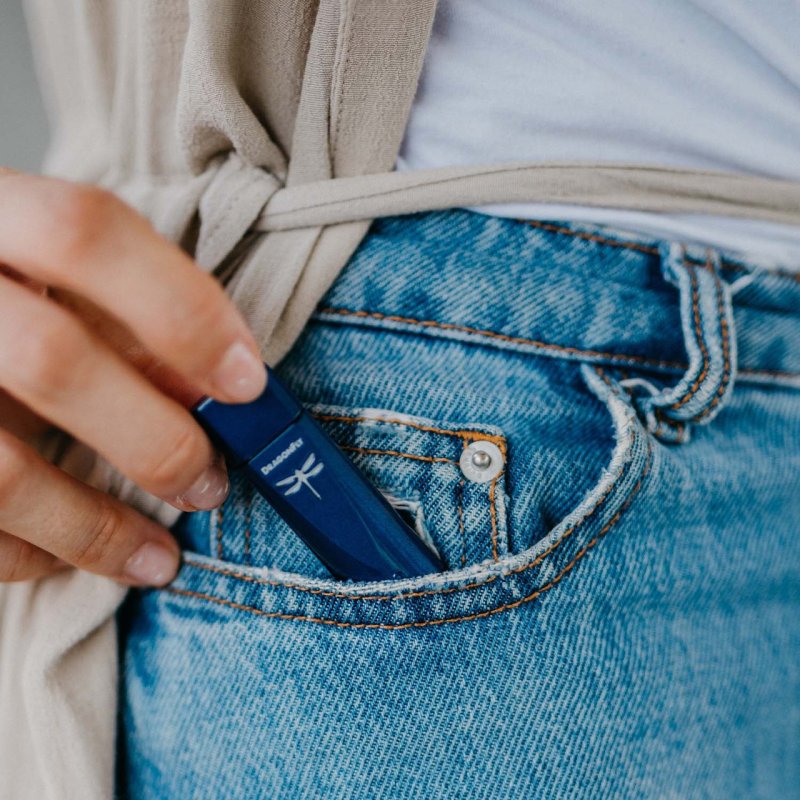
The Cobalt is housed in an aluminium case with a metallic cobalt-blue finish. At 57.5mm × 18.6mm × 11.9mm it is approximately 10% smaller than the Black and Red, making it the most pocket-friendly DragonFly to date. The USB Type-A connector is gold-plated. A DragonTail USB-A to USB-C adapter and a leatherette travel pouch are included.
Choosing Between Black, Red, and Cobalt
All three DragonFly models share the Streamlength asynchronous USB platform, monoClock single-clock architecture, direct-coupled analogue output topology, and MQA rendering. The DragonFly Black is the entry point — ESS 9010, analogue volume control, 1.2V output, ideal for efficient headphones and external amplifiers. The DragonFly Red adds the ESS 9016, ESS 9601 headphone amplifier with bit-perfect digital volume control, and 2.1V output for greater headphone-driving authority. The Cobalt adds the ES9038Q2M with slow roll-off filtering for superior transient naturalness, the PIC32MX274 for faster processing and lower power draw, and the dedicated noise-dissipation filtering that sets it apart — the choice for listeners who want the lowest possible noise floor and the most refined, fatigue-free presentation this form factor can deliver.
Specification
| Product Type | USB DAC / Preamplifier / Headphone Amplifier |
|---|---|
| DAC Chip | 32-bit ESS Sabre ES9038Q2M |
| Digital Filter | Minimum-Phase Slow Roll-Off |
| USB Microcontroller | Microchip PIC32MX274 (32-bit, USB 2.0) |
| USB Transfer Mode | Isochronous Asynchronous (Streamlength) |
| Clock System | monoClock / Hybrid-PLL (Single Clock from ESS DAC Chip) |
| Headphone Amplifier | ESS Sabre 9601 — Bit-Perfect Digital Volume Control |
| Maximum Output Voltage | 2.1V RMS |
| Minimum Headphone Impedance | 16 Ohms |
| Bit Depth | Up to 24-bit |
| Supported Sample Rates | 44.1kHz, 48kHz, 88.2kHz, 96kHz (Higher Rates Downsampled by Host) |
| MQA | Yes — MQA Renderer |
| Noise Dissipation | Dedicated Power-Supply Filtering (WiFi, Bluetooth, Cellular) |
| Digital Input | USB Type-A (Male, Hardwired, Gold-Plated) |
| Analogue Output | 3.5mm Stereo Jack |
| Output Modes | Variable (Headphones / Powered Speakers) or Fixed (Preamp / Amplifier Input) |
| LED Sample-Rate Indicator | Red (Standby), Green (44.1kHz), Blue (48kHz), Yellow (88.2kHz), Light Blue (96kHz), Purple (MQA) |
| Desktop Compatibility | macOS 10.6.8+, Windows 7+, Linux |
| Mobile Compatibility | iOS 5+ (Requires Apple Camera Adapter), Android 5.0+ (Requires DragonTail or OTG Adapter) |
| Drivers Required | No (Plug-and-Play) |
| Power Supply | USB Bus-Powered (No External Power Required) |
| Firmware Updates | Yes — Via AudioQuest Desktop Device Manager |
| Enclosure | Aluminium, Metallic Cobalt-Blue Finish |
| Dimensions (L × W × D) | 57.5mm × 18.6mm × 11.9mm |
| Weight | 22g |
| Included Accessories | DragonTail USB-A to USB-C Adapter (Carbon-Level), Leatherette Travel Pouch |