


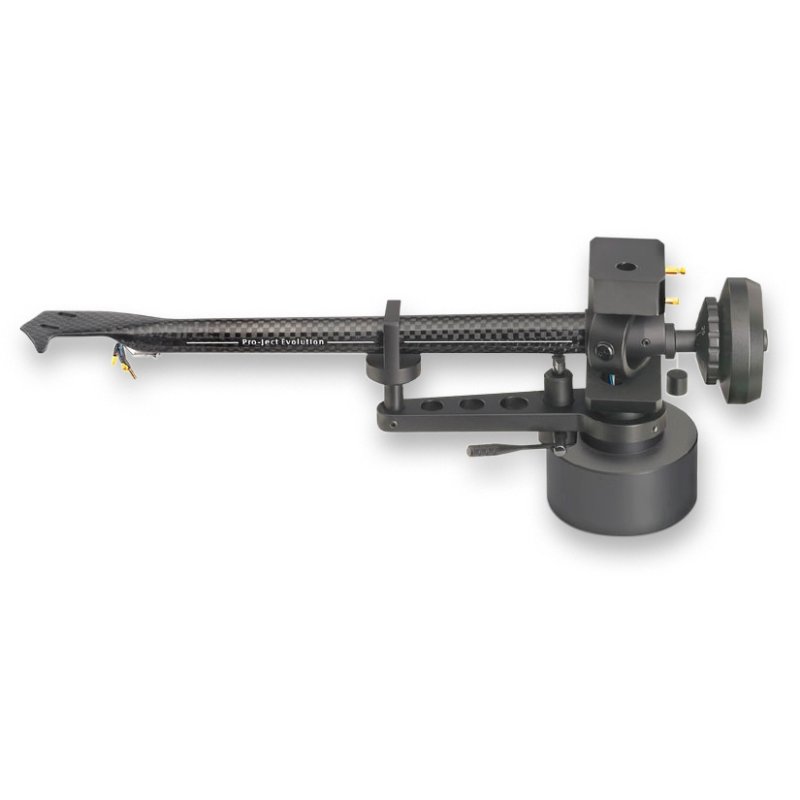

The 9CC Evolution sits within Pro-Ject Audio Systems' Evolution tonearm range, a family of high-performance replacement and upgrade arms designed to complement both Pro-Ject turntables and compatible third-party decks from other manufacturers. It occupies the upper-mid tier of the Evolution series, offering a sophisticated bearing and armtube construction that puts it within reach of audiophile-grade turntables, including many from the RPM, X, and Signature lines, as well as non-Pro-Ject decks fitted with a Linn-standard mounting collar.
Armtube and Headshell
The defining characteristic of the 9CC Evolution is its one-piece construction: the headshell and 9-inch (230 mm effective length) armtube are fashioned from a single piece of carbon-fibre. Carbon fibre is chosen for its combination of high stiffness and low mass, both of which are critical in a tonearm: stiffness minimises flexing that would colour the signal, while low mass reduces the effective mass at the cartridge, allowing the stylus to track the groove with minimal mechanical loading. The armtube is conical in profile rather than parallel-walled, a shape that avoids standing wave reflections along the tube's length. The single-piece design also eliminates the headshell-to-armtube joint found on interchangeable-headshell arms, removing a source of micro-vibration and signal loss at this sensitive connection point.
Bearing Assembly
The 9CC Evolution uses an inverted cardanic bearing design, with four stainless steel tips mounted in ABEC 7 quality ball bearings. ABEC 7 is a precision tolerance class specifying tight limits on runout, bore diameter, and width, resulting in a bearing that is both smooth and extremely low in friction. The inverted cardanic configuration locates the bearing pivot points above the armtube's centre of mass, providing inherent stability during playback. The bearing housing is machined in a solid ring form: the massive outer ring suppresses resonances, while its open design prevents the housing itself from becoming a resonance trap. Taken together, the bearing assembly allows the stylus to trace the record groove smoothly with minimal friction-induced distortion.
Counterweight and Damping
The counterweight rod is positioned with the weight shaft lowered to record level, a design detail that reduces the cantilever forces on the cartridge and minimises dynamic wow during playback of warped records. The counterweight itself is lined with a Thermo-Plastic Elastomer (TPE) compound, which absorbs high-frequency resonances at the rear of the arm that could otherwise be reflected back towards the cartridge and headshell. Four counterweight options are supplied, suitable for cartridges weighing between 5 g and 14 g, covering a wide range of cartridges from lightweight moving-magnet types to heavier high-output moving-coil designs.
Adjustment and Setup
The solid armbase allows accurate height adjustment of the armtube and VTA (vertical tracking angle), enabling the stylus to maintain the correct geometry relative to the record surface. A single-screw fixing of the armtube to the bearing housing allows the armtube to be rotated for azimuth adjustment without removing the headshell, a practical design that simplifies cartridge alignment. The straight armtube geometry reduces the toe-in error inherent in curved designs. A silicone-damped armlift can be adjusted in height to suit the arm's position after VTA setup.
Wiring and Termination
The internal wiring runs as a continuous unbroken run of flexible high-purity copper conductors from the headshell contacts through to the termination point, avoiding additional joins that would add resistance and introduce potential signal contamination. The Flying Lead version terminates with bare wire flying leads and a separate earth wire, which connect directly to phono inputs or an external junction box, allowing the user to choose their own phono cable and thereby upgrade this part of the signal path independently.