


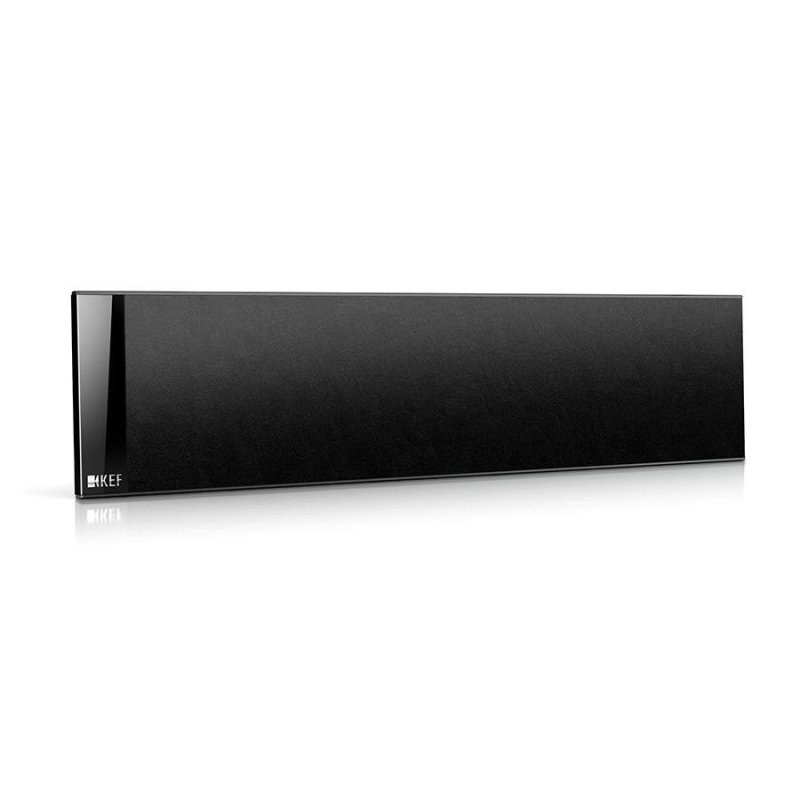
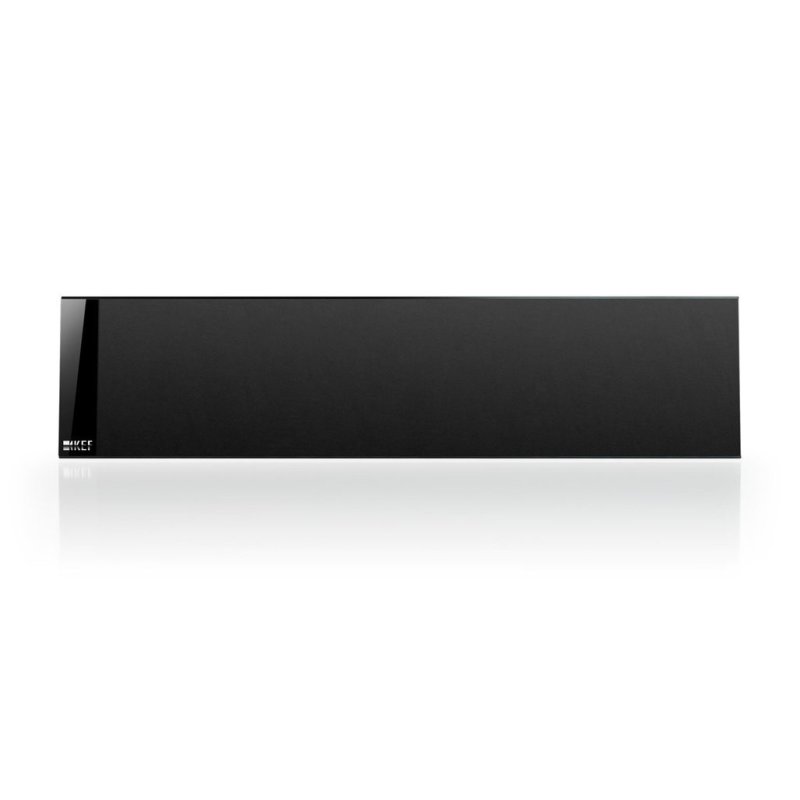
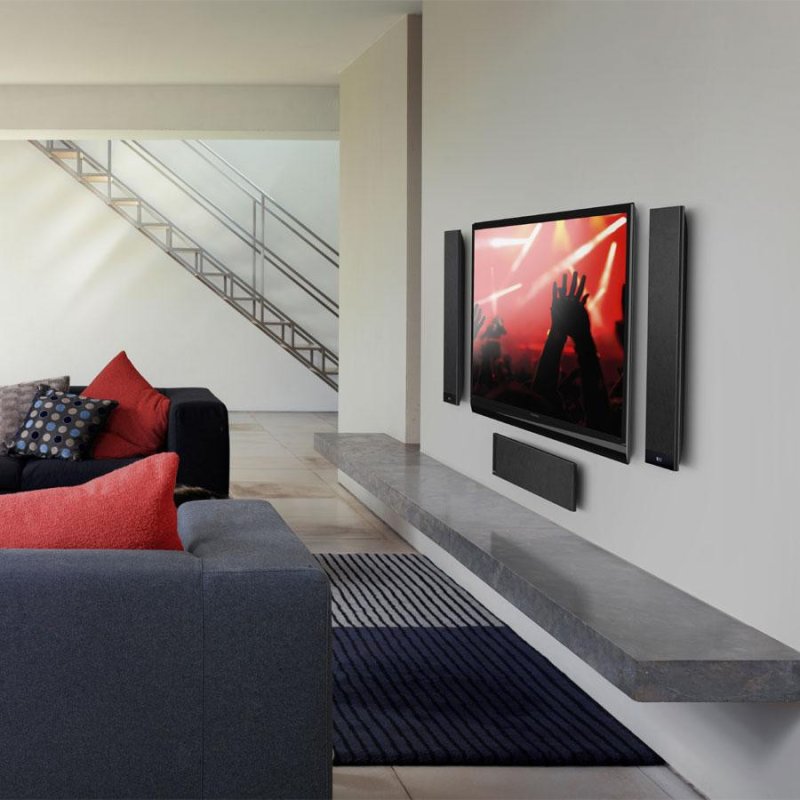

The KEF T301c is the centre channel speaker in KEF's T Series — a range of ultra-shallow home cinema loudspeakers engineered to complement the slim profile of modern flat-panel televisions. Where the smaller T101c pairs a single 115mm mid/bass driver with a 25mm tweeter, the T301c steps up to a two and a half-way topology, placing the tweeter between two 115mm dual-layer drivers to deliver a broader, more forceful sound that suits larger rooms and higher listening levels. At just 35mm deep and 600mm wide, it can be mounted directly to the wall or positioned horizontally on its supplied desk stand directly below a flat-screen TV.
Twin-Layer Mid/Bass Drivers
The two 115mm (4.5in.) mid/bass drivers use KEF's Twin Layered MF Driver technology, developed specifically for the T Series to achieve a total driver depth of only 27mm — significantly shallower than a conventional driver of comparable cone area. The radiating diaphragm is a thin-walled moulding with integral stiffening ribs running both radially and circumferentially; a thin layer of high-elastic-modulus material bonded to the rear of those ribs substantially raises the fundamental resonance above the working frequency band, ensuring pistonic motion is maintained up to the crossover point. The design was optimised using finite element analysis (FEA) and incorporates a Z-Flex Surround with carefully designed undulations that minimise mass-loading at the diaphragm's edge while allowing free fore-and-aft travel. Ventilation gaps in the circumferential ribs prevent high-pressure build-up beneath the vibrating diaphragm. The flat-fronted profile also contributes acoustically: by removing the discontinuities a conventional cone would introduce, the drivers act as a near-perfect baffle, minimising diffractive colouration of the tweeter output — an approach KEF describes as a step toward the Perfect Baffle principle seen in its Concept Blade.
25mm Vented Tweeter with Tangerine Waveguide
The 25mm (1in.) aluminium-dome tweeter is the same diameter as the unit used in KEF's flagship Muon and Reference Series — significantly larger than the 19mm tweeters more common in speakers of this type. The larger dome provides a better compromise between high-frequency extension and output capability. Despite the shallow enclosure, KEF was able to incorporate a rear-venting duct behind the dome: this increases the effective volume of air behind the dome, preventing the compressions and expansions that cause non-linear distortion in a sealed rear chamber, and lowers the tweeter's fundamental resonance so it can be operated over a wider bandwidth with a simpler crossover. The tweeter is topped with KEF's patented Tangerine Waveguide — technology originally developed from research into compression drivers used in concert sound systems — which improves the coupling between the dome and the air immediately in front of it, increasing both sensitivity and high-frequency dispersion.
Slim System Design and Wall-Mount Bass Extension
The total enclosure depth is 37mm including the wall-mounting bracket, which itself adds only 2.5mm. Achieving this required fully integrating the speaker terminals into the rear panel and using zero-build-height wall connections. The cabinet is fully braced: the drive units are designed to brace the enclosure panels directly, eliminating cabinet resonances that would otherwise colour the midrange. KEF's Selecta-Mount system is built into the desk stand: a small electrical circuit within the stand introduces an additional filter section when the speaker is placed away from the wall, automatically switching the bass balance from its on-wall-optimised response to a free-space response — the wall boundary effect enhances upper bass when a speaker is close to a wall, and without compensation this produces a coloured result when the speaker is used on a stand.
Installation
The T301c includes both a wall-mounting bracket with integrated keyhole slots — the bracket protrudes only 2.5mm from the rear of the speaker — and a desk stand that holds the speaker horizontally below a TV. The desk stand can be set to tilt the speaker back by 5 degrees toward the listening position, which improves the intelligibility of the critical centre channel. AV receivers should be configured with the centre channel set to SMALL and bass management engaged at 120Hz or above.