
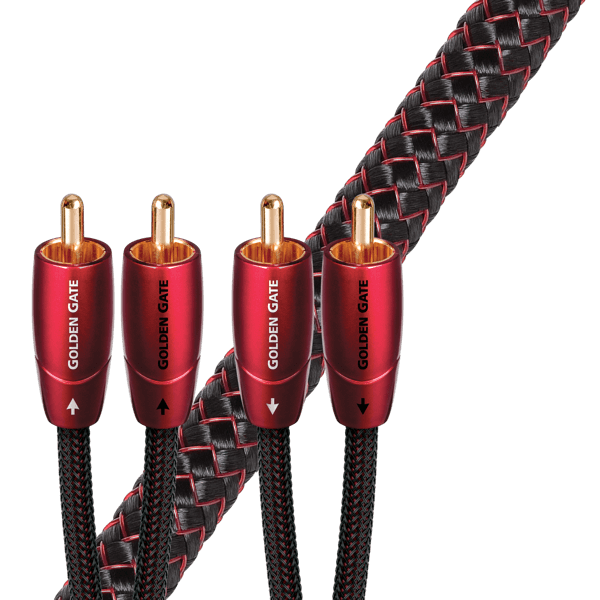

The Golden Gate is the third tier in AudioQuest’s Bridges & Falls series of analogue interconnects, sitting above the Tower and Evergreen and below the Big Sur. Like all Bridges & Falls cables, it places both left and right channels in a single jacket — a stereo pair sharing one cable — with an Asymmetrical Double-Balanced geometry. The Golden Gate’s principal upgrade over the Evergreen below it is its conductor material: it moves from Long-Grain Copper (LGC) to Perfect-Surface Copper (PSC), a meaningfully higher-purity metal that AudioQuest processes using proprietary technology designed to preserve the conductor surface quality at every stage of manufacture.
All copper conductors contain grain boundaries — microscopic junctions between the crystalline structures within the metal. These boundaries create points of discontinuity that interact with the electrical signal passing through the conductor, generating distortion. The extent of this distortion depends on two factors: the number and severity of grain boundaries within the conductor, and the condition of the conductor’s surface. Standard copper processing introduces surface imperfections — oxidation, microscopic roughness, stress damage from drawing — that compound the effect of internal grain boundaries. AudioQuest’s LGC (used in the Tower and Evergreen) is a step above generic copper, with longer grain structures meaning fewer boundaries per unit length. PSC takes this further by applying proprietary metal-processing technology that protects the wire’s surface through every stage of drawing and fabrication, keeping the high-purity, low-oxide copper as soft, pure, and smooth as possible. The result is measurably lower distortion than LGC.
The distinction matters because the conductor surface is not just a physical boundary — it is where the electrical and magnetic fields that guide the signal interact most directly with the metal. Any imperfection on the surface acts as an obstacle, causing the signal’s electric and magnetic fields to scatter and distort. In an analogue interconnect carrying the full audio bandwidth, this surface-level distortion manifests as a loss of clarity, a compression of dynamic contrasts, and a haziness in the stereo image. PSC minimises this by maintaining a surface that is, in AudioQuest’s terminology, “astonishingly smooth and pure.”
While the conductor metal is the defining upgrade, the Golden Gate shares much of its architectural design with the Evergreen. Both use solid (not stranded) conductors, eliminating the strand-interaction distortion that occurs in conventional multi-strand cables. Both use foamed-polyethylene insulation, nitrogen-injected to maximise air content, because air absorbs almost no energy from the signal passing through the conductor. Both use AudioQuest’s Metal-Layer Noise-Dissipation System (NDS), which intercepts captured radio-frequency interference before it can be drained to the equipment’s ground plane, preventing the ground-reference modulation that conventional shields inadvertently cause. And both use the Asymmetrical Double-Balanced geometry that provides separate paths for ground and shield — where many single-ended cable designs force these two functions through a single conductor, the double-balanced approach keeps them separate for lower noise and a cleaner ground reference.
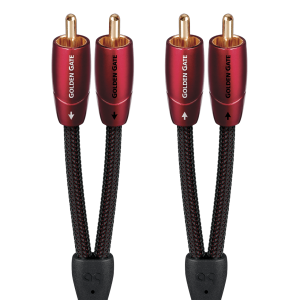
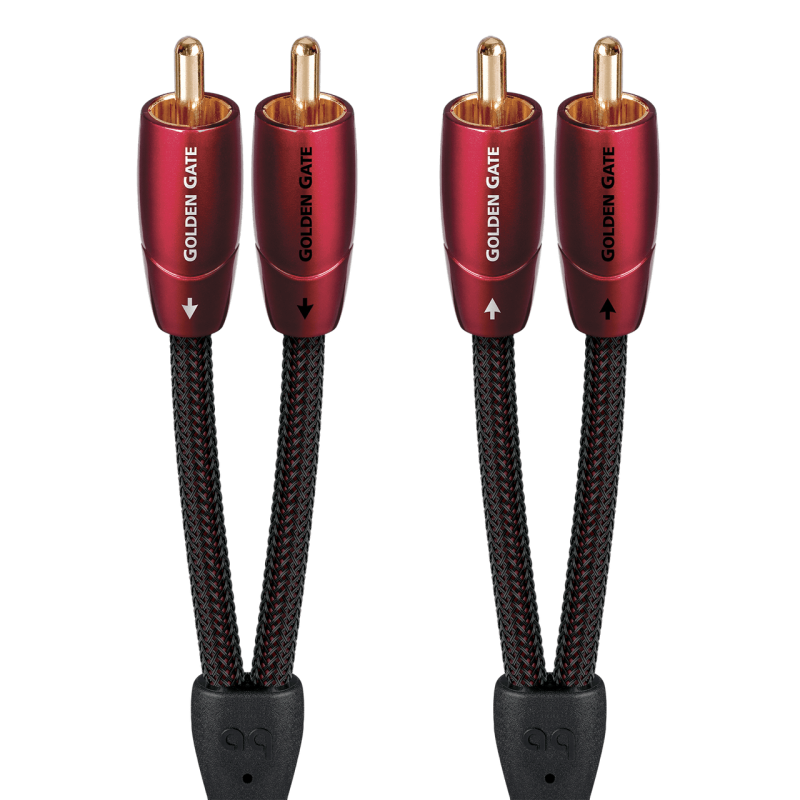
The jacket is a red-on-black nylon braid, following the Bridges & Falls colour-coding convention (Tower: black with white stripes PVC; Evergreen: green on black nylon braid; Golden Gate: red on black nylon braid; Big Sur: brown on black nylon braid). All internal conductors are direction-controlled, with arrows on the cable indicating the optimal signal direction for RF noise dissipation.
The Golden Gate uses cold-welded, gold-plated RCA plugs with stamped ground shells. Cold welding bonds the conductor to the plug using pressure rather than solder, avoiding two problems: the introduction of solder (a relatively poor conductor and a dissimilar metal) at the signal junction, and heat damage to the conductor’s crystal structure at the termination point. The gold plating prevents oxidation at the contact surface.
Moving up to the Big Sur, AudioQuest upgrades both conductor and termination: the Big Sur uses PSC+ (a further refinement of the PSC processing applied to an even purer base metal) and cold-welded, gold-plated Purple Copper terminations — a high-purity copper alloy selected for its signal-transfer properties rather than the more common brass used in most audio connectors.
The single-jacket design that defines the Bridges & Falls series keeps both channels in close proximity, resulting in a thin, flexible cable that is easy to route and connect. However, because the left and right RCA plugs at each end share a common jacket, they are necessarily close together. If the RCA input or output sockets on your equipment are spaced more than approximately 7.6cm apart, AudioQuest recommends considering their Rivers or Elements series cables, which use separate left and right cables. For most equipment — particularly compact integrated amplifiers, DACs, CD players, and phono stages where the sockets are grouped closely — the Bridges & Falls spacing is not a problem.
| Type | Stereo Analogue Interconnect (Dual RCA to Dual RCA) |
|---|---|
| Series | Bridges & Falls |
| Conductors | Solid Perfect-Surface Copper (PSC) |
| Geometry | Asymmetrical Double-Balanced |
| Insulation | Foamed Polyethylene |
| Noise Dissipation | Metal-Layer Noise-Dissipation System (NDS) |
| Direction Control | Yes (All Internal Conductors) |
| Terminations | Cold-Welded, Gold-Plated RCA |
| Jacket | Red on Black Nylon Braid |
| Also Available As | 0.6m, 1m, 2m, 3m, 5m, 8m, 12m, 16m, 20m |
The Golden Gate is the third tier in AudioQuest’s Bridges & Falls series of analogue interconnects, sitting above the Tower and Evergreen and below the Big Sur. Like all Bridges & Falls cables, it places both left and right channels in a single jacket — a stereo pair sharing one cable — with an Asymmetrical Double-Balanced geometry. The Golden Gate’s principal upgrade over the Evergreen below it is its conductor material: it moves from Long-Grain Copper (LGC) to Perfect-Surface Copper (PSC), a meaningfully higher-purity metal that AudioQuest processes using proprietary technology designed to preserve the conductor surface quality at every stage of manufacture.
All copper conductors contain grain boundaries — microscopic junctions between the crystalline structures within the metal. These boundaries create points of discontinuity that interact with the electrical signal passing through the conductor, generating distortion. The extent of this distortion depends on two factors: the number and severity of grain boundaries within the conductor, and the condition of the conductor’s surface. Standard copper processing introduces surface imperfections — oxidation, microscopic roughness, stress damage from drawing — that compound the effect of internal grain boundaries. AudioQuest’s LGC (used in the Tower and Evergreen) is a step above generic copper, with longer grain structures meaning fewer boundaries per unit length. PSC takes this further by applying proprietary metal-processing technology that protects the wire’s surface through every stage of drawing and fabrication, keeping the high-purity, low-oxide copper as soft, pure, and smooth as possible. The result is measurably lower distortion than LGC.
The distinction matters because the conductor surface is not just a physical boundary — it is where the electrical and magnetic fields that guide the signal interact most directly with the metal. Any imperfection on the surface acts as an obstacle, causing the signal’s electric and magnetic fields to scatter and distort. In an analogue interconnect carrying the full audio bandwidth, this surface-level distortion manifests as a loss of clarity, a compression of dynamic contrasts, and a haziness in the stereo image. PSC minimises this by maintaining a surface that is, in AudioQuest’s terminology, “astonishingly smooth and pure.”
While the conductor metal is the defining upgrade, the Golden Gate shares much of its architectural design with the Evergreen. Both use solid (not stranded) conductors, eliminating the strand-interaction distortion that occurs in conventional multi-strand cables. Both use foamed-polyethylene insulation, nitrogen-injected to maximise air content, because air absorbs almost no energy from the signal passing through the conductor. Both use AudioQuest’s Metal-Layer Noise-Dissipation System (NDS), which intercepts captured radio-frequency interference before it can be drained to the equipment’s ground plane, preventing the ground-reference modulation that conventional shields inadvertently cause. And both use the Asymmetrical Double-Balanced geometry that provides separate paths for ground and shield — where many single-ended cable designs force these two functions through a single conductor, the double-balanced approach keeps them separate for lower noise and a cleaner ground reference.
The jacket is a red-on-black nylon braid, following the Bridges & Falls colour-coding convention (Tower: black with white stripes PVC; Evergreen: green on black nylon braid; Golden Gate: red on black nylon braid; Big Sur: brown on black nylon braid). All internal conductors are direction-controlled, with arrows on the cable indicating the optimal signal direction for RF noise dissipation.
The Golden Gate uses cold-welded, gold-plated RCA plugs with stamped ground shells. Cold welding bonds the conductor to the plug using pressure rather than solder, avoiding two problems: the introduction of solder (a relatively poor conductor and a dissimilar metal) at the signal junction, and heat damage to the conductor’s crystal structure at the termination point. The gold plating prevents oxidation at the contact surface.
Moving up to the Big Sur, AudioQuest upgrades both conductor and termination: the Big Sur uses PSC+ (a further refinement of the PSC processing applied to an even purer base metal) and cold-welded, gold-plated Purple Copper terminations — a high-purity copper alloy selected for its signal-transfer properties rather than the more common brass used in most audio connectors.
The single-jacket design that defines the Bridges & Falls series keeps both channels in close proximity, resulting in a thin, flexible cable that is easy to route and connect. However, because the left and right RCA plugs at each end share a common jacket, they are necessarily close together. If the RCA input or output sockets on your equipment are spaced more than approximately 7.6cm apart, AudioQuest recommends considering their Rivers or Elements series cables, which use separate left and right cables. For most equipment — particularly compact integrated amplifiers, DACs, CD players, and phono stages where the sockets are grouped closely — the Bridges & Falls spacing is not a problem.
| Type | Stereo Analogue Interconnect (Dual RCA to Dual RCA) |
|---|---|
| Series | Bridges & Falls |
| Conductors | Solid Perfect-Surface Copper (PSC) |
| Geometry | Asymmetrical Double-Balanced |
| Insulation | Foamed Polyethylene |
| Noise Dissipation | Metal-Layer Noise-Dissipation System (NDS) |
| Direction Control | Yes (All Internal Conductors) |
| Terminations | Cold-Welded, Gold-Plated RCA |
| Jacket | Red on Black Nylon Braid |
| Also Available As | 0.6m, 1m, 2m, 3m, 5m, 8m, 12m, 16m, 20m |
Join our email list to receive updates and exclusive offers directly in your inbox
*By completing this form you are signing up to receive our emails. You can unsubscribe at any time.