


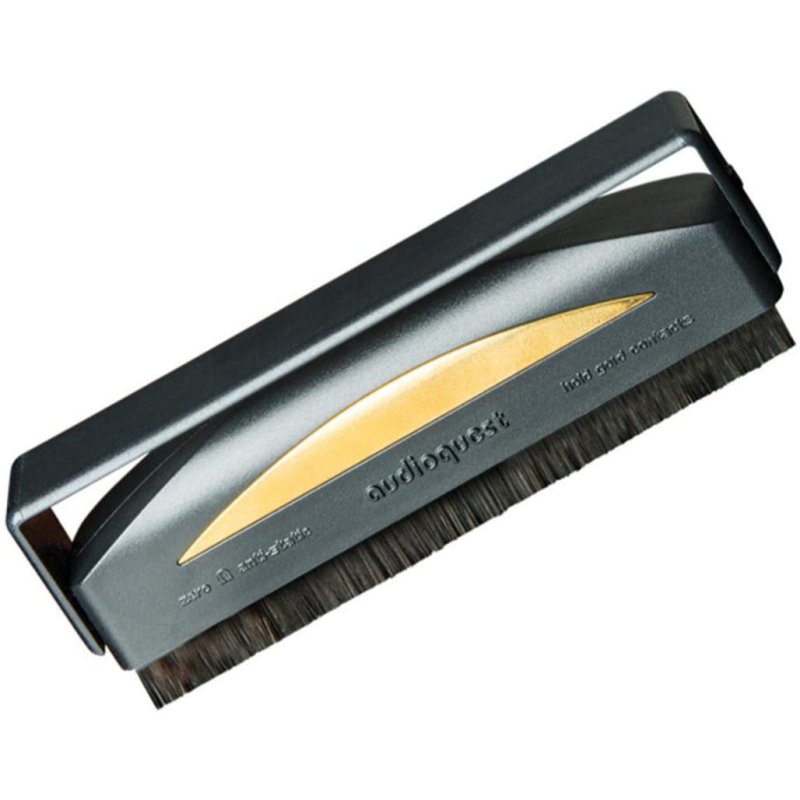
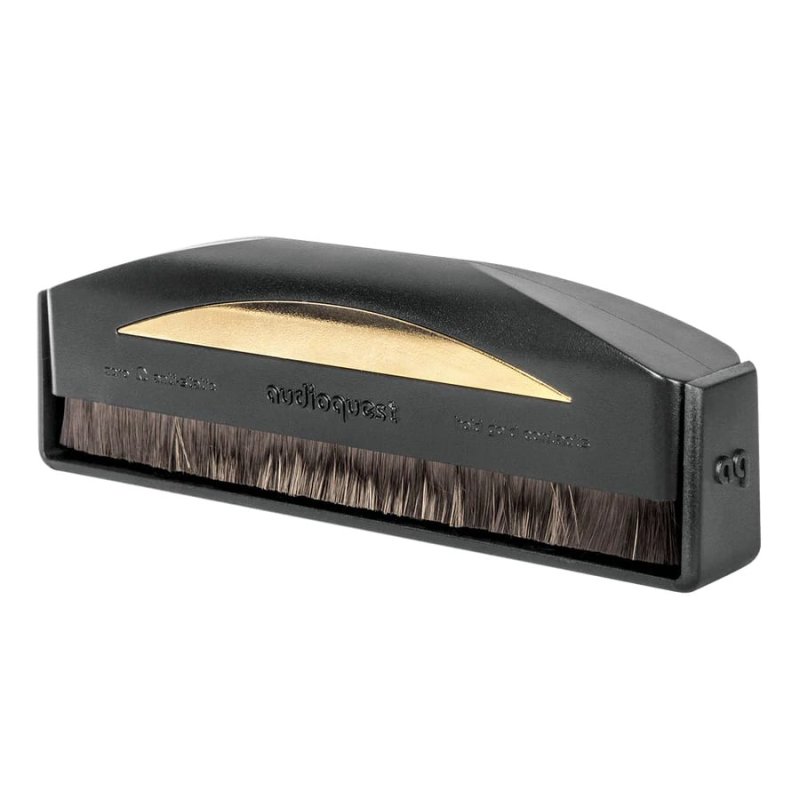
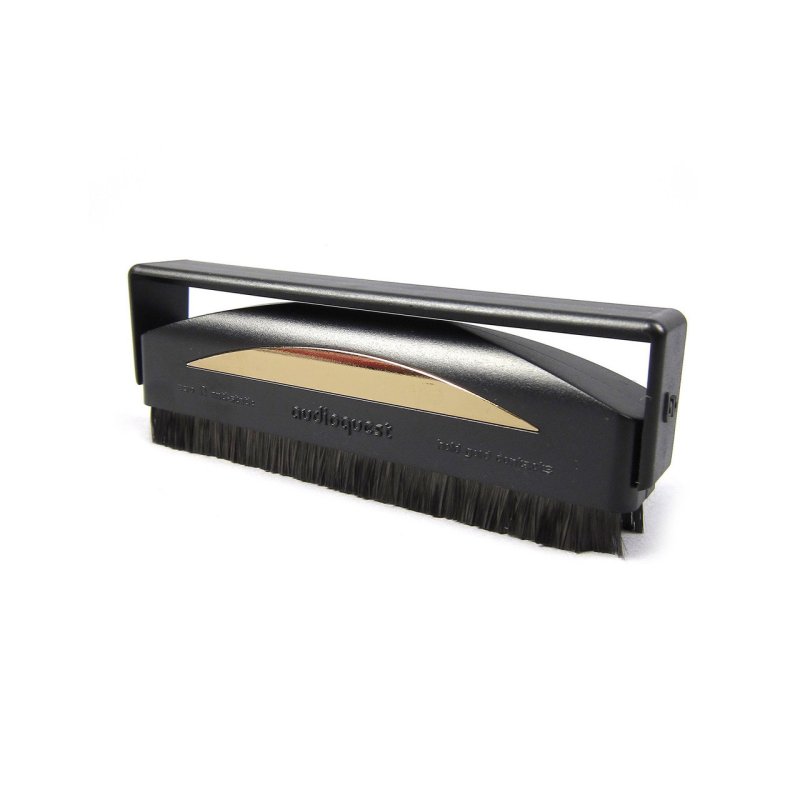

The Gold is the flagship model in AudioQuest’s Anti-Static Record Brush range, sitting above the Silver and the original Carbon Fiber Record Brush — a design that traces its lineage back to 1982 and has become one of the most widely used dry record brushes in hi-fi. The Gold represents a complete redesign of that original concept, with new tooling for every component and a focus on electrical conductivity that earlier models lacked.
Why Conductivity Matters
A carbon fibre record brush serves two purposes: physically sweeping dust and debris from the grooves, and dissipating the static charge that builds up on vinyl surfaces during playback. Static actively attracts airborne dust, turning a clean record into a dirty one between plays. The crackling and popping commonly associated with vinyl is frequently caused not by groove damage but by microscopic dust particles disturbed by the stylus as it passes.
AudioQuest identified a fundamental limitation in most carbon fibre brushes: the electrical path between the conductive bristles and the user’s hand is incomplete. The bristles themselves are conductive and the user’s body can act as a ground, but if the handle and internal components break that conductive path, the anti-static function is significantly compromised. The Gold addresses this by engineering an unbroken conductive path from its super-conductive carbon fibres, through the internal components, to gold-finished conductive contacts positioned where your fingers naturally grip the brush. When held at these gold contact points, the user completes the circuit and becomes the ground through which static charge dissipates.
Fibre Count and Fibre Size
The Gold uses 1,248,000 individual super-conductive carbon fibres arranged in two rows. This is a substantial increase over the Silver model’s 1,086,000 fibres and a larger increase again over the original Carbon Fiber Record Brush. AudioQuest selected finer individual fibres for the redesigned brushes — finer fibres reach further into the record groove and are more effective at capturing the microscopic dust particles that actually cause audible problems during playback. Visible dust is relatively easy to remove; it is the invisible micro-particles settled deep in the groove walls that cause the most damage to both sound quality and stylus wear.
Gold vs Silver
The Silver Anti-Static Record Brush shares the same fundamental redesign philosophy — conductive path from fibres to hand, dual-row layout, finer fibres than the original — but differs in two respects. It uses 1,086,000 conductive carbon fibres compared to the Gold’s 1,248,000 super-conductive fibres, and its finger contact is an uncoated metal grip rather than the Gold’s conductive gold-finished contacts. Both are effective anti-static brushes; the Gold offers a higher fibre density for more thorough groove cleaning and a gold-contact grip for potentially lower resistance in the static discharge path.
How to Use
Place the record on the turntable platter and start the motor. Once the record is spinning at the correct speed, hold the brush by its gold contacts and gently lower the carbon fibres across the record grooves. The fibres should make contact with the surface but should not bend — if they are bending, too much pressure is being applied. Allow the record to rotate two or three times, then smoothly slide the brush outward toward the edge and off. A discreet lip on the underside of the handle strips collected dust from the bristles when the brush is rotated within its housing, ensuring old debris is not returned to the record on the next use. This is a dry brush — it is not designed for use with liquid cleaning solutions.