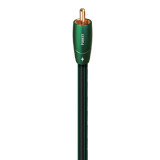
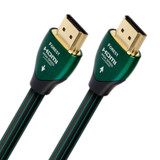
The Forest sits second in AudioQuest's six-tier USB cable range, above the Pearl and below the Cinnamon. The USB hierarchy follows the same silver-plating progression as AudioQuest's Ethernet and HDMI ranges: Pearl (solid Long-Grain Copper, no silver), Forest (0.5% silver-plated LGC), Cinnamon (1.25% silver), Carbon (5% silver with Carbon-Based 3-Layer Noise-Dissipation System), Coffee (10% silver with 72V Dielectric-Bias System), and Diamond (100% solid Perfect-Surface Silver with 72V DBS). The Forest is the first model in the range to add silver plating to the conductor surface, and the USB A-to-B variant is the most common connection for computer-based audio — linking a laptop, desktop, or music server to a standalone DAC or DAC/amplifier.
Why the USB Cable Affects Audio Quality
USB audio is a high-frequency digital signal, operating at up to 480 Megabits per second under the USB 2.0 specification that virtually all audio DACs use. USB 3.0 is a dual-link system not used for USB audio — so this is a USB 2.0 cable, optimised for the single-link data path that carries the audio stream. At these frequencies, the same high-frequency principles that apply to Ethernet and digital coaxial cables are in play: the signal travels almost exclusively on the outer surface of the conductor due to the skin effect, the insulation material directly influences signal integrity, and radio-frequency interference can modulate the receiving device's ground plane to produce audible distortion in the analogue output stage.
Unlike network streaming over Ethernet — where TCP/IP provides error correction — USB audio uses isochronous transfer, a mode designed for real-time data that prioritises timing over error correction. There is no retry mechanism: if the data is corrupted or jitter-affected in transit, it reaches the DAC's conversion stage in that state. This makes the quality of the USB cable between the source computer and the DAC one of the most directly audible digital connections in a system.
Solid Conductors — Unique to the A-to-B Variant
An important detail that distinguishes the Forest USB A-to-B from other Forest USB variants (USB-C to B, USB-C to C, USB-A to Micro B, and USB-C to Lightning): the A-to-B version uses fully solid 0.5% silver-plated Long-Grain Copper conductors, while the other connector variants use Semi-Solid Concentric conductors at the same 0.5% silver content. Solid conductors completely eliminate strand interaction — the electrical and magnetic interference between individual wires within a stranded conductor — which is the single largest source of cable-induced distortion. Semi-Solid Concentric construction greatly reduces strand interaction but does not eliminate it entirely. The A-to-B variant therefore offers the purest conductor geometry in the Forest USB family, making it the preferred choice where the source device provides a USB Type-A port.
The 0.5% silver plating places a layer of higher-purity, higher-conductivity metal on the conductor surface where the high-frequency USB signal actually travels. As with the Forest Ethernet cable, the result is performance approaching that of a solid silver conductor at a fraction of the cost — an approach AudioQuest describes as one of the most cost-effective upgrades in their digital cable range.
Hard-Cell Foam Insulation
The Forest USB uses Hard-Cell Foam (HCF) insulation — a nitrogen-injected material that creates air pockets within the dielectric. This is a step up from the Foamed Polyethylene used in AudioQuest's more affordable Bridges & Falls analogue interconnects and represents the same engineering principle: because nitrogen (like air) does not absorb energy, it cannot store and subsequently release energy back into the conductor as distortion. The Hard-Cell Foam formulation adds greater rigidity than standard foamed PE, which serves a dual purpose in a USB cable. It minimises dielectric absorption in the same way as the analogue cables, but it also locks the conductors into a stable geometric relationship along the full length of the cable, maintaining consistent impedance — critical for preserving the timing precision of the digital signal.
Metal-Layer Noise-Dissipation
Where most cables treat shielding as a simple barrier, AudioQuest's Metal-Layer Noise-Dissipation takes a more considered approach to what happens to radio-frequency interference once the shield captures it. A conventional shield absorbs RF energy and drains it to the component's ground connection. The problem is that this dumps noise energy directly into the equipment's ground plane — the reference voltage against which all audio signals are measured. Modulating this ground reference with RF noise creates distortion that is audible in the analogue output, even though the digital data itself may arrive bit-perfect.
The Metal-Layer Noise-Dissipation system absorbs and reflects most RF interference before it reaches the ground layer, preventing the captured noise from contaminating the ground plane. This is the same principle as the Metal-Layer NDS used in AudioQuest's Evergreen, Golden Gate, and Big Sur analogue interconnects. Moving up the USB range, the Carbon introduces a more sophisticated Carbon-Based 3-Layer NDS, and the Coffee and Diamond add 72V Dielectric-Bias System technology for the most comprehensive noise management.
Direction Control and Shielding
All conductors in the Forest USB are direction-controlled — oriented during manufacture so that the inherent grain-structure directionality of the drawn metal dissipates RF noise away from the audio equipment's sensitive circuitry. Arrows on the connectors indicate the optimal direction: from the source (computer, server, or transport) toward the receiving device (DAC). The cable features triple shielding to minimise external electromagnetic interference, and the gold-plated USB connectors ensure a corrosion-free contact surface for reliable, low-resistance connections over the long term.
Use Cases
The USB A-to-B connection is the standard interface between a computer and a standalone DAC — whether that is a desktop unit like the Audiolab D9, a DAC/headphone amplifier, or the USB input on an integrated amplifier with built-in digital-to-analogue conversion such as the Audiolab 6000A MKII. It is also the connection used by many CD transports with USB outputs and by dedicated music servers. For users connecting a laptop with USB-C to a DAC with a USB-B input, AudioQuest offers the Forest in a USB-C to B variant, though this uses Semi-Solid Concentric rather than fully solid conductors. Where the source device has USB-A and the best possible conductor geometry is the priority, the A-to-B variant is the optimal choice.
AudioQuest recommends keeping USB audio cables as short as practically possible — the standard 0.75m length is sufficient for most desktop setups and minimises signal degradation. Longer lengths are available for installations where the source and DAC cannot be positioned close together.
| Type |
USB Digital Audio Cable (Type A to Type B) |
| USB Standard |
USB 2.0 (480 Mbps) |
| Conductors |
Solid 0.5% Silver-Plated Long-Grain Copper (LGC) |
| Insulation |
Hard-Cell Foam (Nitrogen-Injected) |
| Noise-Dissipation |
Metal-Layer Noise-Dissipation |
| Shielding |
Triple-Shielded |
| Direction Control |
Yes (All Conductors) |
| Connectors |
Gold-Plated USB Type-A (Source) to USB Type-B (DAC) |
| Termination |
Wave Solder |
| Jacket |
Black with Green Stripes |
| Available Lengths |
0.75m, 1m, 1.5m, 3m, 5m |
| Also Available As |
USB-C to B, USB-C to C, USB-C to A, USB-A to Micro B 2.0, USB-C to Lightning |
| Country of Origin |
China |