


- “Anthem’s STR preamplifier is one of the most forward-thinking audiophile products on the market today.” — SoundStage! Hi-Fi (May 2020)
- “I think the STR can be considered extraordinary regardless of its price.” — SoundStage! Hi-Fi (May 2020)
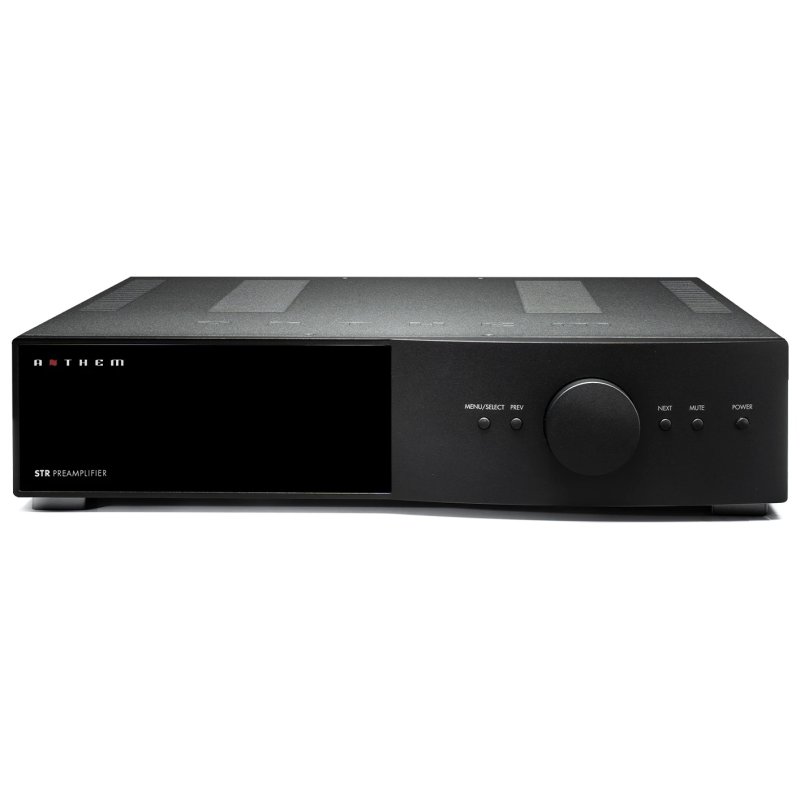
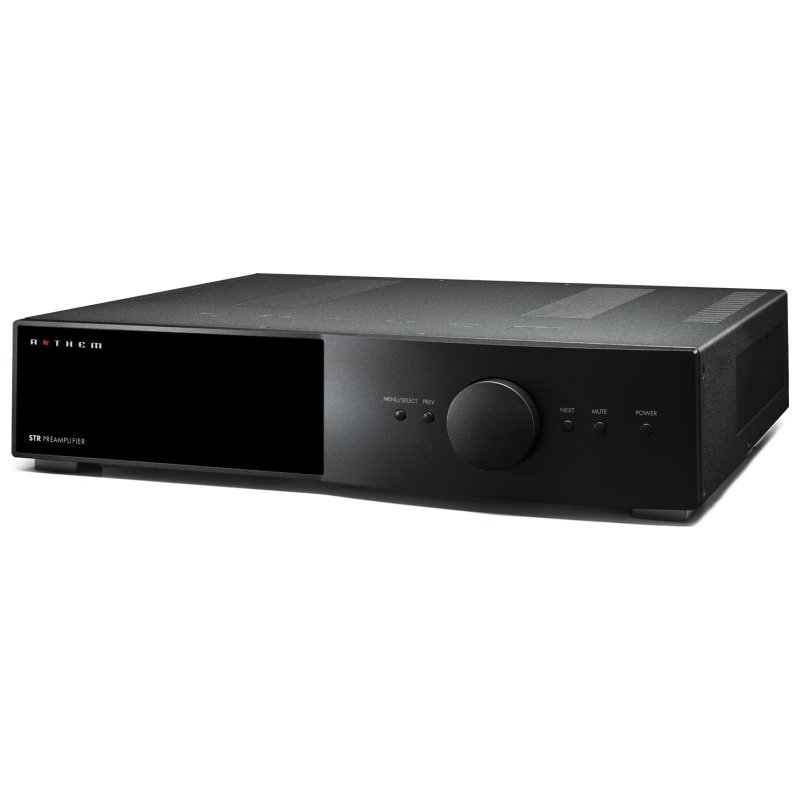
Anthem STR Preamplifier Black
♻️
Trade In and Pay Less
Trade your existing kit toward this purchase

- ARC Genesis room correction, calibrated microphone supplied
- MM and MC phono with six pre-RIAA curves
- Asynchronous USB DAC to 32-bit / 384 kHz
Awards & Reviews
Videos
Description
The STR Preamplifier is the two-channel preamplifier in Anthem's STR series, designed and engineered by Paradigm Electronics and made in Canada, and intended to partner the STR Power Amplifier. It is far more than a line stage: alongside its analogue preamplifier circuitry it carries a full digital front end, a moving magnet and moving coil phono stage, a DSP engine with bass management for two subwoofers, and Anthem Room Correction.
Anthem Room Correction
The STR Preamplifier includes the newest and most powerful generation of Anthem Room Correction (ARC), which Anthem states has 50% more processing power than any other version of ARC. ARC Genesis runs on Mac or Windows and works with the calibrated microphone, stand and cabling supplied in the box. It plays test tones through the system, measures the response at several positions around the listening area, then uploads correction filters to the preamplifier so that the acoustic signature of your speakers is shaped for your room, which matters most at lower frequencies. Auto mode handles the whole process for you; Professional mode opens up the target curve for manual adjustment. A free ARC Mobile app is also available.
Digital Section
The asynchronous USB input accepts PCM up to 32-bit / 384 kHz and DSD at 2.8 and 5.6 MHz, while the AES/EBU, coaxial and optical inputs handle up to 192 kHz. Whatever arrives, a dedicated asynchronous 32-bit / 192 kHz sample rate converter reclocks the data, so the DAC stage's anti-imaging filter is optimised for a single sampling rate and the signal gains immunity from source jitter. Signal processing employs 64-bit accumulation and feedback to preserve fine detail. Through the rest of the DAC circuitry, thin film high precision resistors and super low noise op-amps are used for lowest distortion, lowest noise and most transparent sound.
Phono Stage
Separate inputs are provided for moving magnet and moving coil cartridges, with the phono section completely shielded to maintain a clean signal. Beyond the standard RIAA curve, six pre-RIAA curves are provided, and the phono curve is continuously adjustable for proper playback of any record that predates the RIAA equalisation standard. Vinyl can be left entirely in the analogue domain, or converted to digital so that the equalisation options and ARC processing can be applied.
Subwoofers and Home Cinema
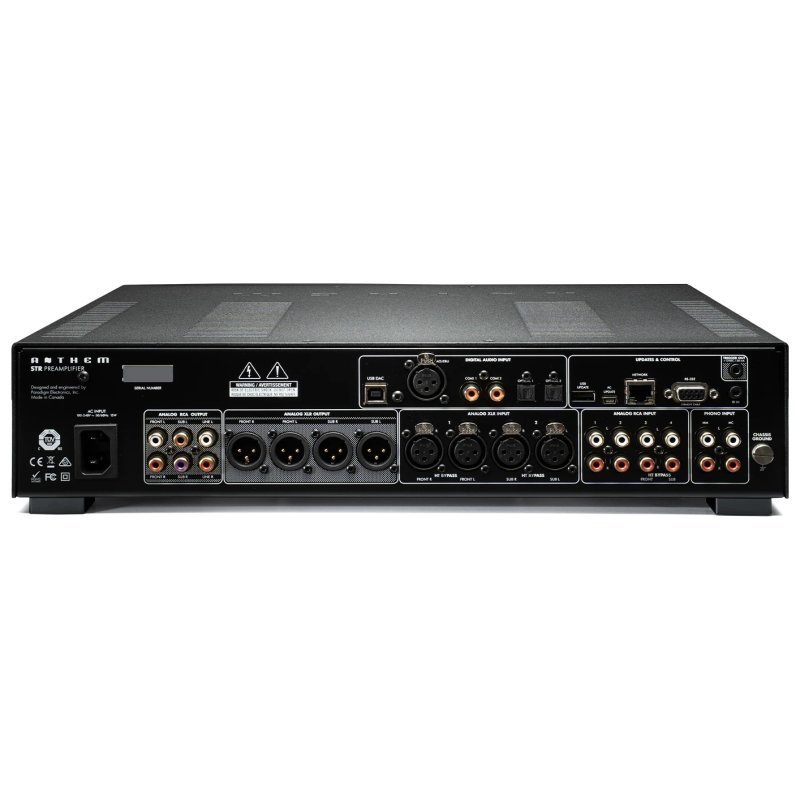
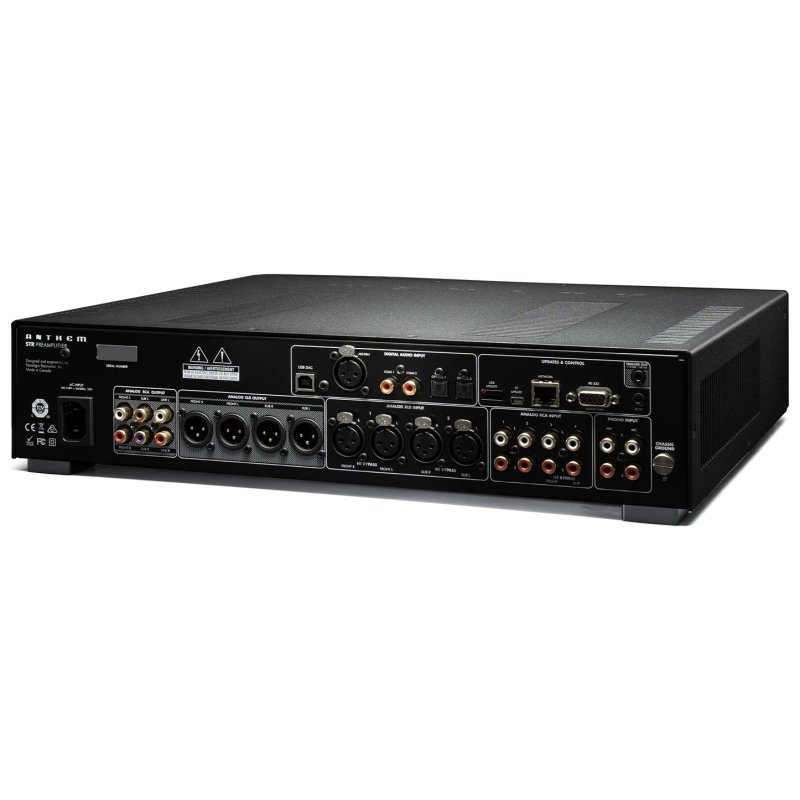
Bass management covers one subwoofer or two, in mono or as independent left and right channels, and works in concert with ARC for seamless subwoofer blending. Balanced XLR outputs are provided for the two front channels and both subwoofers, alongside stereo RCA outputs, RCA subwoofer outputs and a fixed-level line output suitable for a headphone amplifier or recording device. Home Theater Bypass takes an RCA or XLR feed from an existing surround processor for the fronts and the subs; relays hard-wire the input jacks to the outputs so the preamplifier becomes, in effect, a straight wire, and the mode engages while the preamplifier is on standby so it does not have to be switched on to watch films.
Control and Setup
A graphic front panel display and five buttons handle setup alongside the supplied remote control. Analogue input levels are adjustable to match sources, minimise noise and prevent distortion, and Direct mode keeps the analogue signal out of the DSP altogether. Up to 30 virtual inputs can be created for setup flexibility, each assigned to a physical input and given its own name, gain, conversion setting, speaker profile and ARC setting. Ethernet, RS-232 and a PC USB port are provided for control, ARC and firmware updates, along with an IR input and a 12 V DC trigger output for switching a partnering power amplifier.
Specification
| Analogue Inputs | 4 x stereo RCA, balanced XLR (front and subwoofer, configurable for Home Theater Bypass) |
|---|---|
| Phono Inputs | Moving magnet and moving coil (RCA), with chassis ground terminal |
| Digital Inputs | Asynchronous USB DAC (type B), AES/EBU, 2 x coaxial, 2 x optical |
| USB Audio Support | PCM up to 32-bit / 384 kHz, DSD 2.8 / 5.6 MHz |
| Coaxial, Optical and AES/EBU Support | Up to 24-bit / 192 kHz |
| Outputs | Balanced XLR (2 front, 2 subwoofer), stereo RCA, 2 x RCA subwoofer, fixed-level line output |
| Room Correction | Anthem Room Correction (ARC) Genesis, calibrated microphone supplied |
| Frequency Response (analogue in, Direct mode) | 10 Hz - 80 kHz (+0.00, -0.10 dB) |
| Frequency Response (analogue in, DSP mode) | 10 Hz - 40 kHz (+0.00, -0.20 dB) |
| Frequency Response (digital in, 192 kHz) | 10 Hz - 50 kHz (+0, -0.5 dB) |
| THD+N (Direct mode) | 0.0016% (1 kHz, 20 Hz - 20 kHz BW, 2 Vrms output) |
| THD+N (DSP mode) | 0.0006% digital in, 0.0017% analogue in |
| Signal to Noise Ratio (Direct mode) | 120 dB (IEC-A, 2 Vrms output) |
| Signal to Noise Ratio (DSP mode) | 113 dB digital in, 108 dB analogue in |
| Maximum Output | 3.3 Vrms (RCA), 6.6 Vrms (XLR) |
| Phono Gain | 61 dB (MC), 41 dB (MM) at 1 kHz, volume set to 0 dB |
| Phono Input Impedance | 100 Ω (MC), 47 kΩ with 270 pF (MM) |
| RIAA Response | ± 0.1 dB (20 Hz - 20 kHz) |
| Phono Equalisation | RIAA plus six pre-RIAA curves, continuously adjustable |
| Virtual Inputs | Up to 30 |
| Control | Ethernet, RS-232, IR input, 12 V DC / 50 mA trigger output |
| Power Requirement | 100-240 V, 50/60 Hz |
| Power Consumption | 0.45 W standby, 1.2 W standby with network, 10 W typical |
| Dimensions (W x H x D) | 43.2 x 9.93 x 37.69 cm (depth excluding power cord) |
| Weight | 7.6 kg |
| Finish | Black |
| Also Available As | Black, Silver |
All Options (2)
Currently Viewing
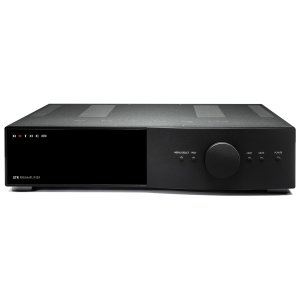
Anthem STR Preamplifier Black
£4,599.00
Available to order
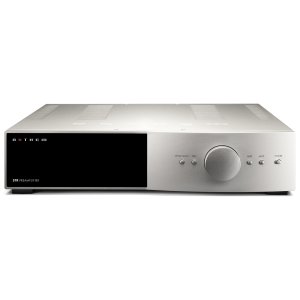
Anthem STR Preamplifier Silver
£4,599.00
Available to order