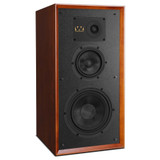
The Wharfedale Linton Heritage is the largest standmount loudspeaker in Wharfedale's Heritage Series, sitting above the compact two-way Denton 80 and Denton 85 Anniversary and below the flagship Dovedale. Launched in 2019 to celebrate Wharfedale's 85th anniversary, it is a contemporary re-engineering of the original Linton that debuted in 1965 and ran in various forms through to the Linton 3XP of the late 1970s. A three-way bass-reflex design with an unusually wide baffle by modern standards, it deliberately rejects the slim-cabinet fashion of contemporary standmounters in favour of an engineering approach that its designer, Peter Comeau (Wharfedale's Director of Acoustic Design), argues produces a more natural midrange and higher sensitivity. The Linton Heritage has since been joined by the Super Linton — a model with upgraded drivers, crossover, and cabinet construction — though the original remains in the range. The speakers are sold as a matched pair; the dedicated Linton Stands are available separately.
Driver Complement
The Linton Heritage is a three-way design using a 200 mm (8 in) woven Kevlar bass driver, a 135 mm (5 in) woven Kevlar midrange driver, and a 25 mm (1 in) textile soft-dome tweeter with a high-flux ferrite magnet. Both the bass and midrange cones use black woven Kevlar, a material chosen for its high stiffness-to-weight ratio — it resists the flexural modes that cause cone breakup at the top of each driver's passband, keeping the response cleaner through the crossover transition regions. The bass driver sits in a die-cast chassis, which provides tighter dimensional tolerances and better heat dissipation than a pressed-steel frame.
The midrange driver is mounted in its own sealed internal enclosure within the main cabinet. This isolation is critical in a three-way design: without it, the back-wave energy from the midrange cone would interact with the air volume shared by the bass driver, causing interference that muddies vocal clarity and degrades imaging. The sealed sub-enclosure ensures the midrange driver sees a well-defined, controlled air volume independent of the bass section. The tweeter is positioned slightly offset towards one side of the baffle, making the speakers "handed" — they should be placed with the tweeters towards the inside of the stereo pair to optimise imaging and high-frequency dispersion at the listening position.
Crossover & the Baffle Step Advantage
Crossover frequencies are set at 630 Hz and 2.4 kHz. Wharfedale states the crossover was developed using computer simulation refined through hundreds of hours of listening tests. The result is a network that Comeau describes as producing a coherent, seamless output — the step responses measured by Stereophile confirmed smooth, well-integrated handoffs between all three drivers.
The Linton's 300 mm baffle width is central to its design philosophy. In most modern standmounters, the narrow baffle causes a phenomenon known as the "baffle step" at a relatively high frequency — the point at which the sound radiation pattern transitions from hemispherical (supported by the baffle) to spherical (radiating freely around the cabinet edges). This transition causes an effective 6 dB drop in forward output that must be compensated for electrically in the crossover, which wastes amplifier power and typically reduces system sensitivity from around 90 dB to 85 dB. The Linton's wider baffle pushes this transition to a lower and broader frequency, meaning less crossover compensation is needed and the full 90 dB sensitivity of the raw drivers is preserved. The practical benefit is that the Linton works comfortably with amplifiers as modest as 25 watts per channel — including many valve designs — while also handling up to 200 watts for high-level listening.
Cabinet Construction
The cabinet uses a three-layer sandwich construction pioneered by Comeau for Wharfedale: a core of high-density chipboard between outer skins of MDF, finished externally with hand-matched real wood veneers. Comeau's reasoning, supported by his own research, is that chipboard's more heterogeneous particle structure scatters panel resonances across a wider frequency band rather than concentrating them at a single dominant frequency as homogeneous MDF tends to do. The MDF skins provide a smooth, consistent surface for veneering and add further mass. Internal damping uses long-hair synthetic wool, chosen for its broadband absorption characteristics. All surfaces except the front baffle — which is painted black and recessed slightly behind narrow wood veneer bezel strips — are veneered, including the top, sides, bottom, and rear panel.
Two flared bass reflex ports on the rear panel tune the cabinet to approximately 39–41 Hz, extending usable bass output to 35 Hz at −6 dB. The reflex loading represents a significant departure from the original 1960s Linton's infinite-baffle (sealed) design, but it delivers substantially improved sensitivity (90 dB versus the original's 86 dB) and deeper bass extension (35 Hz versus the Linton XP2's 60 Hz). The flared port profiles reduce air turbulence and the associated chuffing noise at high output levels.
Grilles & Setup
Unusually for a modern loudspeaker, the Linton Heritage is designed to be used with its grilles in place. The padded cloth grilles sit flush within the recessed front baffle and form part of the acoustic design — they aid high-frequency dispersion from the tweeter, producing a smoother, more integrated treble response than listening with grilles removed. Multiple reviewers and Wharfedale's own engineering team confirm the speaker sounds better with grilles on, which is the opposite of the common audiophile assumption.
The rear panel carries a pair of gold-plated five-way binding posts and a brass escutcheon plate bearing the Wharfedale logo and the 85th Anniversary Limited Edition designation. For optimum performance, Wharfedale recommends the dedicated Linton Stands, which position the tweeter axis at approximately 1,000 mm from the floor — close to typical seated ear height. The speakers should be slightly toed in towards the listener and positioned at least 500 mm from the rear wall to allow the rear ports to breathe. All design work is conducted at Wharfedale's research and development facility in Huntingdon, Cambridgeshire.
Specifications
| Type |
3-way bass-reflex standmount loudspeaker (pair) |
| Bass Driver |
200 mm (8 in) woven Kevlar cone, die-cast chassis |
| Midrange Driver |
135 mm (5 in) woven Kevlar cone, sealed internal enclosure |
| Treble Driver |
25 mm (1 in) textile soft-dome, high-flux ferrite magnet |
| Crossover Frequencies |
630 Hz & 2.4 kHz |
| Frequency Response (±3 dB) |
40 Hz – 20 kHz |
| Bass Extension (−6 dB) |
35 Hz |
| Sensitivity |
90 dB (2.0 V @ 1 m) |
| Peak SPL |
110 dB |
| Nominal Impedance |
6 Ω |
| Minimum Impedance |
3.5 Ω |
| Recommended Amplifier Power |
25–200 W |
| Cabinet Construction |
MDF / high-density chipboard / MDF sandwich; long-hair synthetic wool damping |
| Enclosure Volume |
37.6 litres (1.3 cu ft) |
| Bass Loading |
Twin rear-mounted flared reflex ports |
| Terminals |
Single-wired, gold-plated five-way binding posts |
| Dimensions (H × W × D) |
565 × 300 × 330 mm (22.3 × 11.8 × 13.0 in); depth with terminals: 360 mm (14.2 in) |
| Weight |
18.4 kg (40.5 lb) each |
| Finishes |
Walnut, Red Mahogany, Black Oak (hand-matched wood veneer) |
| Also Available As |
Wharfedale Super Linton (upgraded drivers, crossover & cabinet) |