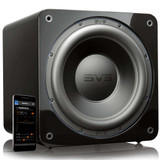
The SB-3000 R|Evolution is the sealed subwoofer in SVS's new 3000 R|Evolution Series, sitting above the 2000 Pro range and below the 5000 R|Evolution and flagship 17-Ultra R|Evolution models. It directly replaces the original SB-3000 — one of the most acclaimed subwoofers in its class — inheriting technologies first developed for the 17-Ultra R|Evolution and 5000 R|Evolution Series and repackaging them into the same compact, room-friendly form factor. For those who want the tight, controlled bass response of a sealed enclosure with genuine deep extension and serious output capability, the SB-3000 R|Evolution represents SVS's current sweet spot of performance and value.
What's Changed from the Original SB-3000
The upgrades from the outgoing SB-3000 are substantial and span every major component. Amplifier power jumps from 800 watts RMS continuous (2,500 watts peak) to 1,200 watts RMS continuous (4,000+ watts peak) — a 50% increase in sustained output. The DSP processor moves from a 50 MHz Analog Devices chip to a 295 MHz unit with over five times the processing power, enabling more sophisticated real-time monitoring of driver excursion, current, and thermal conditions. The parametric equaliser expands from three bands to six, giving considerably more flexibility for room correction. Rated frequency response extends a hertz deeper, from 18 Hz to 17 Hz (±3 dB), and SVS claims a 20–60% reduction in acoustic total harmonic distortion plus noise across the critical low-frequency bandwidth. The amplifier itself measures below 0.05% THD+N at rated power — between 70% and 90% lower than its predecessor. A balanced XLR input now joins the existing RCA connection, and the rear-panel interface gains an OLED display with a display-flip function for inverted mounting scenarios.
Driver Design
The SB-3000 R|Evolution retains a 330 mm (13-inch) front-firing driver, but the unit is newly designed. The voice coil uses SVS's Flat-Edge Split-Wind construction, where winding density varies across the coil's height — lower density at the centre, higher density at the outer sections. This geometry maximises magnetic force at high excursion levels while keeping moving mass low, which benefits both output capability and transient speed. The coil is wound on a 51 mm (2-inch) aluminium former — an upgrade from the polyimide-impregnated fibreglass former used in the original SB-3000 — chosen for its superior thermal conductivity, allowing heat to dissipate more quickly during sustained high-output passages.
The motor uses a two-piece toroidal Y30 ferrite magnet in an overhung configuration, meaning the voice coil extends beyond the magnetic gap at rest. This ensures the coil remains within a linear region of magnetic flux even at extreme excursion, maintaining consistent force and reducing distortion. Maximum linear excursion (Xmax) is 30.1 mm, with mechanical excursion (Xmech) reaching 72.9 mm — considerable displacement for a 330 mm driver. The cone is rigid 1100-series aluminium, chosen for its high stiffness-to-mass ratio: stiff enough to resist flexing or break-up modes at high drive levels, yet light enough to respond quickly to transient demands. The surround is a long-throw SBR (styrene-butadiene rubber) design that maintains pistonic motion across the full excursion range.
Amplification
The STA-1200D2 amplifier is a fully discrete Class D design using four 60-amp, 200-volt MOSFETs. Class D topology provides high efficiency — important in a sealed enclosure where the amplifier must work harder to produce deep bass without the assistance of port resonance — while the discrete MOSFET output stage can deliver the high instantaneous current demands of a subwoofer driver at full excursion. The switch-mode power supply uses dual 65 MHz power management units that work in concert with the DSP, continuously monitoring output voltage and current, mains input conditions, and multiple temperature sensors. This allows the power supply to maintain a consistent regulated 160-volt rail voltage regardless of mains fluctuations, ensuring stable output under demanding conditions.
Digital-to-analogue conversion uses premium DACs with a signal-to-noise ratio exceeding 120 dB, and the 56-bit double-precision filtering in the DSP provides ample headroom for the six-band parametric equaliser, room-gain compensation, and real-time limiter algorithms without introducing quantisation artefacts.
Sealed Cabinet Design
The sealed enclosure is constructed from MDF with a rigid front baffle and internal bracing designed to remain acoustically inert even at reference drive levels. A sealed cabinet behaves as a second-order high-pass filter, producing a gentler roll-off slope below the system's resonant frequency compared to a ported design's steeper fourth-order roll-off. In practice, this means the SB-3000 R|Evolution's bass response decays more gradually below its rated bandwidth, and room gain — the natural boost that room boundaries provide at low frequencies — extends the usable in-room response further than anechoic measurements suggest. SVS notes that typical small-to-medium rooms will add 2–3 Hz of effective extension beyond the rated 17 Hz figure.
The sealed approach also eliminates port noise, turbulence, and the group delay associated with ported alignments, resulting in tighter transient response. This makes the SB-3000 R|Evolution particularly well-suited to music reproduction, where the speed and precision of bass articulation matter as much as sheer output. For those who prioritise maximum output and the deepest possible extension over compactness, SVS offers the PB-3000 R|Evolution — a ported variant using the same driver and amplifier platform, rated to 16 Hz (±3 dB) in a larger cabinet.
Control & Integration
The SVS Subwoofer Control App connects via Bluetooth and provides access to volume, low-pass filter frequency and slope, phase (adjustable in one-degree increments from 0° to 180°), polarity, six parametric equalisers, room-gain compensation, and three user-saveable presets — useful for switching between optimised settings for music, film, and late-night listening. An auto room EQ feature, which will use the mobile device's microphone to measure and correct in-room response, is expected via a firmware update in 2026.
Connectivity includes unbalanced RCA inputs (10 kΩ impedance, compatible with signals up to 4 Vrms) and balanced XLR inputs (18 kΩ impedance, compatible up to 4 Vrms / +14 dBu). The balanced option is worthwhile for longer cable runs or systems with balanced preamplifier outputs, as it rejects common-mode noise that can accumulate over distance. A rear-panel USB port provides power for the optional SVS SoundPath Wireless Audio Adapter, and a 3.5 mm trigger input (3–12 V AC/DC) and 3.5 mm IR input allow integration with control systems and power-management triggers. The rear-panel OLED display mirrors the app's core controls for direct access without a phone.
Specifications
| Type |
Sealed powered subwoofer |
| Driver |
330 mm (13 in) high-excursion aluminium cone, front-firing |
| Voice Coil |
51 mm (2 in) flat-edge split-wind on aluminium former |
| Motor |
Two-piece toroidal Y30 ferrite, overhung configuration |
| Xmax / Xmech |
30.1 mm / 72.9 mm |
| Driver Weight |
10.9 kg (24.1 lb), of which motor assembly is 8.4 kg (18.5 lb) |
| Amplifier |
STA-1200D2 Class D, discrete MOSFET output |
| Continuous Power |
1,200 watts RMS |
| Peak Power |
4,000+ watts |
| THD+N (Amplifier) |
< 0.05% at rated power |
| DSP |
295 MHz Analog Devices, 56-bit double-precision filtering |
| DAC Signal-to-Noise Ratio |
> 120 dB |
| Frequency Response |
17–230 Hz (±3 dB) |
| Inputs |
Unbalanced RCA (10 kΩ); Balanced XLR (18 kΩ) |
| App Control |
SVS Subwoofer Control App (Bluetooth) — iOS, Android, Amazon Fire |
| DSP Functions |
Volume, low-pass filter, phase (0°–180° in 1° steps), polarity, 6-band parametric EQ, room-gain compensation, 3 presets |
| Additional Connections |
USB (SoundPath Wireless Adapter power); 3.5 mm trigger input (3–12 V); 3.5 mm IR input |
| Rear Panel Display |
OLED with display-flip function |
| Cabinet Construction |
MDF with rigid front baffle & internal bracing |
| Grille |
Non-resonant extra-thick ABS frame with fabric mesh |
| Feet |
Screw-in iso-elastomer |
| Dimensions (with Grille) |
397 mm (15.6 in) H × 385 mm (15.2 in) W × 426 mm (16.8 in) D |
| Dimensions (without Grille) |
397 mm (15.6 in) H × 385 mm (15.2 in) W × 397 mm (15.6 in) D |
| Weight |
24.9 kg (54.8 lb) |
| Shipping Dimensions |
530 mm (21.2 in) H × 516 mm (20.3 in) W × 516 mm (20.3 in) D |
| Shipping Weight |
30.0 kg (66.1 lb) |
| Finishes |
Premium Black Ash; Piano Gloss Black |
| Standby Power Consumption |
0.5 watts |
| Also Available As |
PB-3000 R|Evolution (ported variant, rated to 16 Hz) |