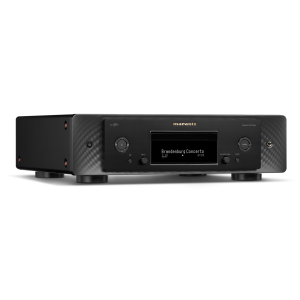

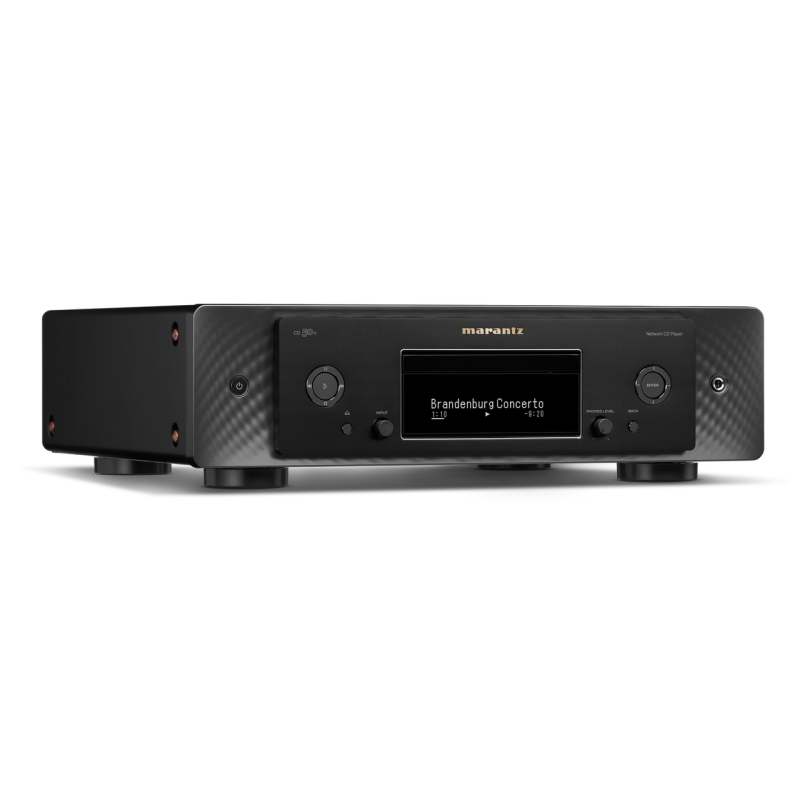
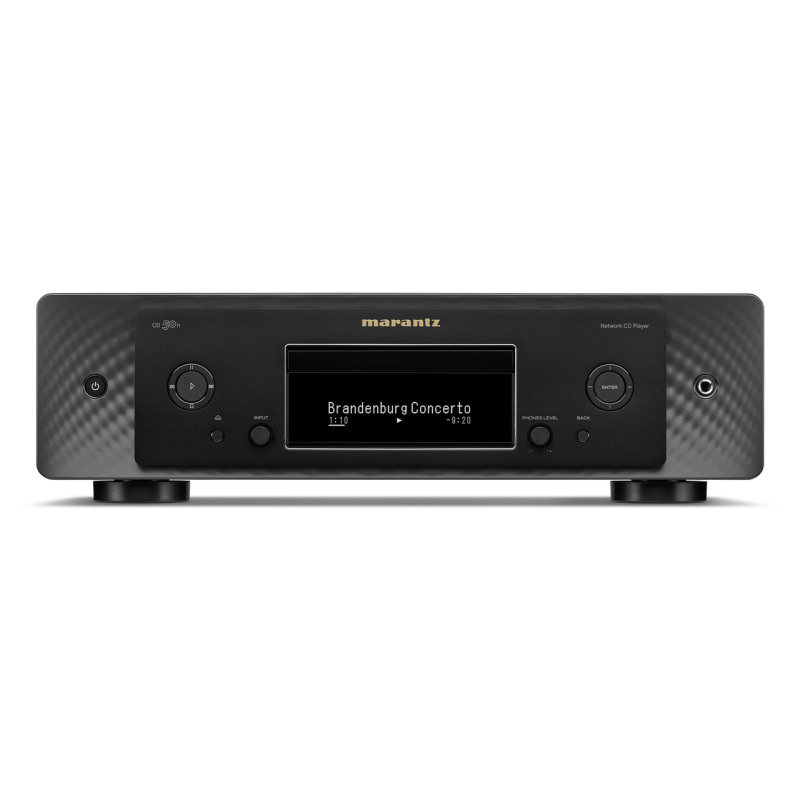
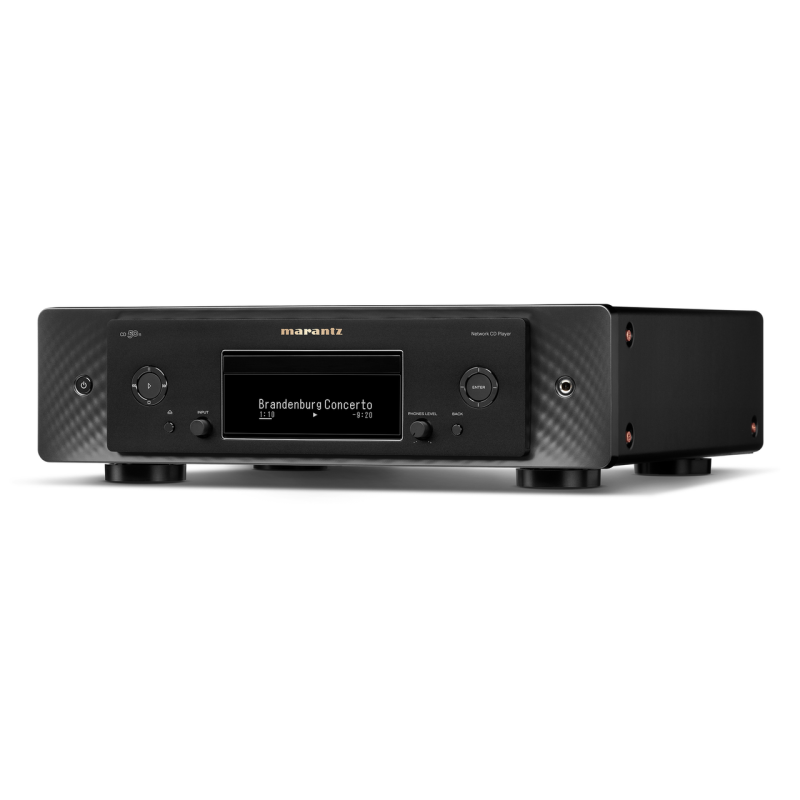
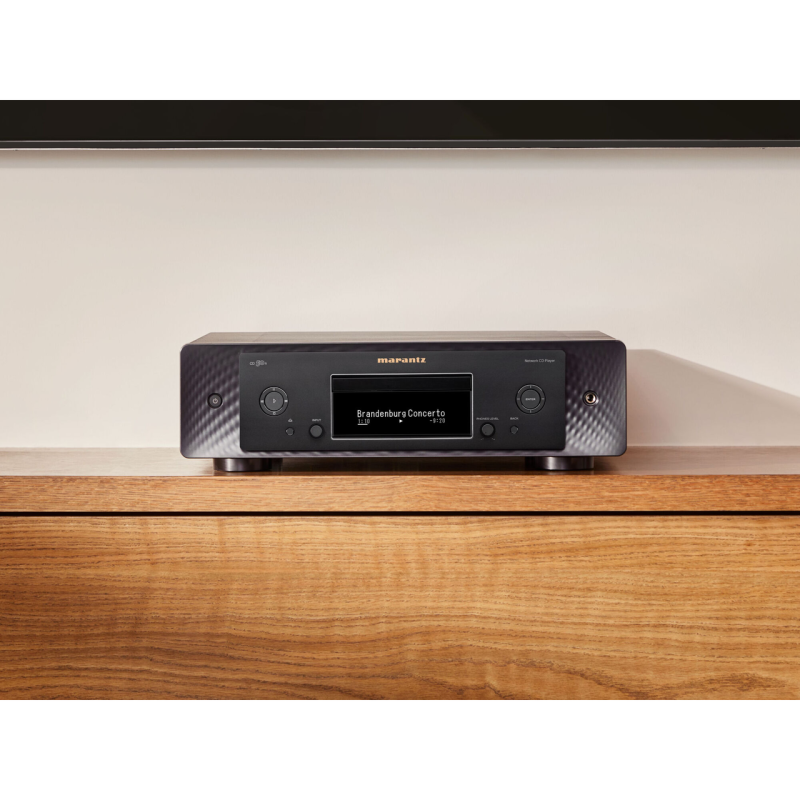

The CD 50n is Marantz's premium network CD player, positioned above the CD 60 — a transport-only player with no streaming or external DAC inputs — and below the SACD 30n, which adds SACD playback capability. The CD 50n's distinction within the range is the combination of CD playback, full HEOS network streaming, a USB-B DAC input with asynchronous transfer, and HDMI ARC connectivity, which allows it to serve as a streaming hub and DAC for a connected television.
Construction
The chassis uses a double-layer construction of two 1 mm steel plates, a design Marantz specifies for vibration damping and shielding of sensitive audio circuitry from electromagnetic interference. The circuit layout is symmetrical, with left and right channels mirrored to maintain consistent signal paths and minimise crosstalk — channel separation is rated at 110 dB across all formats. A toroidal power transformer feeds the unit with separated rectifier circuits serving the analogue and digital sections independently, isolating noise generated by the digital circuitry from the analogue signal path. The front panel features a three-line OLED display with dimmer and off modes.
Amplification and DAC Architecture
The analogue output stage uses Marantz's proprietary HDAM (Hyper Dynamic Amplifier Module) in the low-pass filter stage, with HDAM SA2 modules in the output buffer. These discrete amplification circuits avoid integrated op-amps. The headphone amplifier uses the same HDAM SA2 circuit.
A DAC Master Clock Design positions the master clock directly adjacent to the DAC chip to minimise trace lengths and reduce jitter from electromagnetic interference. In USB DAC mode, a signal isolator electrically separates the DAC circuitry from the USB interface to reduce noise coupling from the connected computer. Two selectable digital filters — part of Marantz's Musical Digital Filtering — allow adjustment of the transient response for CD and PCM DAC playback.
CD Transport and Disc Playback
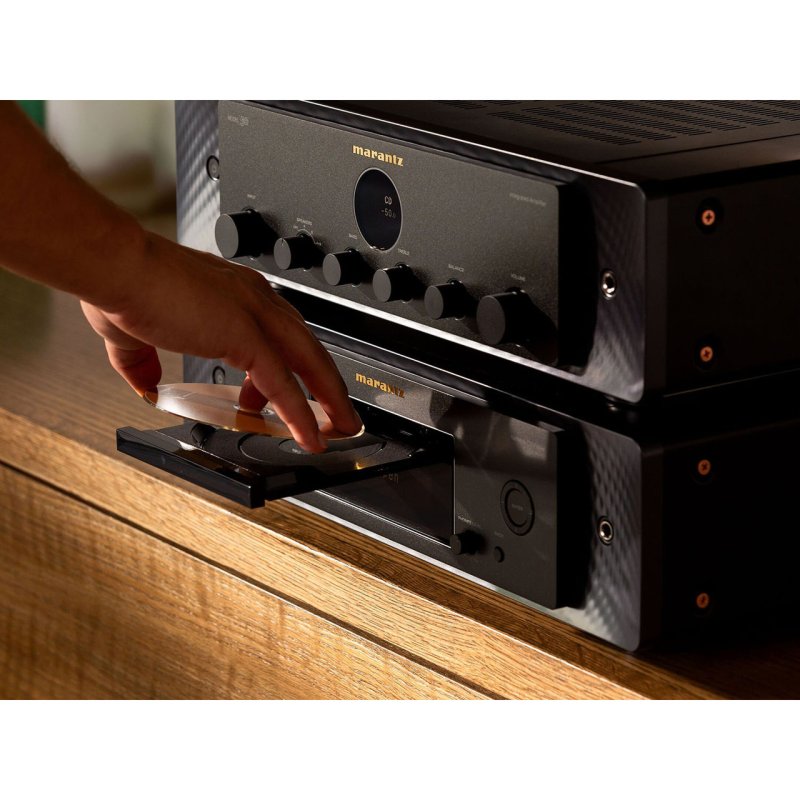
The transport accepts standard CD, CD-R, and CD-RW discs. Playback programme memory holds up to 25 tracks, with repeat and random play modes also available. Frequency response from CD is 2 Hz to 20 kHz (±1 dB), with total harmonic distortion of 0.0016% and dynamic range of 100 dB.
USB DAC and Digital Inputs
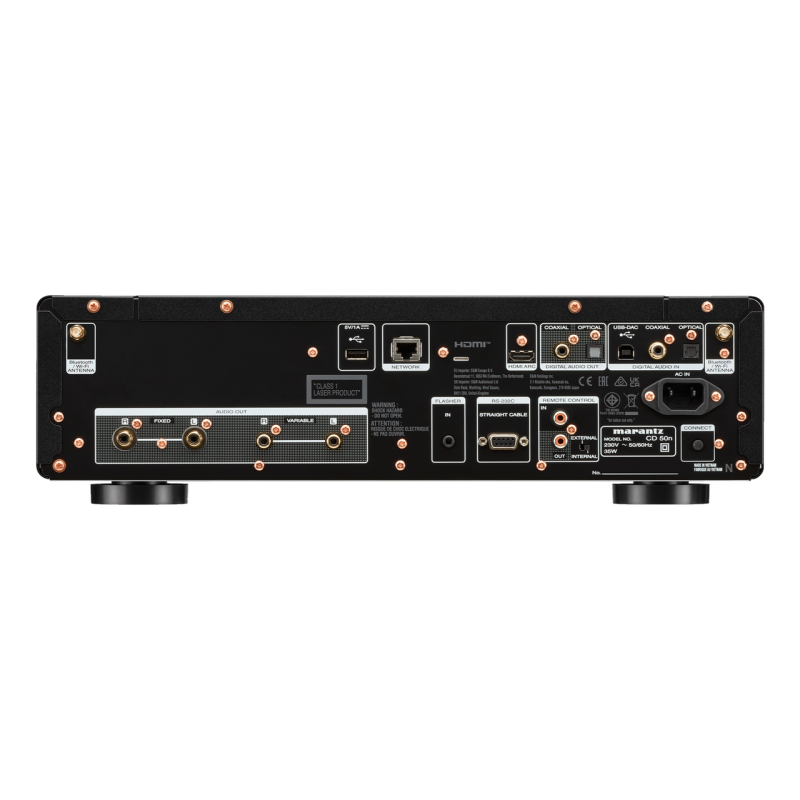
The rear-panel USB Type-B input operates in asynchronous mode, accepting PCM audio up to 192 kHz/24-bit and DSD via DoP at DSD64, DSD128, and DSD256 (up to 11.2 MHz). An ASIO driver is available for Windows. Optical and coaxial digital inputs accept signals up to 192 kHz/24-bit. HDMI ARC accepts audio from a connected television. All digital inputs share the same DAC circuitry, with the signal isolator active in USB DAC mode.
Analogue Outputs and Headphone Stage
Two RCA output pairs are provided: a fixed-level output and a variable output with volume control adjustable via the supplied remote or the HEOS app, allowing direct connection to a power amplifier without a preamplifier. The headphone amplifier provides three output levels — High (200 mW into 32 Ω), Mid (120 mW), and Low (16 mW) — accommodating both sensitive in-ear monitors and demanding headphones. Optical and coaxial digital outputs allow connection to an external DAC or AV receiver.
Network Streaming and Connectivity
HEOS Built-in provides access to Spotify Connect, TIDAL, Deezer, Amazon Music, Qobuz, and TuneIn Internet Radio. AirPlay 2 is supported for streaming from Apple devices, and Bluetooth enables wireless connection from mobile devices. The unit is Roon Tested for integration with Roon music management software. Network streaming supports FLAC and WAV up to 192 kHz/24-bit, ALAC up to 96 kHz/24-bit, DSD, MP3, WMA, and AAC, with gapless playback on FLAC, WAV, and DSD. Connectivity options include dual-band Wi-Fi (2.4 GHz and 5 GHz) and wired Ethernet. Installation integration is supported via RS-232, IP control, D-Bus, and a flasher input.