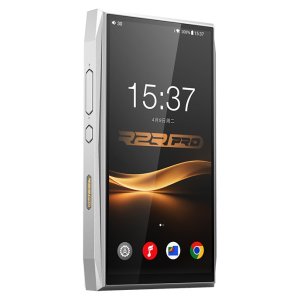

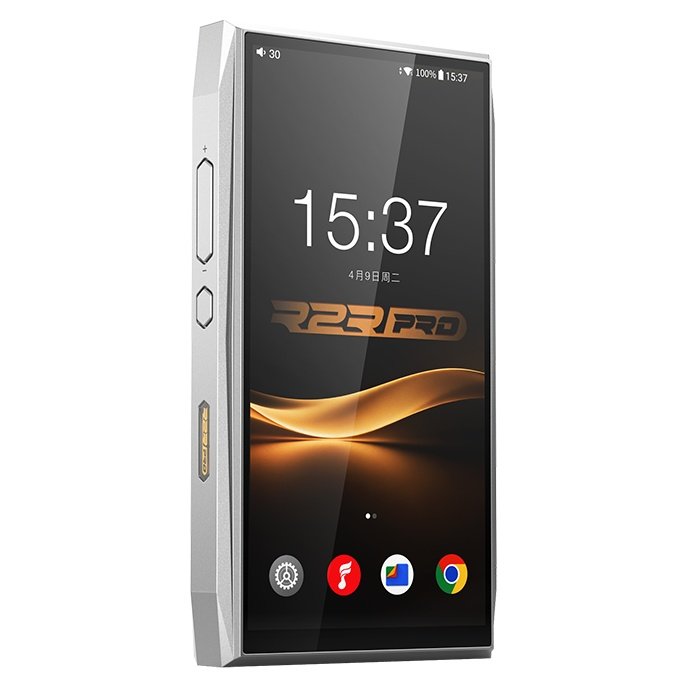
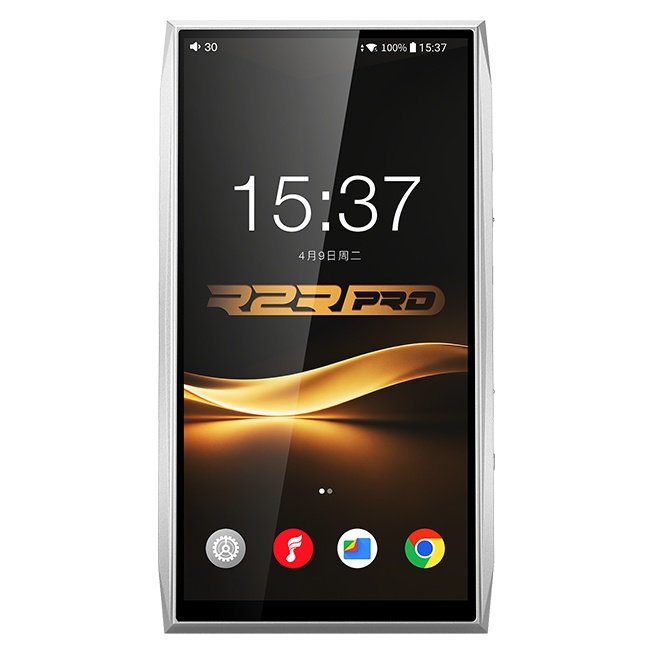

The FiiO M25 R2R is a portable hi-res music player built for listeners who want the natural, analogue-leaning character of a resistor-ladder DAC in a device that also has the power to drive demanding headphones. It is the R2R PRO version of the M25, and sits beneath the flagship M27 in FiiO's player range; a VERITA version built around AKM AK4191EQ and dual AK4499EX DAC chips is sold separately. This listing is for the Silver finish, with Black also available.
R2R PRO Resistor Array
In place of an off-the-shelf DAC chip, the M25 R2R uses a FiiO-developed 24+5-bit segmented R2R PRO resistor array built from 316 high-precision, low-temperature-drift thin-film resistors. The upper five bits are decoded by 31 thermometer-coded resistors, which addresses the error accumulation of a conventional R2R ladder and lowers distortion, while the remaining 24 bits run through the ladder itself. FiiO's aim is to keep the smooth, organic presentation R2R is known for while improving detail, resolution, dynamics and soundstage. A high-capacity FPGA paired with custom dual femtosecond crystal oscillators forms the sixth generation of FiiO's Digital Audio Purification System (DAPS), the same FPGA used in the M27, handling clocking and data with very low jitter. The player can run in a NOS (non-oversampling) PCM output mode, and two sound profiles, Flat and Warm, are selectable from the settings.
Desktop-Class Amplification
The audio path is fully differential from decoding and volume control through to the headphone amplifier, with four independent signal paths throughout. In super high gain mode, available when a fast charger is connected, the 4.4mm balanced output delivers at least 1700mW per channel into 32 ohms and 220mW per channel into 300 ohms. The 3.5mm single-ended output provides 500mW per channel into 32 ohms. Output impedance is below 0.8 ohms balanced and 0.6 ohms single-ended, so sensitive in-ear monitors are as well served as full-size headphones; FiiO recommends loads from 8 to 350 ohms on either output. Four gain settings, a 31-band lossless parametric EQ with AUTO EQ, an ALL TO DSD mode and full MQA decoding are all on board. Multi-stage power purification and zoned multi-rail power supplies keep the analogue stages isolated from digital noise.
Platform and Display
The M25 R2R runs on the Qualcomm Dragonwing QCS6490, an eight-core system-on-chip sharing its architecture with the Snapdragon 778G, with a high-performance A78 core running at up to 2.7GHz. It is paired with 8GB of RAM and 128GB of internal storage (around 112GB available to the user), and a microSD slot accepts cards up to 2TB. Streaming apps, large libraries and background tasks stay responsive. The 5.5-inch fully laminated 1080x2160 display gives plenty of room for album art and library browsing, and the body proportions are tuned so the player is still comfortable to hold and operate one-handed. The chassis uses a diamond-cut, CNC-machined design with multiple facets that catch the light. Retro Pod Mode and Cassette Mode interfaces are included for a more playful way to listen.
Connectivity
Five working modes cover Android, Pure Music, AirPlay, USB DAC and Bluetooth receiving. An independent XMOS XU316 USB controller lets the M25 R2R act as a high-resolution USB DAC for a computer, phone or tablet, supporting PCM up to 768kHz/32-bit and DSD512. Local playback handles the same rates natively, and the 3.5mm socket doubles as a coaxial digital output up to 384kHz/24-bit. Dual-band Wi-Fi supports AirPlay and wireless music transfer, while Bluetooth 5.2 transmits in SBC, aptX, aptX HD, aptX Adaptive, LDAC and LHDC and receives in SBC and LDAC. Both the 3.5mm and 4.4mm sockets also serve as single-ended and balanced line outputs for use with a desktop amplifier or active speakers.
Battery and Charging
A 6500mAh battery gives up to 14.5 hours from the 3.5mm output or 12.5 hours balanced, measured at high gain with the screen off. Two USB-C ports are fitted: a USB 3.0 port for data and charging, and a separate POWER IN port for a dedicated supply when the player is used on a desk. The player supports QC3.0, QC4.0, PD2.0 and PD3.0 PPS fast charging at up to 30W, with a full charge in around 2.5 hours.