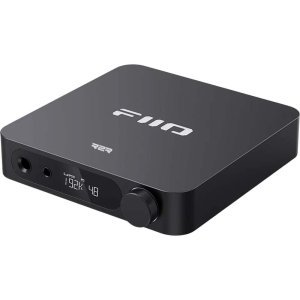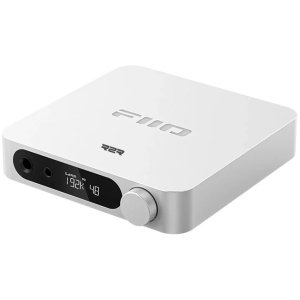

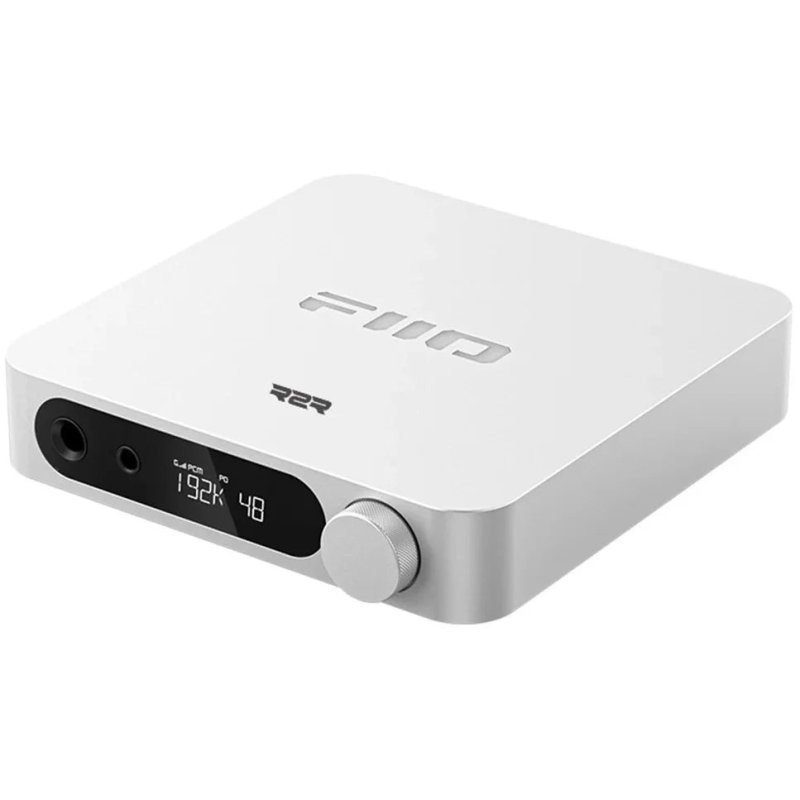

The FiiO K11 R2R sits in the upper tier of FiiO's desktop DAC and amplifier range, positioned above the standard K11 by replacing its delta-sigma chip with a fully differential, self-developed 24-bit R2R resistor-ladder architecture. It is a compact, all-in-one desktop unit that combines digital-to-analogue conversion and headphone amplification in a single chassis, intended for desktop listening from a computer, streamer, or disc player.
R2R DAC Architecture
The conversion stage uses a four-channel fully differential 24-bit R2R ladder DAC developed by FiiO, comprising two sets of 48 precision thin-film resistor arrays per channel, totalling 192 resistors per unit. Each resistor carries a 0.1% tolerance rating and a 30 ppm temperature coefficient. The differential topology lowers noise compared with single-ended ladder implementations and produces fewer FFT harmonics, contributing to what FiiO describes as a darker, quieter musical background.
NOS and OS Modes
The K11 R2R offers two user-selectable decoding modes. NOS (Non-Oversampling) mode decodes audio at its original sample rate, preserving the native character of the recording. OS (Oversampling) mode upsamples all incoming audio to 384 kHz before decoding, which some listeners find produces a smoother, more refined presentation. The choice between modes allows the user to tailor the sound to personal preference.
Supported formats include PCM at up to 384 kHz and 24 bits, and DSD256. DSD decoding requires the source device to be set to Native DSD output mode; the K11 R2R then converts internally to PCM before applying the R2R conversion.
Amplifier Stage and Volume Control
Volume is managed by an NJW1195A four-channel resistor-ladder electronic potentiometer, chosen for its low distortion and low noise characteristics. The analogue output stage uses SGM8262 op-amps for balanced output, with Ti OPA1642 op-amps handling the low-pass filter and single-ended signal conversion stages. Three gain levels and three independent volume curves allow the K11 R2R to be optimised for different headphone sensitivities, from in-ear monitors to high-impedance over-ear headphones.
Balanced output power is rated at 1,300 mW per channel into 32 ohms, and single-ended output at 660 mW into 32 ohms. The output stage includes a dedicated headphone protection circuit and a pop-noise elimination system.
Power Supply
The K11 R2R uses 17 low-noise LDO precision voltage regulators alongside two DC-DC converters, generating separate supply rails at voltages including 9 V, 8 V, 7.5 V, 6 V, 5.4 V, 3.3 V, 1.8 V, and 1.2 V. The unit is powered by an external 12 V switching power supply supplied in the box. High-quality beryl solid capacitors are used throughout the power and signal paths.
Connectivity and Controls
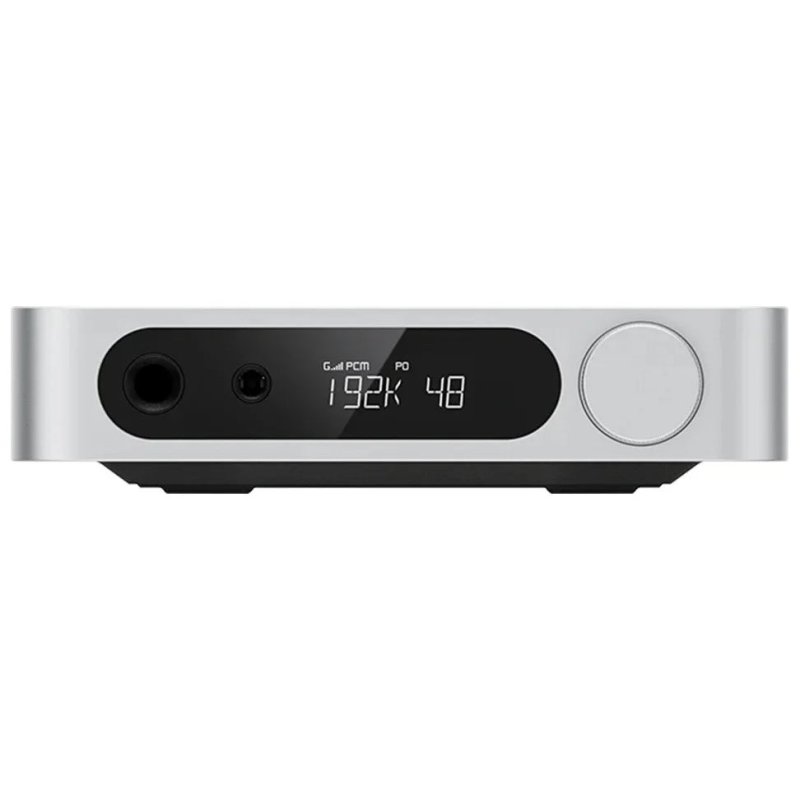
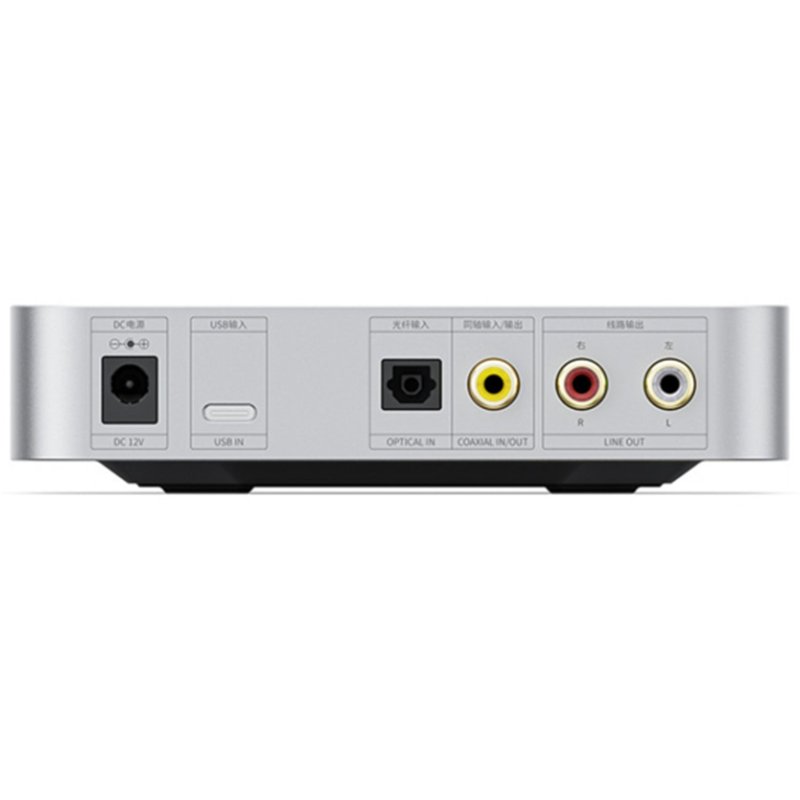
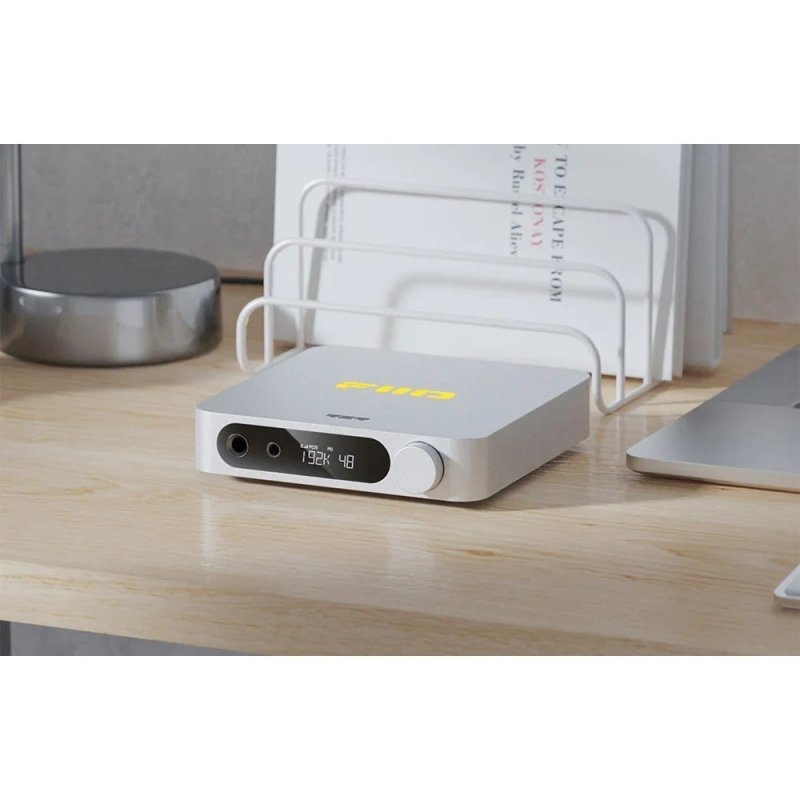
Inputs on the rear panel include USB-C (audio, accepting up to 384 kHz PCM and DSD256), an optical TOSLINK input (up to 96 kHz), and a coaxial RCA digital input and output (up to 192 kHz). The front panel provides a 6.35 mm single-ended headphone socket and a 4.4 mm balanced headphone socket, alongside a custom LCD display showing sample rate, volume level, gain setting, and output mode. The rear panel also carries a pair of RCA analogue line outputs for connection to a power amplifier or integrated amplifier.
A single multi-function rotary knob on the front panel handles power on and off, volume adjustment, menu navigation, and source switching. Double-pressing the knob toggles between Headphone Out, Pre-out (single-ended line), and Line Out modes.
Build and Additional Features
The K11 R2R is finished in an aluminium alloy chassis available in Silver. The FiiO logo on the top panel is backlit with adjustable RGB illumination, with the colour corresponding to the current sample rate. Brightness, colour, and lighting patterns are all adjustable via the volume knob. The unit includes DC output protection, an automatic low-power sleep mode when no signal is detected, a phosphor-copper metal shielding cover, and thermal management via a silicone gel and aluminium alloy heat-dissipation system.