


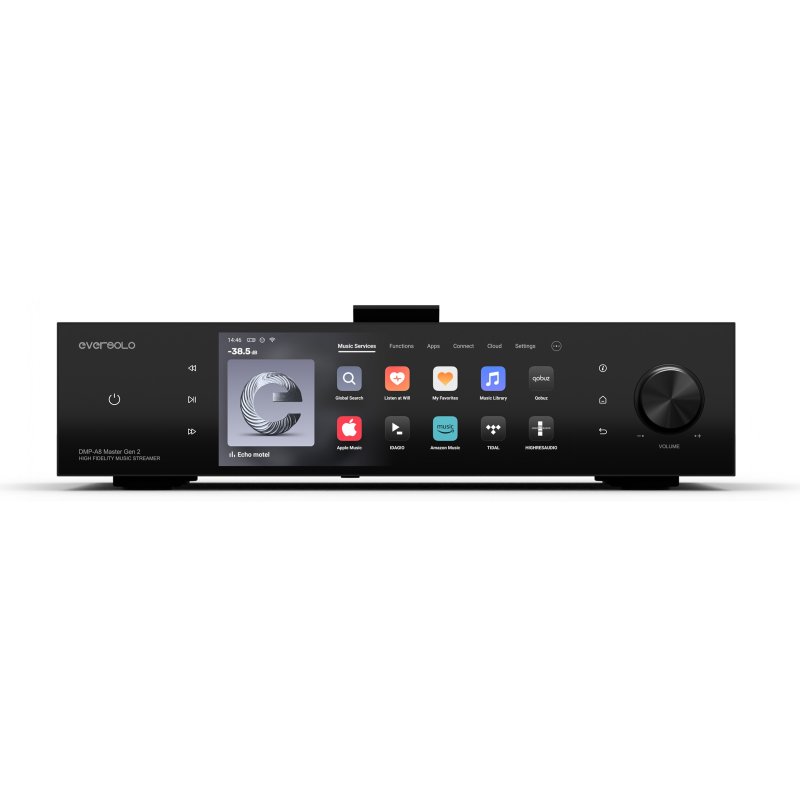
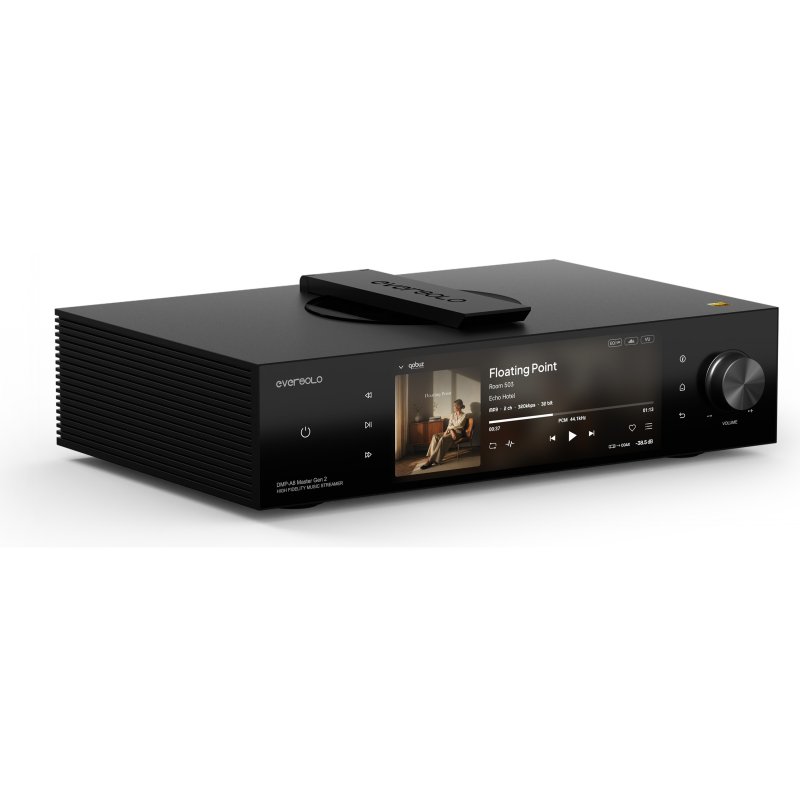

The DMP-A8 Master Gen 2 is the flagship of EverSolo's DMP-A8 Gen 2 range, sitting above the standard DMP-A8 Gen 2 by adding a built-in CD transport, an oven-controlled master clock and a 10MHz external clock input. It brings network streaming, a flagship AKM digital-to-analogue conversion stage, CD playback and ripping, and a fully balanced analogue preamplifier together in one aerospace-grade aluminium chassis, so it can serve as the only source and volume control ahead of a power amplifier or a pair of active speakers.
What the Master Edition Adds
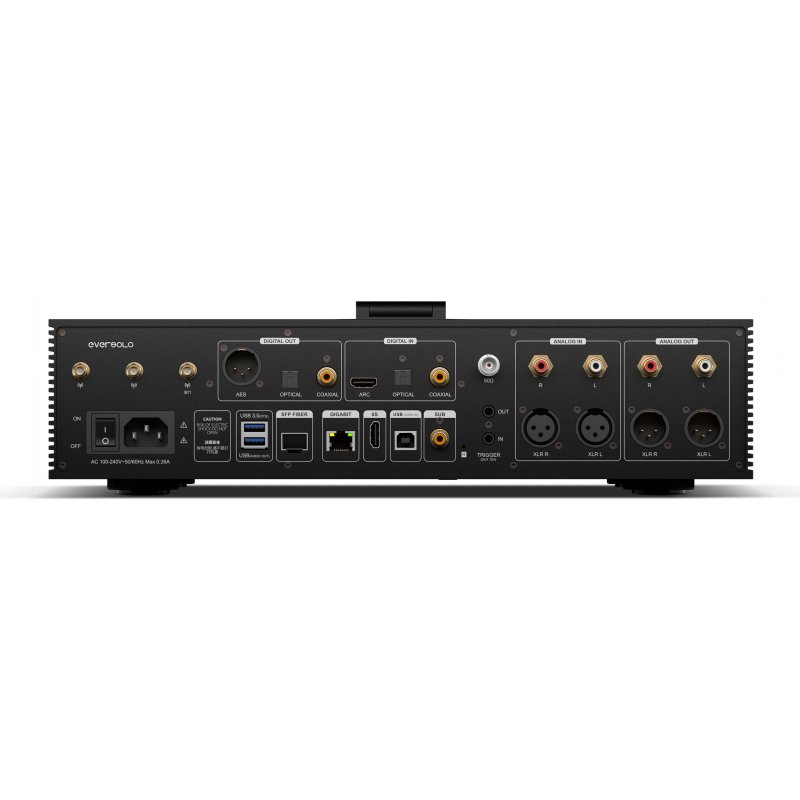
Three things separate the Master Gen 2 from the standard DMP-A8 Gen 2. First, a custom CD playback system is built into the chassis, so discs can be played and ripped directly rather than through an external USB drive. Second, the audio clocks run from a low phase noise OCXO (oven-controlled crystal oscillator) that holds the oscillator at a stable operating temperature to limit frequency drift, with jitter quoted below 50fs. Third, a 50 ohm BNC socket accepts a 10MHz adaptive external clock input for integration with a separate master clock. The chassis that houses the disc mechanism stands 98.5mm tall against 88mm for the standard model, and the unit weighs 6kg.
Digital Conversion and Analogue Stage
Conversion uses the AKM Velvet Sound pairing of AK4191EQ and AK4499EXEQ, the AK4191EQ handling digital processing while the AK4499EXEQ performs D/A conversion. OPA1612 operational amplifiers are used in the analogue stage. Volume is set in the analogue domain by a high-precision R-2R resistor ladder rather than by digital attenuation, and the analogue inputs feed a preamplifier circuit offering up to 10dB of gain. A dual power supply separates the linear analogue and digital sections, the linear supply quoted at a 20uV noise floor. EverSolo quotes 0.000075% THD+N from the balanced outputs, with dynamic range and signal to noise ratio both above 129dB.
CD Playback and Ripping
The custom disc system is optimised for audio use, with high-precision error correction to reduce read errors and interference. Ripping automatically retrieves album artwork, track information and metadata, with intelligent error correction and duplicate detection to prevent repeated imports. Ripped discs sit in the local library alongside network and streaming sources.
Streaming and Library
Native integrations cover TIDAL, Qobuz, Apple Music, Amazon Music, Deezer, HIGHRESAUDIO, IDAGIO, Presto Music, SoundCloud, Calm Radio, TuneIn and Radio Paradise, and the unit accepts Spotify Connect Lossless, TIDAL Connect, Qobuz Connect, DLNA and Network Audio Adapter streams. SMB, NFS and WebDAV support connects it to a NAS or home server, and an internal M.2 NVMe PCIe 3.0 slot takes a 2280 drive of up to 8TB for a built-in library. The proprietary EOS audio engine bypasses Android sample-rate conversion for a bit-perfect path, and 8GB of DDR5 memory with 64GB of eMMC storage back an octa-core ARM processor.
Connectivity
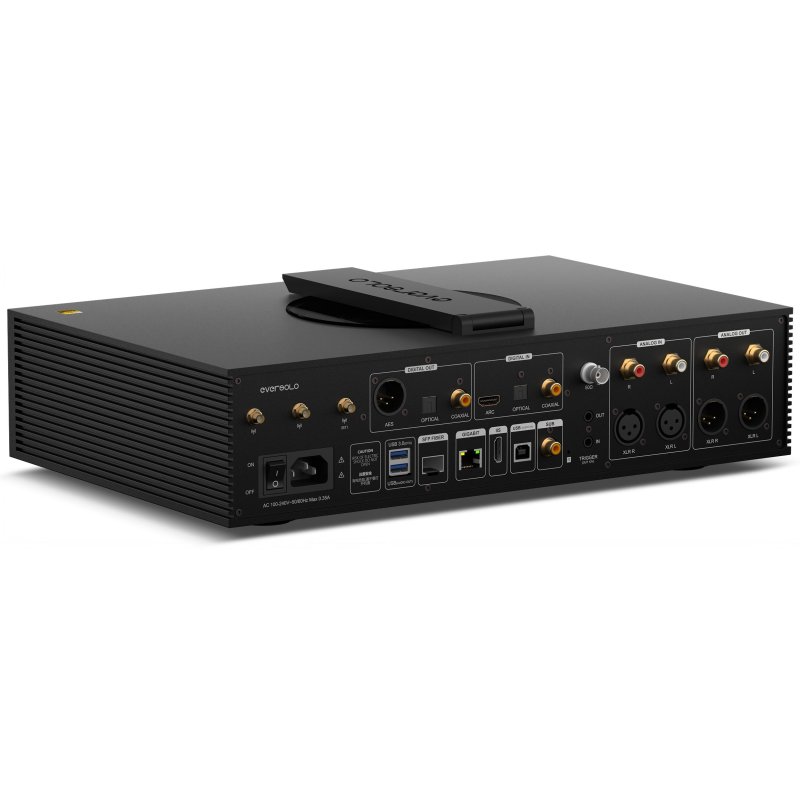
Digital inputs comprise HDMI ARC/eARC, optical and coaxial, joined by USB-B audio in and two USB 3.0 ports. Digital outputs cover AES/EBU on XLR, optical, coaxial, USB audio and an I2S port with eight selectable pin configurations. Analogue connections run to balanced XLR and single-ended RCA on both input and output, plus a dedicated subwoofer output and a 12V trigger in and out. Networking is by Gigabit Ethernet, dual-band Wi-Fi 6 or a dedicated SFP fibre port for galvanically isolated network feeds, with Bluetooth 5.4 handled by a Qualcomm QCC3095 module.
Display, Control and Room Correction
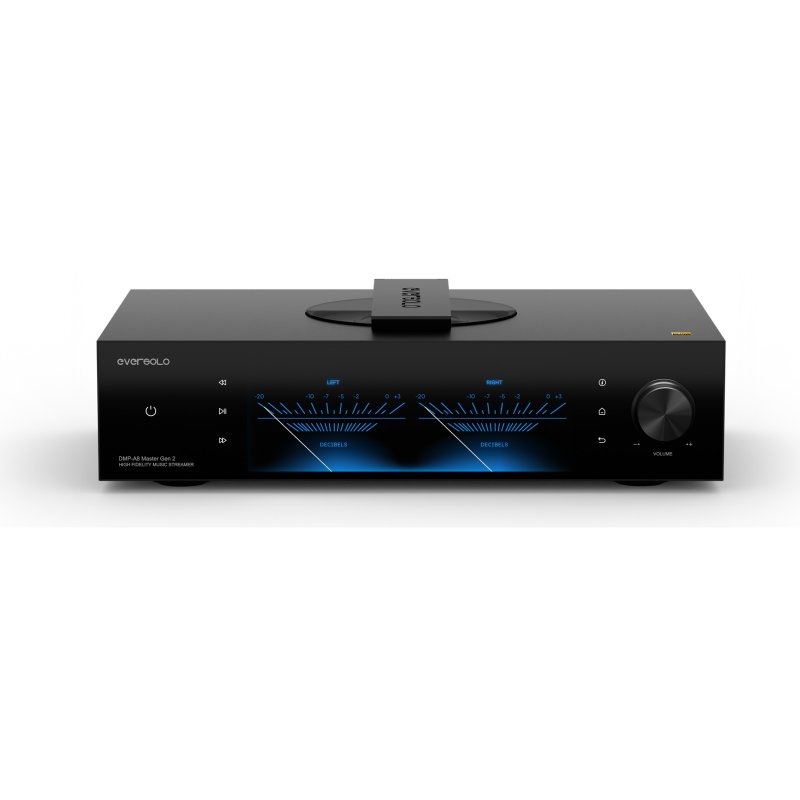
An 8.6-inch LCD touchscreen fronts the unit, switching between playback information, VU meters and spectrum visualisations. Control is by the screen itself, the supplied dual-mode Bluetooth and infrared alloy remote, or the EverSolo Control app on phone, tablet, web and TV. On-board processing includes a 20-band parametric equaliser with FIR filter import, loudness and dynamic range compression, and the evotune PRO room correction system, which combines DRC-based modelling with FIR filtering to address frequency, timing and spatial behaviour in the room.