


- "It's simply as capable a DAC/preamp/headphone amp as this sort of money can buy." TechRadar ★★★★★ (February 2026)
- Editor's Choice, TechRadar (2026)
- "It's a brilliant bit of reference kit and will do well in many systems." Hifi Pig (December 2025)
EverSolo DAC-Z10 DAC & Preamplifier
♻️
Trade In and Pay Less
Trade your existing kit toward this purchase

- AK4191 and AK4499 DAC pair for each channel
- Analogue R2R volume control, fully balanced preamp
- IIS, HDMI eARC, AES/EBU, coaxial, optical and USB inputs
Awards & Reviews
Videos
Description
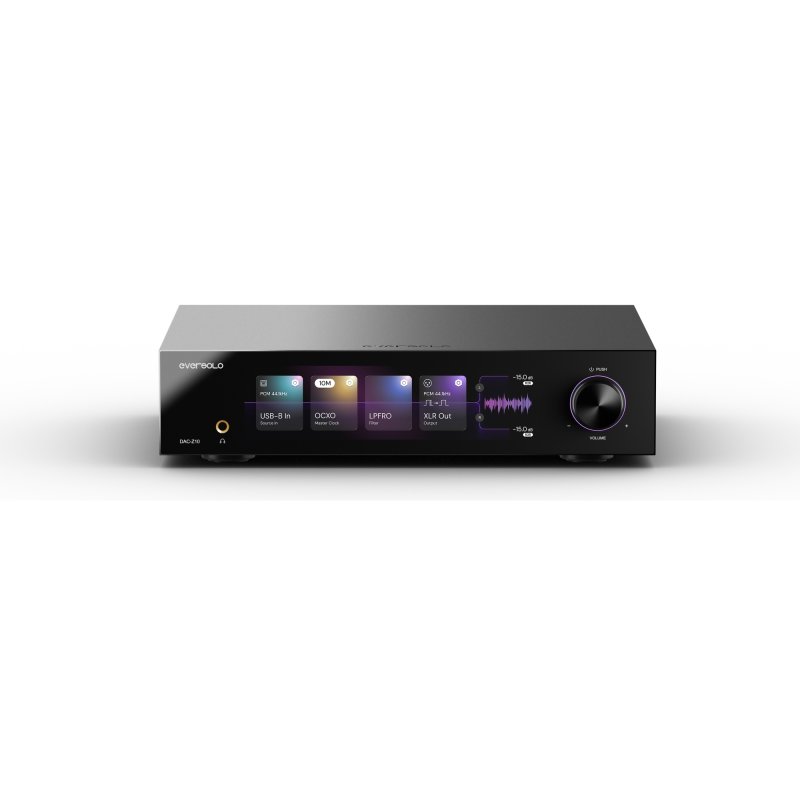
The DAC-Z10 is EverSolo's flagship standalone digital-to-analogue converter, and the first model in a dedicated DAC series that sits alongside the DMP streamer range rather than within it. Where the DMP-A8 and DMP-A10 combine streaming, storage and conversion in one box, the DAC-Z10 leaves networking out entirely and puts the whole budget into conversion, clocking, power supply and analogue output. It is a DAC, a fully balanced preamplifier and a discrete headphone amplifier in a single aluminium chassis, intended to sit between a separate transport or streamer and a power amplifier or active speakers.
Digital Conversion
EverSolo has given each stereo channel its own pair of AKM converters, an AK4191 modulator working with an AK4499 digital-to-analogue stage, so left and right signals stay separate from input through to conversion. Over USB Type-B and the IIS input the DAC-Z10 handles PCM up to 32-bit/768kHz and DSD512; the coaxial, optical and AES/EBU inputs accept PCM up to 24-bit/192kHz along with DSD64 over DoP. Six selectable digital filters are available per input, and analogue gain is handled by OPA1612 op-amps.
Fully Isolated Architecture
The chassis is built around what EverSolo calls its Fully Isolated Architecture, which separates the digital and analogue domains onto individual boards with their own power. Three independent ultra-low-noise linear power supplies feed the left channel, the right channel and the system circuitry separately, so each section works in its own quiet environment rather than sharing a single rail.
Clocking
Timing is handled by an oven-controlled crystal oscillator (OCXO) working with phase-locked loop correction, and a built-in FPGA reshapes IIS data and reconstructs the clock before the signal reaches the converters. For systems that already run a master clock, there are BNC external clock inputs accepting 10MHz and 25MHz references at either 50 Ohms or 75 Ohms impedance.
Preamplifier and Headphone Output
Volume is set in the analogue domain by a precision dual-channel R2R resistor ladder, one network per channel, which keeps the signal intact at low listening levels as well as high. The fully balanced preamplifier stage also accepts XLR and RCA analogue inputs with up to 10dB of gain, and the XLR sockets have switchable polarity for easier system matching. On the front panel, a dedicated 6.35mm headphone amplifier module detects headphone impedance automatically and selects low, medium or high gain to suit, delivering 1W into 16 Ohms and 32 Ohms in high gain mode.
Connectivity
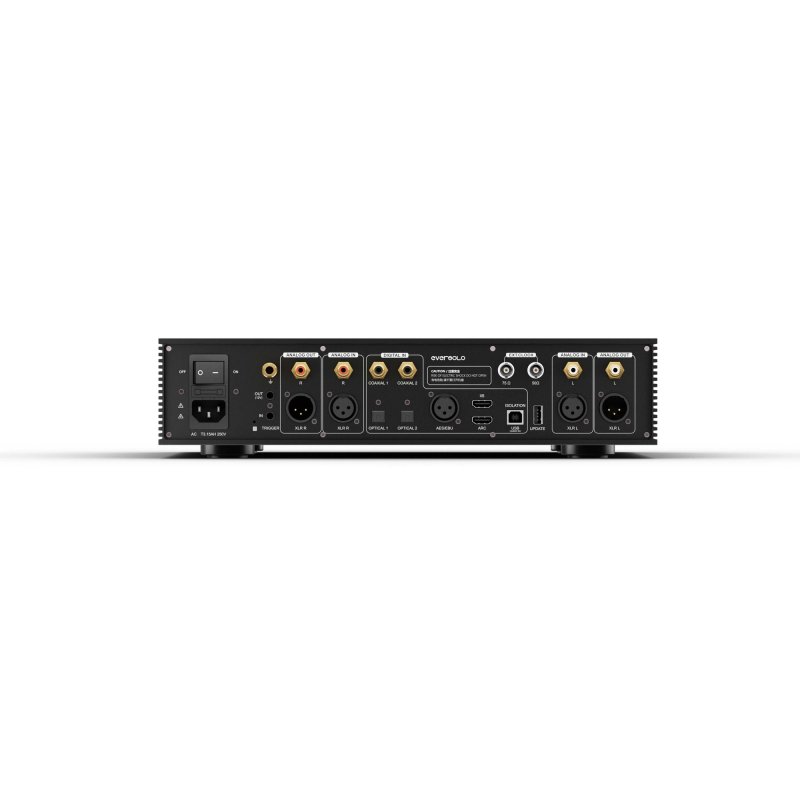
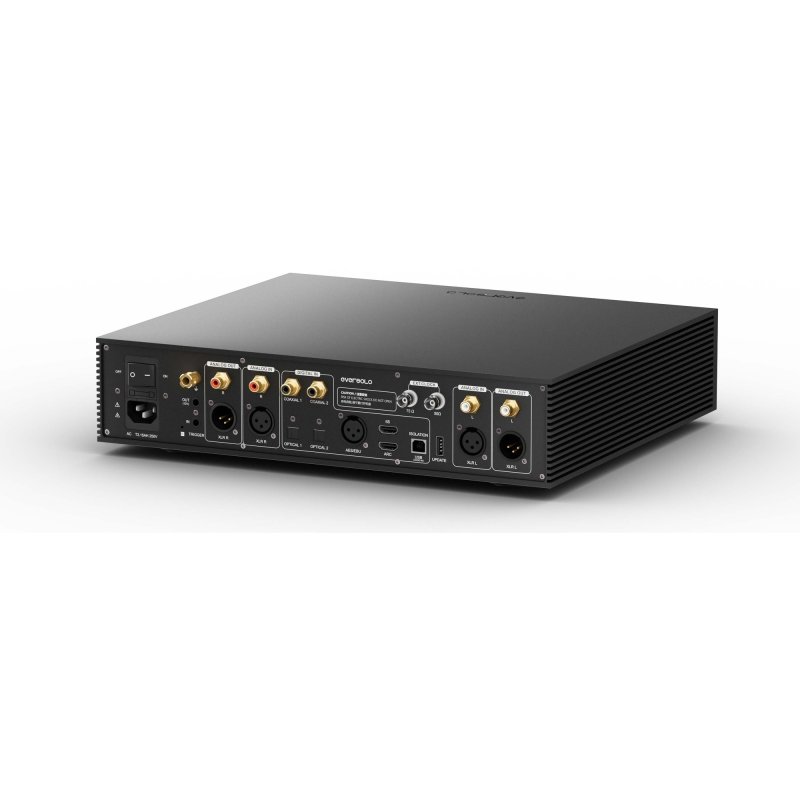
Digital inputs run to two coaxial, two optical, AES/EBU on XLR, an IIS input over HDMI with eight switchable pin configurations, an HDMI input switchable between ARC and eARC for television sound, and an isolated USB Type-B audio input. A Qualcomm QCC5125 Bluetooth 5.0 module adds wireless input with SBC and AAC support. Outputs are balanced XLR and single-ended RCA pre-outs. A rear grounding post, a 12V trigger input and output and a separate USB port for firmware updates complete the panel.
Control and Display
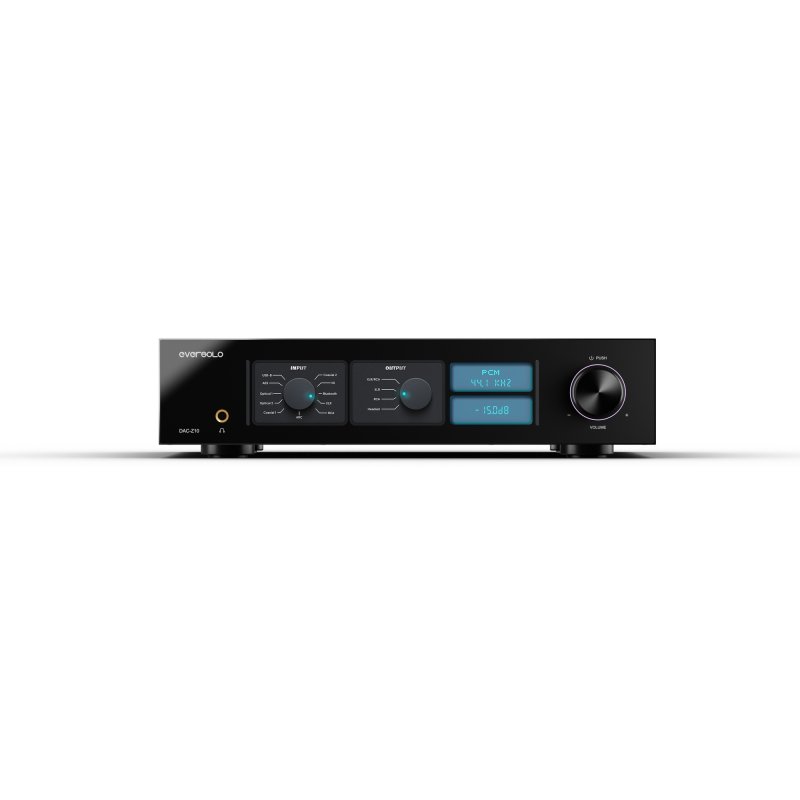
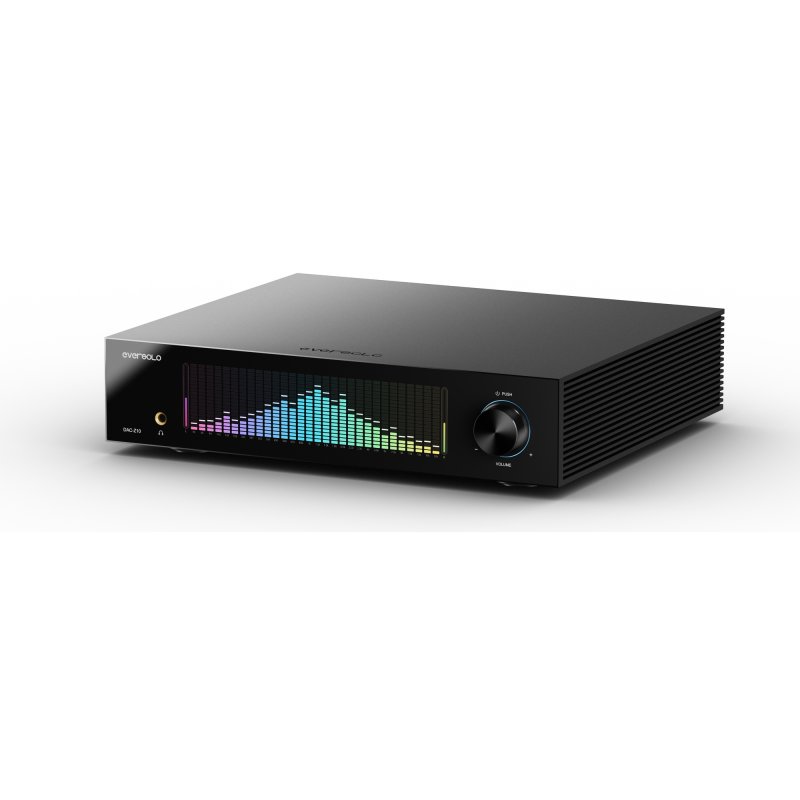
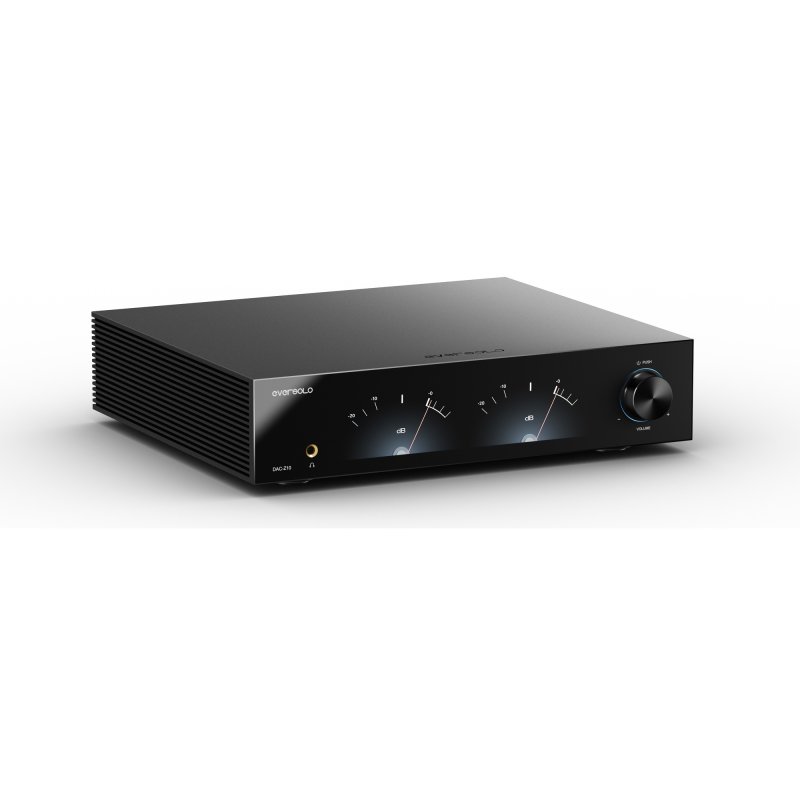
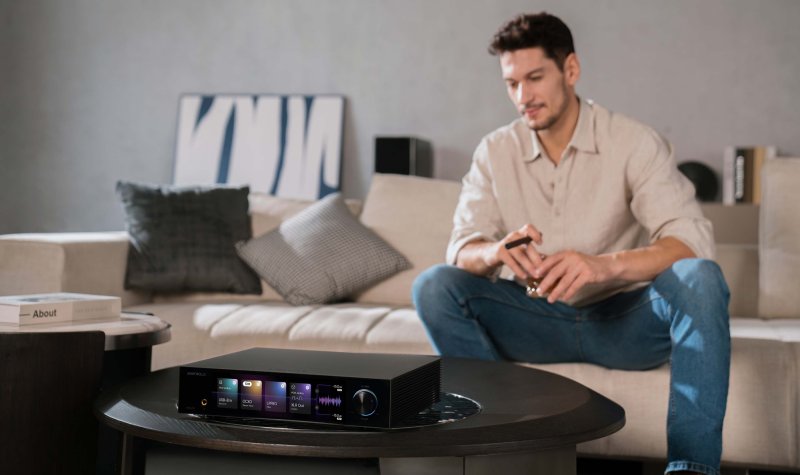
An 8.8-inch IPS touchscreen fills most of the fascia and can be set to show signal routing, virtual VU meters or a spectrum analyser, with an auto screen-off timer for use alongside a television. The volume knob doubles as the power control and its illuminated ring can be set to a range of colours. A supplied remote handset and the EverSolo Control app for iOS and Android, which connects over Bluetooth, provide the alternative control routes.
Specification
| Type | DAC, Preamplifier and Headphone Amplifier |
|---|---|
| DAC | AK4191 + AK4499 per channel (one pair for left, one pair for right) |
| Main Processor | DCP8568 |
| Op-Amp | OPA1612 |
| Volume Control | Dual-channel R2R resistor ladder, analogue domain |
| PCM Support | Up to 32-bit / 768kHz (USB-B and IIS) |
| DSD Support | DSD512 (USB-B and IIS) |
| Coaxial / Optical / AES-EBU Support | Up to 24-bit / 192kHz PCM, DSD64 DoP |
| HDMI ARC Support | Up to 24-bit / 192kHz PCM |
| Clock | OCXO with phase-locked loop and FPGA clock reconstruction |
| External Clock Input | 10MHz / 25MHz, 50 Ohms or 75 Ohms impedance |
| Power Supply Design | Three independent ultra-low-noise linear supplies (left, right, system) |
| Digital Inputs | 2x coaxial, 2x optical, AES/EBU, IIS (HDMI), HDMI ARC/eARC, USB Type-B |
| Bluetooth | Qualcomm QCC5125, Bluetooth 5.0, SBC and AAC |
| Analogue Inputs | XLR (balanced), RCA |
| Analogue Outputs | Pre-out: XLR (balanced), RCA |
| Headphone Output | 6.35mm single-ended, low / medium / high gain |
| Headphone Power (High Gain) | 1W into 16 Ohms, 1W into 32 Ohms, 0.16W into 300 Ohms |
| Recommended Headphone Impedance | 16 to 300 Ohms |
| XLR Output Level | 5Vrms @ 0dBFS |
| RCA Output Level | 2.5Vrms @ 0dBFS |
| Signal to Noise Ratio (XLR) | 130dB A-weighted |
| THD+N (XLR) | 0.00008% @ 1kHz |
| Frequency Response | 20Hz to 20kHz (+/-0.1dB) |
| Display | 8.8-inch IPS touchscreen |
| Chassis | Aluminium alloy |
| Control | Touchscreen, knob, remote control, mobile app over Bluetooth |
| Power Supply | AC 100 to 240V, 50/60Hz |
| Power Consumption | 32W |
| Dimensions (W x H x D) | 31 x 7.8 x 36.5 cm (excluding feet) |
| In the Box | Remote control, power cable, USB cable, USB drive for firmware upgrade, trigger cable, polishing cloth, user manual |