
The Denon AVC-X4700H is the mid-range model in Denon's 2020 AV amplifier lineup, sitting above the AVC-X3700H and below the eleven-channel AVC-X6700H. It offers nine channels of discrete amplification with processing for up to 11.2 channels, full support for Dolby Atmos, DTS:X, Auro-3D and IMAX Enhanced, and an HDMI section that includes 8K/60 Hz and 4K/120 Hz passthrough. Denon's AVC designation denotes the European and UK variant; it is functionally identical to the North American AVR-X4700H but carries a different model number and a 230 V power supply. It was succeeded by the AVC-X4800H in 2022.
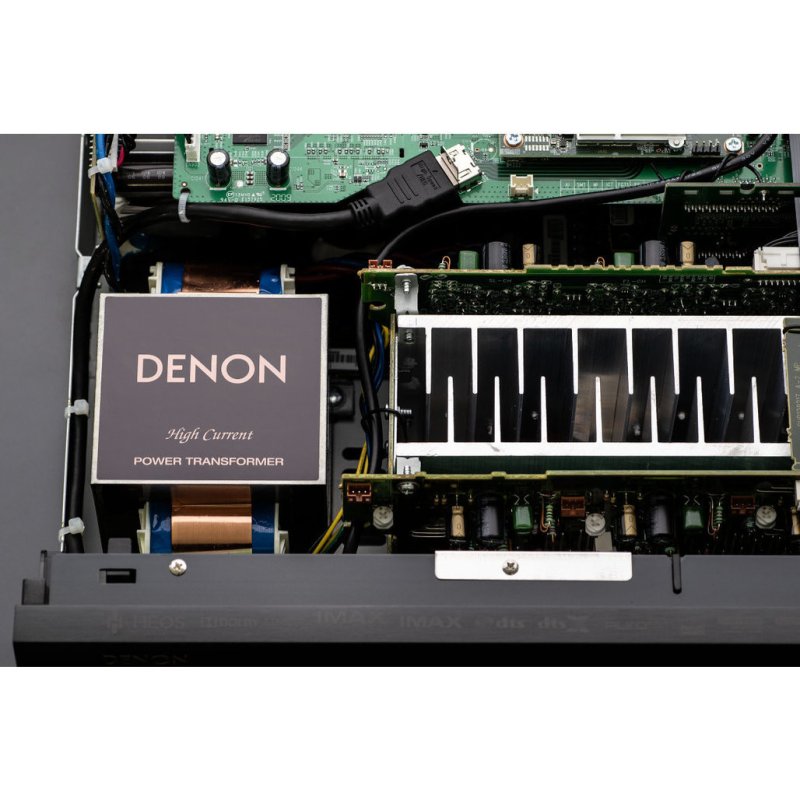
The AVC-X4700H uses nine identical discrete high-current amplifier channels, each rated at 125 watts into 8 Ω (20 Hz – 20 kHz, 0.05% THD, two channels driven). Single-channel output at 6 Ω reaches 200 watts (1 kHz, 1% THD). The discrete topology means each channel has its own dedicated output stage rather than sharing a monolithic amplifier IC — an approach that improves channel separation and allows each amplifier to deliver current independently, which matters when driving complex multi-driver loudspeakers at high levels simultaneously. Speaker impedances from 4 to 16 Ω are supported, giving flexibility across a wide range of loudspeakers.
Digital signal processing is handled by two dual-core Griffin Lite SHARC DSPs — the same platform used in Denon's flagship AVC-X8500H — delivering a combined processing power of 10.8 billion floating-point operations per second. This underpins all decoding, bass management, room correction, and upmixing functions. Digital-to-analogue conversion uses an AKM AK4458VN DAC capable of 384 kHz / 32-bit resolution, deployed across all channels. Denon's proprietary D.D.S.C. HD Digital (32-bit) processing and AL32 Multichannel Alpha Processing handle signal upsampling and interpolation, while a dedicated clock jitter reducer minimises timing errors in the digital path.
The AVC-X4700H decodes all current immersive audio formats. Dolby Atmos is supported up to 7.1.4 with external amplification (5.1.4 or 7.1.2 using the internal nine channels alone), alongside Dolby TrueHD, Dolby Digital Plus, and the Dolby Surround upmixer for legacy content. Dolby Atmos Height Virtualisation is included for systems without physical height speakers — it uses psychoacoustic processing to simulate overhead effects from ear-level drivers, though physical ceiling or up-firing speakers will always produce a more convincing result.
DTS:X is likewise supported up to 7.1.4, with DTS Neural:X upmixing, DTS Virtual:X for virtualised height and surround effects, and DTS-HD Master Audio decoding. Auro-3D support — a distinguishing feature over the less expensive AVC-X3700H, which lacks it — adds a further immersive format with the Auro-Matic upmixer for non-native content. IMAX Enhanced certification rounds out the format support, enabling automatic detection and optimised playback of IMAX Enhanced content.
The HDMI section comprises eight inputs and three outputs. One input and two main-zone outputs are HDMI 2.1, supporting 8K/60 Hz and 4K/120 Hz passthrough with 4:4:4 colour subsampling. The remaining seven inputs are HDMI 2.0b. Early production units were affected by a bug in the HDMI 2.1 chipset; units manufactured from May 2021 onward use a corrected chipset, and Denon offered a free hardware remediation for earlier units. All ports support HDCP 2.3.
HDR format support is comprehensive: HDR10, HDR10+, Dolby Vision, Dynamic HDR, and Hybrid Log-Gamma are all passed through. The 8K-capable input also supports gaming features including Auto Low Latency Mode (ALLM), Variable Refresh Rate (VRR), and Quick Frame Transport (QFT). Enhanced Audio Return Channel (eARC) on the main HDMI output allows the television to send lossless Dolby Atmos and DTS:X bitstreams back to the receiver without a separate optical or coaxial connection. An 8K upscaler processes lower-resolution HDMI and analogue video sources up to 8K resolution.
A front-panel HDMI input sits behind a drop-down flap — a convenience feature absent from the AVC-X3700H below. Legacy analogue video connectivity includes three composite and two component video inputs, with one of each as outputs. The AVC-X4700H can upconvert composite and component video to HDMI, a useful feature for older source equipment.
Room correction uses Audyssey MultEQ XT32, the top tier of Audyssey's consumer technology. It measures the room's acoustic response at up to eight microphone positions and applies correction filters across the full frequency range with high resolution — 512 filter taps in the bass region, where room modes cause the most significant problems. Dynamic EQ adjusts the frequency response at lower listening volumes to compensate for the ear's reduced sensitivity to bass and treble (the Fletcher-Munson effect), while Dynamic Volume manages sudden level jumps between programme material and advertisements. Low Frequency Containment (LFC) reduces bass energy that might otherwise transmit through walls — useful for shared or semi-detached properties. The optional Audyssey MultEQ Editor app provides more granular control over target curves and individual filter adjustment.
Control options include the HEOS app for iOS and Android (which also integrates with the HEOS multi-room ecosystem), Denon's own remote app, Amazon Alexa, Google Assistant, Apple Siri via AirPlay 2, IP control, RS-232, and the included RC-1240 remote control. Two 12-volt trigger outputs and IR in/out connections support custom installation scenarios.
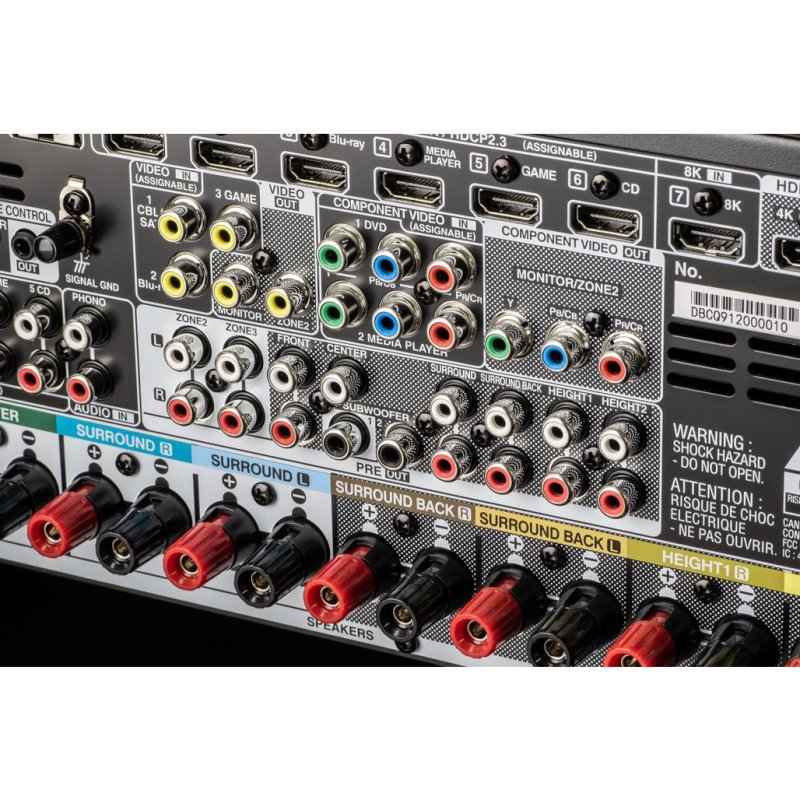
Audio inputs include six analogue stereo RCA line-level connections, a grounded MM phono input for turntables, two optical TOSLINK, and two coaxial digital inputs. The phono stage saves the cost and shelf space of a separate phono preamplifier for casual vinyl listening, though a dedicated external stage will typically outperform a built-in circuit in a receiver of this class. A 6.3 mm headphone output is provided on the front panel. Full 11.2-channel pre-outs allow connection of external power amplification — necessary to reach the maximum 7.2.4 Atmos configuration since only nine amplifier channels are built in, but also useful for upgrading front-channel amplification with a dedicated power amplifier.
Network connectivity includes dual-band Wi-Fi (2.4 GHz / 5 GHz, 802.11 a/b/g/n), Bluetooth 4.2 (with headphone transmission for private listening), and 100BASE-TX Ethernet. Streaming services accessible through HEOS include Spotify, Tidal, Deezer, Amazon Music HD, and TuneIn Internet Radio, alongside local network playback of FLAC, WAV, ALAC, and DSD files up to 5.6 MHz via USB or 2.8 MHz via HDMI. AirPlay 2 provides native Apple device streaming with multi-room capability.
Three zones are supported. Zone 2 offers HDMI video output, component and composite video outputs, powered speaker terminals or pre-outs, and can receive audio from HDMI, digital, analogue, and network sources. Zone 3 provides pre-outs for an external amplifier. Using Zone 2 or Zone 3 with powered speaker outputs reduces the main zone to seven channels, since two amplifier channels are reassigned. The All Zone Stereo function can distribute the main zone's audio across all three zones simultaneously.
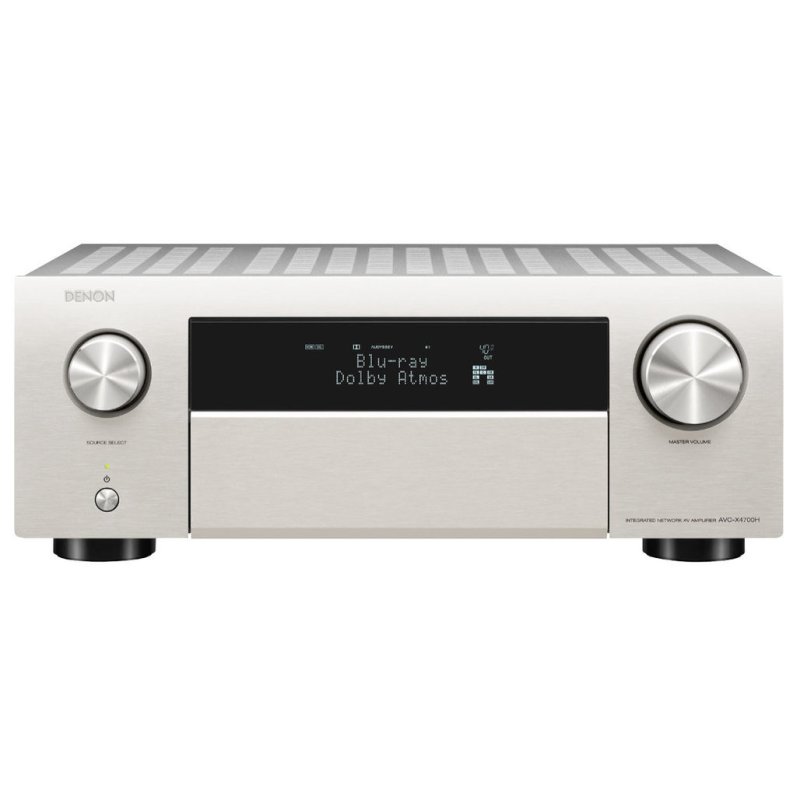
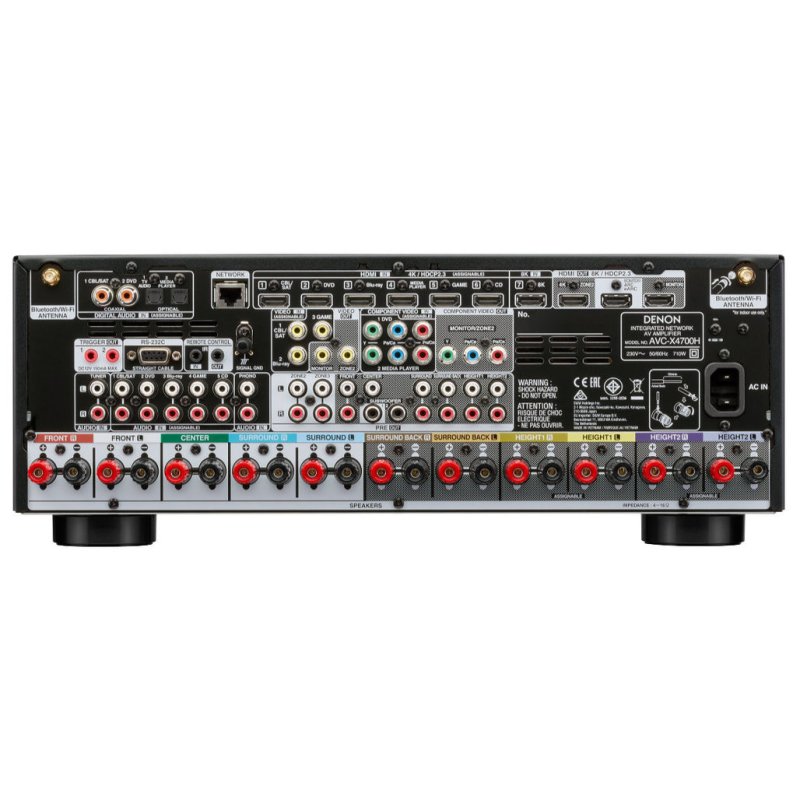
The chassis features a solid aluminium front panel with a brushed metal matte finish, a double-layered base, and stabilised high-density feet to reduce microphonic vibration. The front panel is clean, with only a power button visible; setup buttons, the front HDMI input, USB port, headphone jack, and Audyssey microphone connector are behind the drop-down flap. A two-line display sits between the large input selector and volume dials. The rear panel accommodates eleven pairs of colour-coded speaker binding posts, allowing flexible configuration without rewiring when switching between speaker layouts.
| Type | 9.2-channel integrated network AV amplifier (11.2-channel processing) |
| Amplifier Channels | 9 (discrete, high-current) |
| Power Output (2 ch driven) | 125 W per channel (8 Ω, 20 Hz – 20 kHz, 0.05% THD) |
| Power Output (1 ch driven) | 200 W per channel (6 Ω, 1 kHz, 1% THD) |
| Speaker Impedance | 4–16 Ω |
| Frequency Response | 10 Hz – 100 kHz (+1 / −3 dB, Direct mode) |
| DSP | 2 × dual-core Griffin Lite SHARC (10.8 GFLOPS combined) |
| DAC | AKM AK4458VN (384 kHz / 32-bit) |
| Signal Processing | D.D.S.C. HD Digital (32-bit); AL32 Multichannel; Clock Jitter Reducer |
| Surround Formats | Dolby Atmos (up to 7.1.4), Dolby TrueHD, Dolby Digital Plus, Dolby Surround, Dolby Atmos Height Virtualisation; DTS:X (up to 7.1.4), DTS-HD Master Audio, DTS Neural:X, DTS Virtual:X; Auro-3D with Auro-Matic; IMAX Enhanced |
| Room Correction | Audyssey MultEQ XT32 (with Dynamic EQ, Dynamic Volume, LFC, Sub EQ HT) |
| HDMI Inputs | 8 (1 × HDMI 2.1, 7 × HDMI 2.0b) + 1 front-panel |
| HDMI Outputs | 3 (2 × 8K main zone, 1 × 4K Zone 2) |
| HDMI Features | 8K/60 Hz & 4K/120 Hz passthrough (4:4:4); eARC; HDCP 2.3; ALLM; VRR; QFT |
| HDR Support | HDR10, HDR10+, Dolby Vision, Dynamic HDR, HLG |
| Video Upscaling | Up to 8K (HDMI & analogue sources); analogue-to-HDMI upconversion |
| Analogue Audio Inputs | 6 × stereo RCA line; 1 × phono (MM, grounded) |
| Digital Audio Inputs | 2 × optical TOSLINK; 2 × coaxial |
| Pre-Outs | 11.2-channel RCA |
| Legacy Video Inputs | 3 × composite; 2 × component |
| Legacy Video Outputs | 1 × composite; 1 × component |
| Front-Panel Connections | HDMI input; USB-A; 6.3 mm headphone output; Audyssey microphone input |
| Speaker Terminals | 11 pairs (colour-coded, assignable) |
| Network | Wi-Fi (2.4 GHz / 5 GHz, 802.11 a/b/g/n); Bluetooth 4.2 (SBC, with headphone TX); 100BASE-TX Ethernet |
| Streaming & Voice | HEOS Built-in; AirPlay 2; Spotify; Tidal; Deezer; Amazon Music HD; TuneIn; Amazon Alexa; Google Assistant; Apple Siri |
| Hi-Res Audio | FLAC, WAV, ALAC up to 192 kHz / 24-bit; DSD 2.8 / 5.6 MHz (USB), 2.8 MHz (HDMI) |
| Multi-Zone | 3 zones (Zone 2: HDMI, component, composite, powered or pre-out; Zone 3: powered or pre-out) |
| Control | RS-232; IP; 2 × 12 V trigger; IR in/out; HEOS app; Denon remote app |
| Dimensions | 434 × 167 × 389 mm (17.1 × 6.6 × 15.3 in); with antenna: 434 × 236 × 389 mm |
| Weight | 13.7 kg (30.2 lb) |
| Power Consumption | 710 W (max); 0.1 W (standby) |
| Finish | Black (brushed aluminium front panel) |
The Denon AVC-X4700H is the mid-range model in Denon's 2020 AV amplifier lineup, sitting above the AVC-X3700H and below the eleven-channel AVC-X6700H. It offers nine channels of discrete amplification with processing for up to 11.2 channels, full support for Dolby Atmos, DTS:X, Auro-3D and IMAX Enhanced, and an HDMI section that includes 8K/60 Hz and 4K/120 Hz passthrough. Denon's AVC designation denotes the European and UK variant; it is functionally identical to the North American AVR-X4700H but carries a different model number and a 230 V power supply. It was succeeded by the AVC-X4800H in 2022.
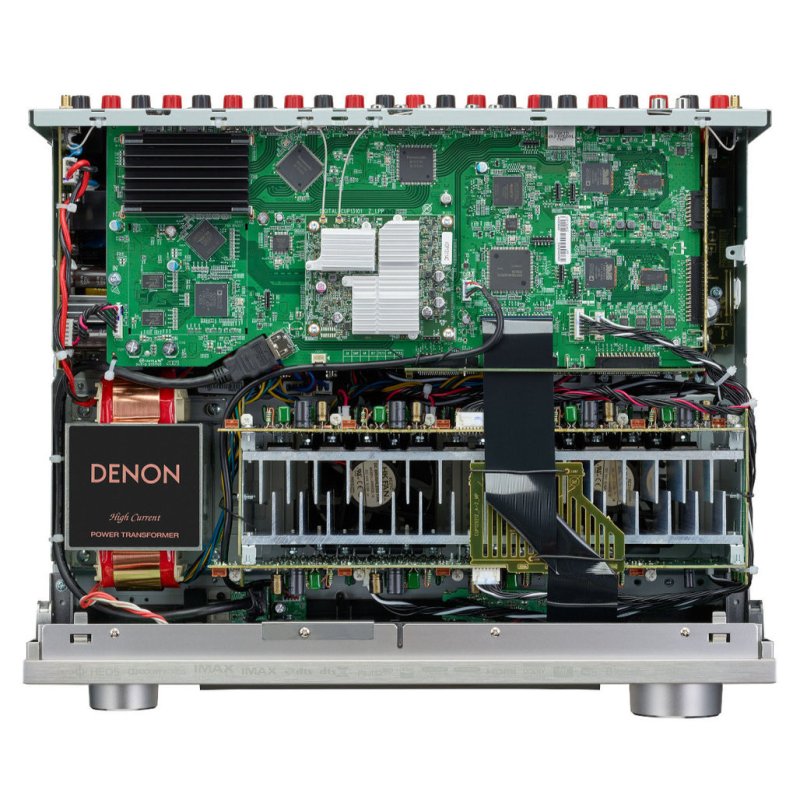
The AVC-X4700H uses nine identical discrete high-current amplifier channels, each rated at 125 watts into 8 Ω (20 Hz – 20 kHz, 0.05% THD, two channels driven). Single-channel output at 6 Ω reaches 200 watts (1 kHz, 1% THD). The discrete topology means each channel has its own dedicated output stage rather than sharing a monolithic amplifier IC — an approach that improves channel separation and allows each amplifier to deliver current independently, which matters when driving complex multi-driver loudspeakers at high levels simultaneously. Speaker impedances from 4 to 16 Ω are supported, giving flexibility across a wide range of loudspeakers.
Digital signal processing is handled by two dual-core Griffin Lite SHARC DSPs — the same platform used in Denon's flagship AVC-X8500H — delivering a combined processing power of 10.8 billion floating-point operations per second. This underpins all decoding, bass management, room correction, and upmixing functions. Digital-to-analogue conversion uses an AKM AK4458VN DAC capable of 384 kHz / 32-bit resolution, deployed across all channels. Denon's proprietary D.D.S.C. HD Digital (32-bit) processing and AL32 Multichannel Alpha Processing handle signal upsampling and interpolation, while a dedicated clock jitter reducer minimises timing errors in the digital path.
The AVC-X4700H decodes all current immersive audio formats. Dolby Atmos is supported up to 7.1.4 with external amplification (5.1.4 or 7.1.2 using the internal nine channels alone), alongside Dolby TrueHD, Dolby Digital Plus, and the Dolby Surround upmixer for legacy content. Dolby Atmos Height Virtualisation is included for systems without physical height speakers — it uses psychoacoustic processing to simulate overhead effects from ear-level drivers, though physical ceiling or up-firing speakers will always produce a more convincing result.
DTS:X is likewise supported up to 7.1.4, with DTS Neural:X upmixing, DTS Virtual:X for virtualised height and surround effects, and DTS-HD Master Audio decoding. Auro-3D support — a distinguishing feature over the less expensive AVC-X3700H, which lacks it — adds a further immersive format with the Auro-Matic upmixer for non-native content. IMAX Enhanced certification rounds out the format support, enabling automatic detection and optimised playback of IMAX Enhanced content.
The HDMI section comprises eight inputs and three outputs. One input and two main-zone outputs are HDMI 2.1, supporting 8K/60 Hz and 4K/120 Hz passthrough with 4:4:4 colour subsampling. The remaining seven inputs are HDMI 2.0b. Early production units were affected by a bug in the HDMI 2.1 chipset; units manufactured from May 2021 onward use a corrected chipset, and Denon offered a free hardware remediation for earlier units. All ports support HDCP 2.3.
HDR format support is comprehensive: HDR10, HDR10+, Dolby Vision, Dynamic HDR, and Hybrid Log-Gamma are all passed through. The 8K-capable input also supports gaming features including Auto Low Latency Mode (ALLM), Variable Refresh Rate (VRR), and Quick Frame Transport (QFT). Enhanced Audio Return Channel (eARC) on the main HDMI output allows the television to send lossless Dolby Atmos and DTS:X bitstreams back to the receiver without a separate optical or coaxial connection. An 8K upscaler processes lower-resolution HDMI and analogue video sources up to 8K resolution.
A front-panel HDMI input sits behind a drop-down flap — a convenience feature absent from the AVC-X3700H below. Legacy analogue video connectivity includes three composite and two component video inputs, with one of each as outputs. The AVC-X4700H can upconvert composite and component video to HDMI, a useful feature for older source equipment.
Room correction uses Audyssey MultEQ XT32, the top tier of Audyssey's consumer technology. It measures the room's acoustic response at up to eight microphone positions and applies correction filters across the full frequency range with high resolution — 512 filter taps in the bass region, where room modes cause the most significant problems. Dynamic EQ adjusts the frequency response at lower listening volumes to compensate for the ear's reduced sensitivity to bass and treble (the Fletcher-Munson effect), while Dynamic Volume manages sudden level jumps between programme material and advertisements. Low Frequency Containment (LFC) reduces bass energy that might otherwise transmit through walls — useful for shared or semi-detached properties. The optional Audyssey MultEQ Editor app provides more granular control over target curves and individual filter adjustment.
Control options include the HEOS app for iOS and Android (which also integrates with the HEOS multi-room ecosystem), Denon's own remote app, Amazon Alexa, Google Assistant, Apple Siri via AirPlay 2, IP control, RS-232, and the included RC-1240 remote control. Two 12-volt trigger outputs and IR in/out connections support custom installation scenarios.
Audio inputs include six analogue stereo RCA line-level connections, a grounded MM phono input for turntables, two optical TOSLINK, and two coaxial digital inputs. The phono stage saves the cost and shelf space of a separate phono preamplifier for casual vinyl listening, though a dedicated external stage will typically outperform a built-in circuit in a receiver of this class. A 6.3 mm headphone output is provided on the front panel. Full 11.2-channel pre-outs allow connection of external power amplification — necessary to reach the maximum 7.2.4 Atmos configuration since only nine amplifier channels are built in, but also useful for upgrading front-channel amplification with a dedicated power amplifier.
Network connectivity includes dual-band Wi-Fi (2.4 GHz / 5 GHz, 802.11 a/b/g/n), Bluetooth 4.2 (with headphone transmission for private listening), and 100BASE-TX Ethernet. Streaming services accessible through HEOS include Spotify, Tidal, Deezer, Amazon Music HD, and TuneIn Internet Radio, alongside local network playback of FLAC, WAV, ALAC, and DSD files up to 5.6 MHz via USB or 2.8 MHz via HDMI. AirPlay 2 provides native Apple device streaming with multi-room capability.
Three zones are supported. Zone 2 offers HDMI video output, component and composite video outputs, powered speaker terminals or pre-outs, and can receive audio from HDMI, digital, analogue, and network sources. Zone 3 provides pre-outs for an external amplifier. Using Zone 2 or Zone 3 with powered speaker outputs reduces the main zone to seven channels, since two amplifier channels are reassigned. The All Zone Stereo function can distribute the main zone's audio across all three zones simultaneously.
The chassis features a solid aluminium front panel with a brushed metal matte finish, a double-layered base, and stabilised high-density feet to reduce microphonic vibration. The front panel is clean, with only a power button visible; setup buttons, the front HDMI input, USB port, headphone jack, and Audyssey microphone connector are behind the drop-down flap. A two-line display sits between the large input selector and volume dials. The rear panel accommodates eleven pairs of colour-coded speaker binding posts, allowing flexible configuration without rewiring when switching between speaker layouts.
| Type | 9.2-channel integrated network AV amplifier (11.2-channel processing) |
| Amplifier Channels | 9 (discrete, high-current) |
| Power Output (2 ch driven) | 125 W per channel (8 Ω, 20 Hz – 20 kHz, 0.05% THD) |
| Power Output (1 ch driven) | 200 W per channel (6 Ω, 1 kHz, 1% THD) |
| Speaker Impedance | 4–16 Ω |
| Frequency Response | 10 Hz – 100 kHz (+1 / −3 dB, Direct mode) |
| DSP | 2 × dual-core Griffin Lite SHARC (10.8 GFLOPS combined) |
| DAC | AKM AK4458VN (384 kHz / 32-bit) |
| Signal Processing | D.D.S.C. HD Digital (32-bit); AL32 Multichannel; Clock Jitter Reducer |
| Surround Formats | Dolby Atmos (up to 7.1.4), Dolby TrueHD, Dolby Digital Plus, Dolby Surround, Dolby Atmos Height Virtualisation; DTS:X (up to 7.1.4), DTS-HD Master Audio, DTS Neural:X, DTS Virtual:X; Auro-3D with Auro-Matic; IMAX Enhanced |
| Room Correction | Audyssey MultEQ XT32 (with Dynamic EQ, Dynamic Volume, LFC, Sub EQ HT) |
| HDMI Inputs | 8 (1 × HDMI 2.1, 7 × HDMI 2.0b) + 1 front-panel |
| HDMI Outputs | 3 (2 × 8K main zone, 1 × 4K Zone 2) |
| HDMI Features | 8K/60 Hz & 4K/120 Hz passthrough (4:4:4); eARC; HDCP 2.3; ALLM; VRR; QFT |
| HDR Support | HDR10, HDR10+, Dolby Vision, Dynamic HDR, HLG |
| Video Upscaling | Up to 8K (HDMI & analogue sources); analogue-to-HDMI upconversion |
| Analogue Audio Inputs | 6 × stereo RCA line; 1 × phono (MM, grounded) |
| Digital Audio Inputs | 2 × optical TOSLINK; 2 × coaxial |
| Pre-Outs | 11.2-channel RCA |
| Legacy Video Inputs | 3 × composite; 2 × component |
| Legacy Video Outputs | 1 × composite; 1 × component |
| Front-Panel Connections | HDMI input; USB-A; 6.3 mm headphone output; Audyssey microphone input |
| Speaker Terminals | 11 pairs (colour-coded, assignable) |
| Network | Wi-Fi (2.4 GHz / 5 GHz, 802.11 a/b/g/n); Bluetooth 4.2 (SBC, with headphone TX); 100BASE-TX Ethernet |
| Streaming & Voice | HEOS Built-in; AirPlay 2; Spotify; Tidal; Deezer; Amazon Music HD; TuneIn; Amazon Alexa; Google Assistant; Apple Siri |
| Hi-Res Audio | FLAC, WAV, ALAC up to 192 kHz / 24-bit; DSD 2.8 / 5.6 MHz (USB), 2.8 MHz (HDMI) |
| Multi-Zone | 3 zones (Zone 2: HDMI, component, composite, powered or pre-out; Zone 3: powered or pre-out) |
| Control | RS-232; IP; 2 × 12 V trigger; IR in/out; HEOS app; Denon remote app |
| Dimensions | 434 × 167 × 389 mm (17.1 × 6.6 × 15.3 in); with antenna: 434 × 236 × 389 mm |
| Weight | 13.7 kg (30.2 lb) |
| Power Consumption | 710 W (max); 0.1 W (standby) |
| Finish | Black (brushed aluminium front panel) |
Join our email list to receive updates and exclusive offers directly in your inbox
*By completing this form you are signing up to receive our emails. You can unsubscribe at any time.