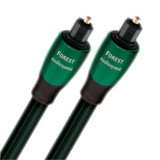
The Cinnamon is the third tier in AudioQuest's digital coaxial cable range, above the Pearl and Forest and below the Carbon, Coffee, and Diamond. The digital coax lineup follows AudioQuest's standard silver-plating hierarchy: Pearl (solid Long-Grain Copper), Forest (0.5% silver-plated LGC), Cinnamon (1.25% silver-plated LGC), Carbon (5% silver), Coffee, and Diamond (100% solid Perfect-Surface Silver). This is a 75-ohm single RCA-to-RCA S/PDIF cable designed to carry digital audio between a CD player, transport, streamer, or other digital source and an external DAC. The Cinnamon upgrades two elements over the Forest: its silver-plating thickness increases from 0.5% to 1.25%, and its braid shield moves from tinned copper to silver-plated copper — a meaningful improvement in both the signal conductor and the return path that the signal depends on.
1.25% Silver: Beyond the Forest's Entry Point
The Forest's 0.5% silver plating established the principle — placing silver on the conductor surface where digital signals travel — and the Cinnamon extends it with a substantially thicker layer. At 1.25%, the silver plating occupies a larger proportion of the conductor's cross-section, pushing the silver layer further beyond the skin depth at S/PDIF frequencies. Digital audio over coaxial cable operates in the megahertz range, where virtually all current density is concentrated at the conductor's outer surface. A thicker silver layer ensures that the signal encounters silver for a greater proportion of its conduction path, reducing the point at which skin-depth penetration reaches through to the copper beneath. The practical result is performance that moves further toward that of a solid silver conductor while remaining at a fraction of the cost — AudioQuest describes this as an incredibly cost-effective approach to manufacturing very high-quality digital coax cables.
The conductor remains solid rather than stranded. In a digital cable, strand-interaction distortion manifests as jitter — timing errors in the data stream that compromise the receiving DAC's ability to accurately reconstruct the analogue waveform. Solid conductors eliminate this interaction entirely, ensuring that the superior surface properties of the silver plating are fully expressed rather than masked by a more fundamental source of signal degradation.
Silver-Plated Braid Shield
One of the Cinnamon's less obvious but technically significant upgrades over the Forest is the quality of its braid shield. The Forest uses foil plus tinned braid for its 100% shield coverage; the Cinnamon upgrades to foil plus silver-plated braid. In any coaxial digital cable, the shield is not merely a barrier against external interference — it functions as the signal return path, the conductor through which the return current flows to complete the circuit. This dual role means that the shield's metal quality directly affects signal integrity in a way that goes beyond noise rejection. A higher-conductivity shield material provides a lower-impedance return path, reducing the resistive losses and high-frequency degradation that accumulate along the shield's length. Silver-plating the braid applies the same skin-effect logic to the return path as the conductor plating applies to the signal path — at megahertz frequencies, the current travels on the braid's surface, where the silver resides.
AudioQuest emphasises that they pay special attention to the shield's metal quality and fabrication techniques on their coaxial cables precisely because the shield participates directly in the audio circuit. In an analogue interconnect, a poor shield adds noise but does not carry the signal itself. In a coaxial digital cable, a poor shield degrades the signal from both directions — it lets interference in and it compromises the return path that the signal depends on.
Hard-Cell Foam Insulation
The Cinnamon shares the Hard-Cell Foam insulation used across AudioQuest's digital coaxial range. Nitrogen-injected to create air pockets (air absorbs virtually no energy, minimising the dielectric absorption that causes timing distortion), the foam's deliberate stiffness locks the conductor into a consistent geometric relationship with the surrounding shield along the cable's full length. This is critical for maintaining the 75-ohm characteristic impedance that the S/PDIF standard requires. Any variation in the spacing between the central conductor and the shield creates a localised impedance mismatch, causing signal reflections that degrade data integrity and introduce jitter. Hard-Cell Foam prevents conductor movement within the cable, keeping the impedance character stable from plug to plug regardless of how the cable is routed.
Noise-Dissipation and Termination
The Metal-Layer Noise-Dissipation System (NDS) addresses the ground-plane contamination that occurs when a conventional shield captures radio-frequency interference and drains it to the equipment's ground. Because the shield is also the signal return path, any RF energy dumped onto the ground plane modulates the reference voltage against which the signal is measured — an effect that is particularly damaging in a digital cable where timing precision is paramount. The NDS intercepts and absorbs most captured RFI before it reaches the ground-connected layer. All internal conductors are direction-controlled, with arrows on the plugs indicating the correct signal flow from source to DAC.
The RCA terminations are cold-welded and gold-plated, with stamped ground shells. Cold welding bonds the conductor to the plug under several tonnes of pressure without introducing solder — a dissimilar, lower-conductivity metal — at the junction, and avoids the heat damage to the conductor's crystal structure that soldering causes. The stamped ground shells are made from a metal chosen for its low-distortion characteristics rather than its machinability.
Cinnamon vs Forest vs Carbon: Choosing Your Level
The digital coaxial range offers a clear upgrade path where each step increases the silver plating thickness. The Forest's 0.5% silver provides the entry point to silver-conductor digital performance; the Cinnamon's 1.25% extends the silver layer to more comprehensively cover the skin depth at S/PDIF frequencies and adds a silver-plated braid for a superior return path. The Carbon, at 5% silver, takes a further fourfold step in plating thickness. For systems built around a dedicated CD transport or high-quality streamer feeding an external DAC, the digital coaxial cable is the sole path between the source's digital output and the DAC's conversion stage — every aspect of the signal's integrity depends on this single cable. The Cinnamon occupies the point in the range where both the signal conductor and the return-path shield have moved to silver-surfaced construction, addressing both halves of the circuit with the same material upgrade.
The jacket is a red-on-black braided sleeve — stiffer than a typical analogue cable jacket, which contributes to the geometric stability that maintains consistent impedance. Available lengths: 0.75m, 1.5m, and 3m.
| Type |
Digital Coaxial Audio Cable (S/PDIF), Single RCA to Single RCA |
| Impedance |
75 Ohm |
| Conductor |
Solid 1.25% Silver-Plated Long-Grain Copper (LGC) |
| Insulation |
Hard-Cell Foam (Nitrogen-Injected) |
| Shielding |
Foil + Silver-Plated Braid, 100% Coverage |
| Noise-Dissipation |
Metal-Layer Noise-Dissipation System (NDS) |
| Direction Control |
Yes (All Internal Conductors) |
| Terminations |
Cold-Welded, Gold-Plated RCA |
| Jacket |
Red on Black Braid |
| Available Lengths |
0.75m, 1.5m, 3m |