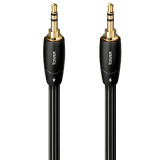
The Tower is the entry point to AudioQuest's Bridges & Falls analogue interconnect series — the most affordable cable in a range that extends upward through the Evergreen, Golden Gate, and Big Sur. Despite sitting at the bottom of the hierarchy by price, the Tower shares a remarkable amount of its internal engineering with the models above it: solid Long-Grain Copper conductors, Asymmetrical Double-Balanced geometry, foamed-polyethylene insulation, Metal-Layer Noise-Dissipation, and cold-welded gold-plated terminations are all present and identical to the Evergreen. What separates the two is not what is inside the cable but what is around it — and that distinction is actually one of the Tower's key advantages.
Tower vs Evergreen: The Jacket Difference
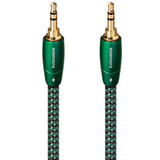
The Evergreen uses a green-on-black nylon braid jacket — attractive and tactile, but not rated for permanent in-wall installation. The Tower uses a CL3/FT4-rated PVC jacket in black with white stripes. CL3 (Class 3) and FT4 are fire-safety ratings required by building codes for cables that will be permanently routed inside walls, ceilings, or conduit. The PVC formulation meets the flame-spread and smoke-generation requirements of these standards, meaning the Tower can legally and safely be installed as part of a structured wiring system in any room of the house.
This makes the Tower the natural choice for any installation where the cable will be hidden — behind a wall plate, through conduit from one room to another, or run through a ceiling void to reach a zone amplifier or pair of powered speakers. The Evergreen, by contrast, is designed for visible, accessible connections: between components on a rack, from a desktop DAC to powered monitors, or from a portable player to a headphone amplifier. Both cables carry the same signal with the same internal construction; the choice between them is determined by where the cable will live, not by any difference in audio performance.
Solid Long-Grain Copper Conductors
Every conductor in the Tower is a single solid piece of Long-Grain Copper — the same LGC used throughout AudioQuest's entry-level and mid-range analogue interconnects, digital coaxial cables, and Ethernet cables. Solid conductors eliminate strand interaction entirely. In a stranded cable, the individual thin wires that make up each conductor are in constant electrical and magnetic contact with one another, creating a form of distortion that is difficult to filter out because it is embedded in the signal itself. A solid conductor removes the problem at source: there are no strands to interact.
Long-Grain Copper is AudioQuest's specification for copper with a controlled grain structure — fewer grain boundaries per unit length than standard OFC (Oxygen-Free Copper), and fewer impurities (particularly oxides) at those boundaries. Each grain boundary acts as a micro-discontinuity in the conductor, a point where the crystal structure of the metal changes direction and where oxides can accumulate. Fewer boundaries mean fewer discontinuities and a smoother, more linear path for the signal. Moving up the Bridges & Falls range, the Golden Gate steps up to Perfect-Surface Copper (PSC) and the Big Sur to Perfect-Surface Copper+ (PSC+) — progressively smoother and purer copper formulations — but the solid LGC used in the Tower already represents a substantial improvement over the stranded OFC found in generic 3.5mm cables.
Foamed-Polyethylene Insulation
Any solid material adjacent to a conductor becomes part of the circuit. Insulation materials absorb energy from the signal passing through the conductor, store it briefly, and then release it back — slightly delayed and slightly distorted. This is dielectric absorption, and it manifests as a subtle smearing of the signal's timing and dynamics. AudioQuest addresses this across the Bridges & Falls range with foamed polyethylene insulation: polyethylene is inherently low-loss (it absorbs and releases less energy than PVC, rubber, or most other common insulation materials), and the foaming process injects nitrogen gas to create air pockets within the dielectric. Air absorbs virtually no energy at all, so the higher the air content, the less the insulation interferes with the signal. The result is tighter timing, better-preserved dynamic contrasts, and a cleaner overall presentation than cables using solid PVC or rubber insulation.
Asymmetrical Double-Balanced Geometry and Metal-Layer NDS
The Tower uses AudioQuest's Asymmetrical Double-Balanced geometry — a conductor arrangement purpose-designed for single-ended (unbalanced) connections like the 3.5mm stereo mini plug. In many single-ended cables, the ground conductor and the shield are the same wire, which means any noise captured by the shield is dumped directly into the signal's ground reference. Double-Balanced geometry separates the ground and shield into independent paths, so the shield can do its job of intercepting interference without contaminating the ground plane that the signal depends on for its reference voltage. The result is a lower noise floor and a richer, more dynamic sound.
On top of this, the Tower incorporates Metal-Layer Noise-Dissipation — AudioQuest's approach to preventing captured RF interference from modulating the equipment's ground reference. Conventional shields absorb RF energy and drain it to the component's ground, which sounds helpful but actually introduces a new form of distortion by modulating the ground plane. The Metal-Layer NDS adds a barrier that absorbs and reflects the majority of RF energy before it reaches the ground-connected shield layer. This is the same NDS implementation used in the Evergreen, Golden Gate, and Big Sur — it does not change as you move up the first four tiers of the range.
Cold-Welded, Gold-Plated Terminations
The Tower's 3.5mm stereo mini plugs are gold-plated and cold-welded — attached to the conductors using high pressure and a silver-impregnated contact paste rather than solder. Solder is a relatively poor conductor compared to copper or silver, and the heat required to apply it alters the crystal structure of the copper at the termination point. Cold-welding avoids both problems: no solder in the signal path, no heat damage to the conductor. Gold plating on the plug body and tip prevents oxidation at the contact surface — particularly important on 3.5mm plugs, which tend to be inserted and removed far more frequently than RCA connections and are therefore more exposed to wear and contamination.
The 3.5mm Mini-to-Mini Connection
The 3.5mm stereo mini jack is now the most universal analogue audio connector in consumer electronics. It appears on laptops, tablets, smartphones (where still fitted), portable DACs like the AudioQuest DragonFly range, headphone amplifiers, powered desktop speakers, zone amplifiers, car audio systems, and mixing desks. The Tower 3.5mm Mini-to-Mini connects any two devices with 3.5mm sockets — source to amplifier, DAC to headphone amp, or laptop to powered speakers — and its CL3/FT4-rated jacket means it can be permanently installed through walls for whole-house audio distribution where a 3.5mm connection is the most practical option.
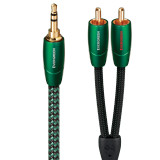
The Tower is also available as: RCA-to-RCA, 3.5mm Mini-to-RCA, and 3.5mm Mini Male-to-Female (headphone extension).
Specifications
| Type |
3.5mm Stereo Mini to 3.5mm Stereo Mini Analogue Interconnect |
| Series |
Bridges & Falls |
| Conductors |
Solid Long-Grain Copper (LGC) |
| Geometry |
Asymmetrical Double-Balanced |
| Insulation |
Foamed Polyethylene (Nitrogen-Injected) |
| Noise-Dissipation |
Metal-Layer Noise-Dissipation |
| Direction Control |
Yes (All Conductors) |
| Connectors |
Cold-Welded, Gold-Plated 3.5mm Stereo Mini Plug (Male) at Each End |
| Jacket |
CL3/FT4-Rated PVC, Black with White Stripes |
| In-Wall Rated |
Yes (CL3/FT4) |
| Available Lengths |
0.6m, 1m, 1.5m, 2m, 3m, 5m, 8m, 12m, 16m, 20m |
| Also Available As |
RCA-to-RCA, 3.5mm Mini-to-RCA, 3.5mm Mini Male-to-Female |