

null
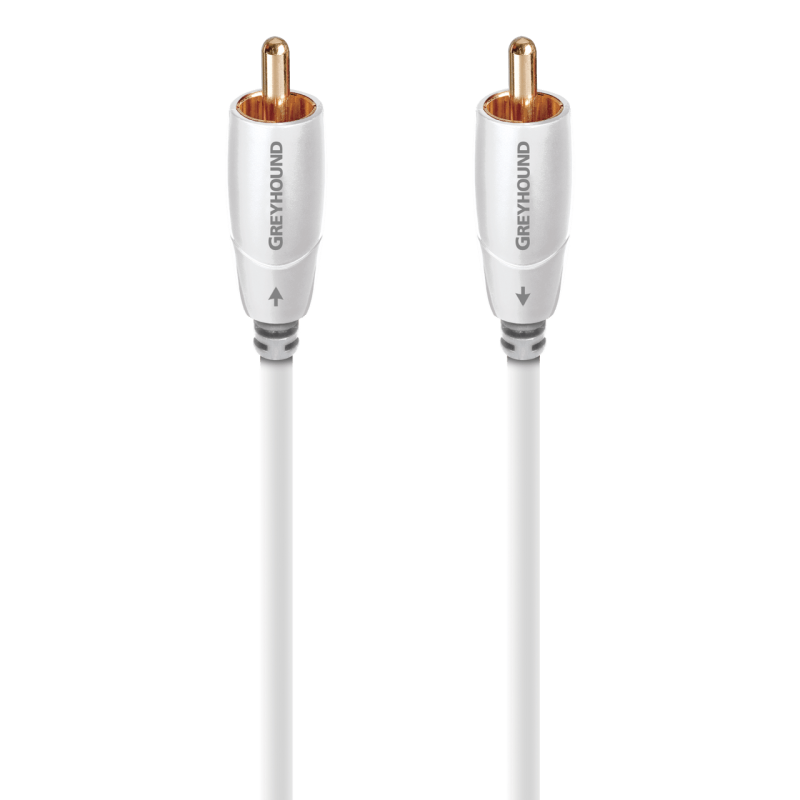
AudioQuest Greyhound Subwoofer RCA Cable (3m Single)

AudioQuest Greyhound Subwoofer RCA Cable (3m Single)

SKU:
AQ-GHOUND-300
SKU:
AQ-GHOUND-300

Guaranteed In Stock -
Stock/Delivery Info

  • Subwoofer audio interconnect
  • Low-frequency optimised design
  • Solid long-grain copper
Was: £79.95
Now: £74.95
Brand:
Audioquest
Availability:Available for next day delivery

AudioQuest Greyhound — RCA Low-Frequency Subwoofer Audio Interconnect

The Greyhound is the second tier in AudioQuest's dog-themed subwoofer cable range, sitting above the entry-level Black Lab and below the Irish Red. The full subwoofer lineup — Black Lab, Greyhound, Irish Red, Boxer, Husky, and Wolf — starts with solid Long-Grain Copper and progressively increases silver content and construction sophistication through to solid Perfect-Surface Silver at the top. The Greyhound represents two simultaneous upgrades over the Black Lab: the introduction of 0.5% silver plating on the conductor surface, and a change from Symmetrical Coax to AudioQuest's Hyperlitz Coax geometry. This is a single RCA-to-single-RCA cable designed to connect the subwoofer/LFE pre-out of an amplifier, AV receiver, or soundbar to the RCA input of a powered subwoofer.

Why a Dedicated Subwoofer Cable

A subwoofer cable carries a low-frequency signal — either the dedicated LFE (Low Frequency Effects) channel in a home cinema system, or a bass-managed output from a stereo amplifier. Although the audio content is predominantly low-frequency, the cable itself must handle more than just bass. The signal passing through the cable includes harmonic content well above the subwoofer's operating range, and this harmonic information is what gives bass its character, texture, and integration with the main speakers. A subwoofer cable that degrades harmonic content above the fundamental frequencies will produce bass that sounds disconnected from the rest of the system — present in weight but lacking in definition and musicality. AudioQuest designs its subwoofer cables with the same conductor, insulation, and noise-dissipation technologies found in its analogue interconnects precisely because the signal demands the same treatment.

Hyperlitz Coax Geometry

The Greyhound's defining structural feature is its Hyperlitz Coax geometry, which differs from the Symmetrical Coax used in the Black Lab. In Symmetrical Coax, the positive and negative conductors are identical — the same gauge and the same material — which prevents the shield from being pressed into service as an inferior audio conductor. In Hyperlitz Coax, the geometry is more elaborate: a perfect circle of eight negative conductors spirals around a single, larger positive conductor at the centre. This arrangement creates a cable with a significantly larger total cross-sectional area than a simple coaxial design of comparable outer diameter, which achieves two things. First, it reduces overall resistance — particularly important for subwoofer cables, which tend to be longer than typical analogue interconnects because subwoofers are often positioned at a distance from the source equipment. Second, the multi-conductor spiral arrangement distributes current across multiple paths, minimising the effects of skin effect (where higher-frequency signal components concentrate on the conductor surface rather than travelling through the full cross-section). The Hyperlitz geometry is unique to the Greyhound within the subwoofer range.

Silver Plating and Conductor Quality

The Greyhound is the entry point for silver content in AudioQuest's subwoofer cable range — the Black Lab below it uses unplated Long-Grain Copper. A 0.5% silver plating is applied to the solid LGC conductor, placing a higher-conductivity, higher-purity metal on the conductor surface where the highest-frequency signal components travel. While a subwoofer cable carries predominantly low-frequency audio content, the harmonic overtones that define bass texture and articulation extend well into the midrange and above. Silver plating on the conductor surface ensures these harmonics are transmitted with the same efficiency as the fundamental bass frequencies, contributing to bass that integrates naturally with the main speakers rather than sounding like a separate, detached layer.

As with all AudioQuest cables, the conductor is solid rather than stranded. In stranded cables, the individual strands make intermittent contact with each other along the cable's length, creating micro-interactions between strands that generate distortion. Because these interactions are dynamic — they change with the signal passing through the cable — the resulting distortion is signal-dependent and particularly audible as a harshness or graininess overlaid on the original signal. Solid conductors eliminate strand interaction entirely.

Insulation, Noise-Dissipation, and Build

The Greyhound uses the same foamed-polyethylene insulation and Metal-Layer Noise-Dissipation System (NDS) found across the subwoofer range. Foamed PE is nitrogen-injected to create air pockets — since air absorbs virtually no energy from the signal, it minimises the dielectric absorption effect where insulation materials store and release energy as timing distortion. The NDS intercepts captured radio-frequency interference before it reaches the equipment's ground plane, preventing the ground-reference modulation that conventional shields cause when they drain captured RFI directly to ground. All internal conductors are direction-controlled for optimal RF noise dissipation, with directional arrows on the cable indicating the correct orientation.

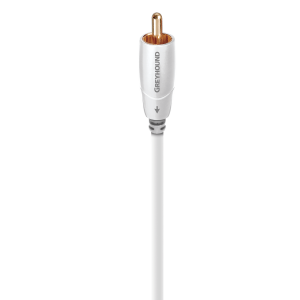
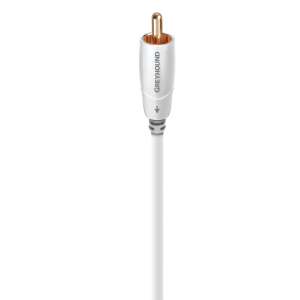
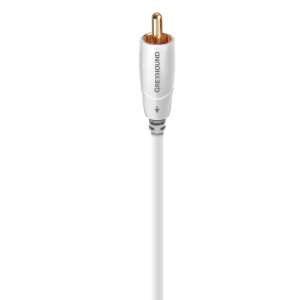
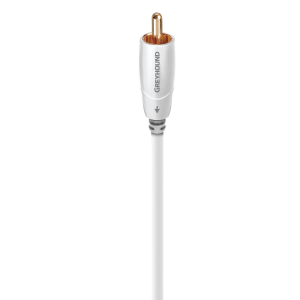
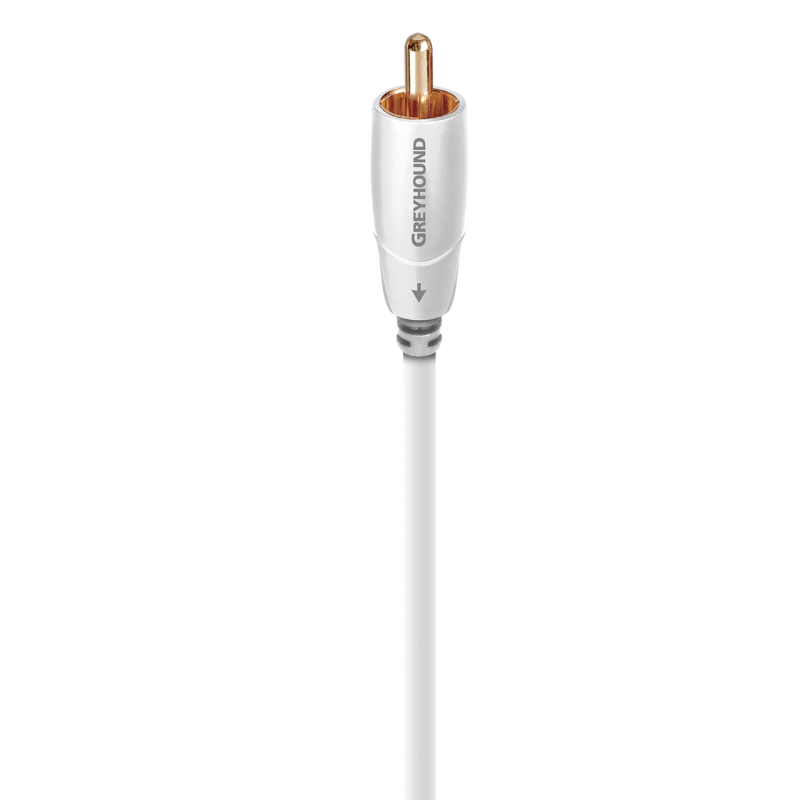
The cable is terminated with cold-welded, gold-plated RCA plugs — the same solder-free termination used throughout the range. The jacket is a white CL3/FT4-rated PVC with light grey striping, making it suitable for in-wall installation where building codes require fire-rated cable. This in-wall rating is shared with the Black Lab (black with white stripes) and is a practical advantage for custom installations where the subwoofer cable needs to run through walls or ceilings to reach a subwoofer positioned at a distance from the electronics.

Subwoofer Placement and Cable Length

Subwoofer cables are typically among the longest signal cables in an audio system because optimal subwoofer placement is determined by room acoustics rather than proximity to the source equipment. A subwoofer positioned for the smoothest bass response in a given room may be several metres from the amplifier or AV receiver. The Greyhound is available in lengths from 2m to 20m to accommodate this reality. The Hyperlitz geometry's low-resistance design is particularly relevant at longer lengths, where cumulative resistance in a thinner cable would begin to attenuate the signal. For systems where audible hum occurs after connecting the subwoofer, AudioQuest provides ground leads that can be attached to the source equipment's chassis or ground terminal to break the ground loop.

Type Low-Frequency Subwoofer Audio Interconnect, Single RCA to Single RCA
Series AudioQuest Subwoofer (Dog Series)
Conductor Solid 0.5% Silver-Plated Long-Grain Copper (LGC)
Geometry Hyperlitz Coax (8 Negative Conductors Spiralling Around 1 Larger Positive)
Insulation Foamed Polyethylene (Nitrogen-Injected)
Noise-Dissipation Metal-Layer Noise-Dissipation System (NDS)
Direction Control Yes (All Internal Conductors)
Terminations Cold-Welded, Gold-Plated RCA
Jacket Light Grey-Striped White CL3/FT4-Rated PVC
In-Wall Rated Yes (CL3/FT4)
Available Lengths 2m, 3m, 5m, 8m, 12m, 16m, 20m