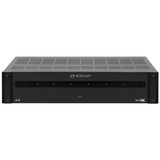
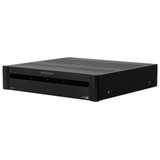
The Emotiva BasX A7+ is a seven-channel Class A/B power amplifier from Emotiva’s BasX range, designed to serve as a dedicated amplification stage for home cinema systems. The BasX series sits at the accessible end of Emotiva’s amplifier portfolio, offering substantial build quality and honest power delivery at a competitive price point. The A7+ is the multi-channel companion to the BasX A2+ stereo power amplifier, sharing the same “Plus” upgrade that introduces balanced XLR inputs alongside the standard unbalanced RCA connections on every channel. With seven channels driven simultaneously, it is suited to driving full 7.1 or 7.2 home cinema speaker systems from a single chassis, freeing an AV receiver’s internal amplifier stages from power-hungry work and allowing it to focus on decoding and processing duties.
Class A/B Topology and Power Supply
Each of the seven channels is built around a Class A/B output stage, a topology that balances efficiency with audio quality by operating in Class A at low signal levels before transitioning to Class B. The amplifier is fed by a heavy-duty linear power supply built around an oversized toroidal transformer. Toroidal designs are preferred in audio applications for their low radiated magnetic field, compact footprint, and minimal mechanical hum relative to conventional EI-core transformers. The combination of a generous transformer with a properly rated reservoir capacitor bank ensures the supply can meet instantaneous current demands across all seven channels without voltage sag.
Balanced and Unbalanced Inputs
The key distinction of the A7+ over the standard BasX A7 is the addition of balanced XLR inputs on every channel, complementing the existing unbalanced RCA inputs. Each of the seven channels therefore accepts either connection type, giving flexibility when integrating with AV processors, pre-pro units, or AV receivers that carry balanced pre-out stages. Balanced connections carry audio on two conductors with opposite polarity; any noise picked up equally by both conductors is cancelled at the differential input stage, making them particularly valuable over longer cable runs in equipment racks where interference can be a concern. Input impedance is 27kΩ and input sensitivity is 1.2V for rated power into an 8Ω load, with a gain of 29dB.
Output Stages and Speaker Connectivity
Each channel’s output is terminated via audiophile-grade five-way binding posts, accepting banana plugs, spade connectors, or bare wire. The amplifier is rated to drive 4Ω or 8Ω nominal loads. A damping factor of greater than 500 at 8Ω indicates a very low output impedance relative to the load, which helps the amplifier maintain tight control over bass driver movement and contributes to accurate low-frequency reproduction.
Performance Measurements
With all seven channels driven simultaneously, the A7+ delivers 90 watts RMS per channel into 8Ω from 20Hz to 20kHz at less than 0.1% THD, and 125 watts RMS per channel into 4Ω at 1kHz at less than 1% THD. Under a reduced two-channel driven condition the per-channel power rises to 120 watts into 8Ω and 175 watts into 4Ω, illustrating the headroom available in the power supply when fewer output stages are drawing from it simultaneously. Total harmonic distortion plus noise (THD+N) at rated power is below 0.02% (A-weighted), and the signal-to-noise ratio exceeds 112dB (A-weighted, ref rated power), ensuring that the amplifier’s own noise floor is well below programme material. Frequency response extends from 10Hz to 80kHz (+0/–1.8dB).
Protection and Control
A comprehensive protection circuit monitors for excessive operating temperature, shorted speaker connections, and ground faults, shutting down the output stages before damage can occur. A 12V trigger input (accepting 5–12V AC or DC) allows the A7+ to be switched on automatically by an AV receiver or processor, with a corresponding 12V DC trigger output at 120mA capacity available to chain further equipment. The mains supply is auto-switching between 115V and 230V AC at 50 or 60Hz, making the unit suitable for use in the United Kingdom without modification.
Construction
The chassis is constructed from steel with a brushed aluminium faceplate, providing rigidity and a degree of electromagnetic shielding for the internal circuitry. The unit occupies a standard 2U rack footprint at 43cm wide, 10cm high, and 39cm deep (17” × 4” × 15.5”, not including rear connectors), and weighs 13.6kg (30 lbs).
| Channels | 7 |
| Amplifier Class | Class A/B |
| Power Output (8Ω, all channels driven) | 90W RMS per channel; 20Hz–20kHz; THD <0.1% |
| Power Output (4Ω, all channels driven) | 125W RMS per channel; 1kHz; THD <1% |
| Power Output (8Ω, 2 channels driven) | 120W RMS per channel |
| Power Output (4Ω, 2 channels driven) | 175W RMS per channel |
| THD+N | <0.02% (A-weighted, ref rated power) |
| Signal-to-Noise Ratio | >112dB (A-weighted, ref rated power) |
| Frequency Response | 10Hz–80kHz (+0/–1.8dB) |
| Damping Factor | >500 at 8Ω |
| Gain | 29dB |
| Input Sensitivity | 1.2V (rated power, 8Ω) |
| Input Impedance | 27kΩ |
| Inputs | 7× balanced XLR, 7× unbalanced RCA (one pair per channel) |
| Outputs | 7× 5-way binding posts (banana, spade, or bare wire) |
| Speaker Impedance | 4Ω–8Ω |
| Trigger Input | 5–12V AC/DC |
| Trigger Output | 12VDC, 120mA |
| Power Supply | Linear with oversized toroidal transformer |
| Mains Voltage | 115/230V AC, 50/60Hz (auto-switching) |
| Dimensions (W × H × D) | 43cm × 10cm × 39cm (17” × 4” × 15.5”, excl. connectors) |
| Weight | 13.6kg (30 lbs) |
| Warranty | 3 years |